Pages

Showing posts with label diversity. Show all posts

25 Oct 2013

Diversity & Oppression in Grassroots Organising (Buckinghamshire & Leeds)

Weekend workshops from Seeds for Change 
15th - 17th November (Buckinghamshire, 25mins from London)
28th Feb - 2nd March (Leeds)

"If you have come to help me, you are wasting your time; but if you are here because your liberation is bound up with mine, then let us work together." Lila Watson

Social movements in Britain have long talked about being inclusive, anti-oppressive, diverse and non-hierarchical. However, many people who would be part of a strong and diverse movement are currently marginalised, while others aren't yet aware of how their behaviour can exclude others.

Seeds for Change is running two residential, weekend workshops in beautiful locations to explore power with grassroots organisers in the UK. Throughout the weekend, participants will explore questions regarding their own use of power: How we might exclude others or be excluded, and how we can use our power to strengthen the social movements we are part of. It is for people involved in groups working for social change: it is both for those who don't feel totally welcome in the groups they are part of, as well as those who do.

There are limited spaces on the workshop, and we expect it to fill up fast, so please email us oxford [AT] seedsforchange.org.uk (replace [AT] with @ ) asking for an application form asap. The weekend costs £50, which covers food and accommodation. We have some full bursaries and some part bursaries, so please don't let cost put you off – email us and we'll do what we can to make it possible for you to come.

There are two workshop dates, one in the North, one in the South.

In the South...
6pm Friday 15th – 3pm Sunday 17th November 2013, Buckinghamshire. 25 minutes on the train from London

In the North...
6pm Friday 28th February – 4pm Sunday 2nd March 2014, Leeds


We look forward to hearing from you,

Hannah, Kathryn and Richard

-- 
01865 403134
www.seedsforchange.org.uk 

28 Apr 2013

Peace News Summer Camp 2013: Taking a Lead from the Global South, 25-29July, Norfolk

 Here's info about a progressive annual camp organised by our friends at Peace News (Note: It is during Ramadan)....
 ----------

PEACE NEWS SUMMER CAMP 2013: TAKING A LEAD FROM THE GLOBAL SOUTH
Thurs 25 July - Mon 29 July 2013, near Diss, Norfolk

Book your tickets online here: http://tinyurl.com/pnsummercamp2013tickets

This year’s camp is organised by activists of colour/people with a global majority heritage. We invite you to join us and others from across the broad spectrum of the peace movement and radical activism for five days of workshops, entertainment and network building!

Taking a Lead From the Global South will be a core strand of the workshop programme, which will include:

- Standing our ground: Peace Communities nonviolently taking back their land in Colombia
- Between NATO, the warlords and the Taliban: Peace activism in Afghanistan
- Finger on the trigger: Western nuclear terrorism since 1945
- Demonising Muslims: Why Islamophobia is more popular than ever
- After Chavez: Social movements in Venezuela
- Turning the world upside down: Global feminisms
- Deschooling society: A Black perspective
- A culture of resistance: The story of Pan-Africanism

ABOUT THE CAMP
When: 25 – 29 July 2013
Where: Near Diss, Norfolk

Peace News Summer Camp is an annual five-day, family-friendly event that attempts to embody many of the characteristics of the future society towards which we’re working – inclusive, democratic, participatory, renewably-powered and environmentally sustainable. It’s an opportunity for a broad spectrum of activists working for radical social change to come together and develop our goals, priorities, knowledge, strategy, skills and networks in support of our different movements, be they anti-capitalist, anti-cuts, anti-racist, anti-war, counter-militarist, disability, environmental, feminist, LGBTQ, or other movements for liberation.

There will be workshops and discussions, practical skills sessions, delicious vegan food, music, film, and participatory entertainment, a bar, a campfire, and activities and facilities for kids and families.

The theme for this year’s camp is TAKING A LEAD FROM THE GLOBAL SOUTH. We’ll be creating opportunities to:

- celebrate what movements in the Global South have contributed to movements in the UK
- discover what movements in the North can learn from those in the Global South
- make global connections between local struggles
- think about what it means to build real solidarity with activists in the Global South

BLACK LEADERSHIP

For this fifth Peace News Summer Camp, for the first time the organising committee are all of global majority heritage. This is an expression of the commitment of Peace News, and of the Summer Camp, to work against racism, and to give an opportunity for new ideas and voices to enter. The new organising collective has added these dimensions to the agenda of the camp:

- celebrating what global majority activists have accomplished in struggles for social change around the world
- helping us better understand and overcome the racism of the societies in which we live
- helping us to understand the connections between racism and other forms of oppression, including those based on disability, class, gender, sexuality and age
- giving us an opportunity to learn more about how racism is affecting our struggles and ourselves and to think about how we can move forward in rooting it out

Peace News Summer Camp is an inclusive event, open to everyone who’s been before, and to everyone else – from all racial and cultural backgrounds – who would like to explore radical ideas and share social change skills.

TICKETS & FOOD

The camp costs £20-£70 depending upon income (for those over 14). Payment can be made by cheque, online or by phone:
- online purchases here [http://peacenews.info/civicrm/event/register?reset=1&id=6]
- 0207 278 3344 for purchases by phone
- Send cheques (payable to “Peace News” to Peace News, 5 Caledonian Rd, London N1 9DY), explaining how many tickets you’re purchasing and at which rates

Food (3 meals a day and drinks) will cost £6-£11 a day for over-14s, depending on income, and should be ordered before the camp starts. Individuals meals will be available to buy at the camp. Food tickets will be available from late April. 


22 Apr 2013

Deepening Facilitation: Report Back on 'Facilitating Change' Week in Wales


A Photo from a previous visit to a nearby area in Wales
 

We the People, We the material 

It's been about a month since I returned from a challenging, yet exhilarating week in rural Wales. There were about 25 of us - most of us were from the UK, and some from other parts of Europe. When people come together, I am excited about the possibilities that exist, and the extent to which those possibilities are tapped depends, in part, on how the group is facilitated. 

At this gathering, called 'Facilitating Change' we had come to explore deeper, more inclusive ways to facilitate groups. It felt like a landmark event, whose ripples are yet to be widely felt. It was organised by Seeds for Change, Rhizome, and Tripod

Everyone participating had some experience in facilitating groups. Some participants also had experience in training others to facilitate. However, perhaps the most profound difference between this gathering and other facilitation training I have been on, was not the level of experience of participants - even though the level here was high - but that at this gathering we focussed almost entirely on the relationships between our selves: WE were the material! - living together, eating together, facilitating together, reflecting on our and each other's patterns, and participating together - for a whole week.

The Magnifying Glass: Mainstream, Margins, and more..
 
A central focus during this rich time we spent together was reflecting on mainstreams and margins within groups, focussing not on groups out there, but on our group that had gathered for the week. What are the mainstream values, attitudes and behaviours, for example, in our group? And which values, attitudes, and behaviours are being marginalised... perhaps unconsciously? 

Related to this, we explored rank, power and privilege, developing awareness of our own rank in the group, how we used our power, or allowed others to step into theirs. I am speaking here from my own understanding.

There was no set formula, and a range of approaches were used to experientially explore the concepts: from 'Process Work', to 'Forum theatre', to Joanna Macy's 'The Work that Reconnects', to the various methods more commonly used in the tool-kit of grassroot facilitators, whether small group work, paired work or exercises within the larger group. Some sessions hit the mark more than others. But each offered much learning. The variety made it both interesting, and for me, very effective.
  

Participants become the facilitators
 
The sessions on the first day-and-a-half were facilitated by the organisers. Thereafter, much of the facilitation was passed to us, the participants, and we would facilitate in pairs. After the previous session had ended, there would be space for some feedback to the pair who had facilitated it. The group as a whole would then consider where we are at now: "What is the diagnosis?", What is emerging right now? And what is being silenced? 

These kinds of questions would help inform us, and in particular the next pair, stimulating us to reflect on what approaches and exercises might further the group now. The next pair were chosen by picking two names from an envelope - this was a time when I think we all felt quite anxious - in particular because the pair would then have just half an hour, or so, to prepare their session!

Diving Deeper into the Process

Whether you were facilitating, or participating, the week was challenging! The process was 'alive' throughout - our attention was frequently directed towards considering where the group was at in any given time, and what was needed to take the group (i.e us!) further. 

Conflict was drawn out. Not all significant conflict. Differences were acknowledged. Not all significant differences either - we were far from 100% successful  - but the important thing for me was that it became more ok to express within the group things that would usually be more difficult - not that it became easy either! 

One helpful approach used at least a couple of times after something especially difficult had happened, was some kind of re-enactment - a few people playing different roles, helping to bring up different themes or emotions that had been acutely felt, even if not expressed. This often carried with it a quality of humour, which softened the tension, and made communication easier. It was wonderful to witness this, and for me, this helped to bridge differences and draw me closer to other participants. 


The week also created a context that supported greater awareness of my own pain and patterns, helped strip away some of my social mask - and related to that - deepened my relationship with others. Out of this experience, I am more aware how easy it can be for action groups to just travel on the surface, going through the motions. I want to dive deeper. I want to glide underwater, into the unknown, and experience the depths, the richness that is there. And I want to support others to be able to do the same.

While there was plenty of time spent in the company of one another, whether during formal sessions or during the evening, I felt it important to have some time alone. My spiritual practises that I immersed myself into several times a day were really helpful to me, helping to reduce some of the mental noise and process some of the emotions that were arising. 

I also felt that a few more exercises of a meditative or contemplative nature within the formal workshops would have been really helpful. There were certainly strong emotions that arose for many of us, and practises that expanded the 'inner container' that held 'emotional content' would, I think, have really helped our individual and collective processing of that content.


The Question of Resistance

So, was nobody in the group resisting the process? The answer is that there was plenty of resistance. Particularly at the beginning. We were being pushed to go deeper, to be real, to stop being polite that would otherwise hold us back from talking about the difficult stuff. This resistance tried to defend its ground, but eventually - after some pain - things began to open up.   

There were also the later stages of the week. In retrospect, I sense that I became a little complacent during these even though I never stopped journeying. However, I have wondered if I could have voiced a little more that I was feeling within, during the later stages, and which might thus add fuel for more growth. Or maybe I intuitively felt there was enough already being processed: too much fuel can also smother a fire. I'll be reflecting more on this.


Some Personal Insights

Some personal insights that became more real for me during the week were as follows:

-Within a groups, it can be fine to ditch the agenda (or to be prepared to).
-The fastest journey is not necessarily the seemingly shortest route.
-Emotions hold wisdom, and wisdom informs.

-------------


For anyone who is interested, below is some of the pre-gathering reading that went round.... 
 
"We wanted to give you a bit of background, to give you a an idea where this project has come from and to help you get into a state of mind which will help us have a productive week together. Hopefully you'll get a wee bit of time away from your busy lives, while travelling if not before, to reflect on why you were attracted to come to this event, your hopes and expectations…

This was a project that was dreamed up a few years ago that we've been working hard on ever since. It came out of noticing that despite the great increase in the use of facilitation in the grassroots social change and campaigning scenes in the UK, in part through the Training for Action trainings in advance of the Scottish G8 and through the Camp for Climate Action, we still participate in some really bad meetings! So despite this increased capacity, both of facilitators formal and informal, and of general meeting skills, what happened? Why are meetings sometimes drawn out and overly painful? How come facilitators from time to time fail to support fairness and creativity in our processes?

Well, this set us thinking (when we say us, we mean a loose set of experienced activist-facilitators from different places). Was the problem that we'd focussed too much on certain skills without allowing our intuition to develop? Are there secrets out there in different cultures and approaches that we've 'missed? What are the attitudes or understandings that are lacking, or is it something else? What is the place of values in all this? Are there values behind good facilitation? Is good facilitation about helping a group uncover their values and work to them?

We're sure you've got more questions too, and some answers. And it's in this spirit that we're all getting together. It is not just about learning new tools and exercises, though I'm sure we'll all learn some along the way, maybe even develop new ones. Its about working out how we can develop the state of mind and express the values that underpin our practice as intuitive facilitators. It's a chance for all the great people who are taking part to bang our heads together, to think, to dream, to feel, and to see what we come up with and where we get to; and wherever we do get to, it'll be a start. Hopefully together we will advance how grassroots facilitation is practiced, for ourselves, for other facilitators, and for all we work with."

Ameen,

Love, Muzammal
---

WIN's workshops: click here


13 Jan 2013

Seedy Sunday: UK's Biggest Seed Swap!: Sun 3rd Feb 2013, Brighton

Seedy Sunday Brighton, the UK's biggest and longest-running community seed swap event.
Date: Sunday 3rd February, 10am - 4.00pm 
Venue: Brighton Corn Exchange, Church Street, BN1 1UE.
Seedy Sunday is the UK's biggest community seed swap. The event takes place every February in Brighton and Hove, in southern England. Seedy Sunday is also a campaign to protect biodiversity and protest against the increasing control of the seed supply by a handful of large companies.

Entry to Seedy Sunday is just £3, concessions £2, children free. Come and enjoy more than 50 stalls, lots of talks, demonstrations and children's activities as well as the community seed-swap.
Seedy Sunday is supported by The Heritage Seed Library and The Millennium Seed Bank and generously sponsored by Infinity Foods. 
More info: www.seedysunday.org
Location Map: Click here

Seedy Sunday Talks Programme 2013

Every year Seedy Sunday aims to provide a stimulating, challenging and entertaining series of talks during the day and this year we're very excited to have some great speakers joining us to discuss some very important topics. Whether you're interested in politics and campaigning or horticulture and sowing the seeds you've swapped, there are talks on this year's programme for everyone.  Each talk will be followed by an opportunity for questions and discussion. 
(Check the programme on the day for final details)

  • ‘Open Pollinated Seeds, Our Key to Seed Sovereignty’, Peter Brinch, The Open Pollinated Seeds Initiative
  • ‘Not Weeds But Resources’, Roy Vickery, South London Botanical Institute and editor of www.plant-lore.com 
  • ‘Are you a first time seed-sower? An introduction to basic sowing and growing for the absolute beginner, Steve Bustin, local garden writer. 
  • ‘Saving Seeds from Corporate Control’, Patrick Mulvaney, UK Food Group.
  • James Wong, TV Botanist and science presenter and author of new book ‘James Wong’s Homegrown Revolution’.

More info: www.seedysunday.org  
Location Map: Click here

19 Nov 2011

Register: 'Creating The Tent' Gathering (Brighton & Hove)

Register asap for this inclusive event. Some WIN Reps will be participating..---

CREATING THE TENT In celebration of Human Rights Day

An inclusive, spiritual gathering with contributions from
Jewish, Christian, Muslim, Hindu, Buddhist and Quaker perspectives
Saturday, 10th December 2011
At Brighton Friends’ Meeting House

This event is open to all people who welcome the opportunity of listening, sharing, and creating the tent together. The programme will include talks, chants, creative exercises, discussion and silence. You may wish to participate in the afternoon event, or in the evening, or in both.

Please bring a vegetarian dish to share at 6.15pm (optional).

Location: Main Meeting Room, Brighton Friends’ Meeting House, Ship Street, Brighton BN1 1AF. For venue information, see: http://www.brightonquakers.co.uk/

A selection of books and CDs will be available to browse or purchase in Room 4.

Time: Afternoon event – registration from 1.30pm
Start: 2pm-6.15pm
Refreshments: 6.15pm-7.15pm
Evening: Sufi Zikr
Time: 7.30pm-9.00pm

Please register attendance by Monday, 21st November 2011

To register: by phone call and donation
Tel: Brighton & Hove Progressive Synagogue, 01273 737223 (Mon-Fri, 1pm-5pm)
Please make cheque payable to: BHPS
And send to: Brighton & Hove Progressive Synagogue,
6 Lansdowne Road, Hove, East Sussex BN3 1FF
Suggested donation for the afternoon event: £10
An additional donation will be welcome for the evening

Places will be limited so do register early


The Sufi Zikr will be kindly offered by Omar Inayat-Khan – great grandson of
Hazrat Inayat Khan who brought Sufism to the West – with Farida Inayat-Khan

The event is organised by
Rabbi Elizabeth Tikvah Sarah, Brighton & Hove Progressive Synagogue,
And Zohra Evlynn Sharp, Sufi Movement,

In collaboration with the

Brighton Festival of World Sacred Music
and the Quakers in Brighton
Rabbi Elli will be delighted to welcome you to Shabbat Morning Service in Hove.
Please advise when you ring if you wish to attend. Photo ID will be necessary.

7 Nov 2011

WIN's Second Core Strand: 'Deep Democracy'


The Deep Democracy strand comprises an intention to move:
Away from concentration of power amongst the rich and privileged;
towards
more equalisation of power that honours diversity, draws out consensus and empowers all.


Democracy: Beyond the Superficial

Deep democracy aims to draw out the diverse voices and tap into the wisdom each brings. The protests of various social movements around the world are indicative of the failure of  superficial forms of democracy; the phrase “we are the 99 percent” is a voice representing the masses of people whose lives are exploited at the hands of the 1 percent.   

The concentration of power in the hands of a few leads to marginalization of voices that undermines the wholeness of individuals, communities, and ultimately, our world. Greater wisdom emerges when people actively listen to each other.   Putting the time into processes conducive to deeper dialogue often also saves time in the long run that may otherwise have to be spent on resolving conflicts and undoing damage to people and ecosystems.    


Can Process be Sacred?  

The Qur' an states:
"Far better and more lasting is what God will give to those who believe and trust in their Lord; who shun great sins and gross indecencies…..; conduct their affairs by mutual consultation…" (Qur' an: 42:19)

Read full piece>>


Strength in Diversity


At Wisdom In Nature, we have found that it is only when the walls that separate us can be softened, is it possible to begin real dialogue. This process of softening has the potential to be taken even further, reaching a place from where it can become easier to look at the world from another's viewpoint. When this process deepens within our group's meetings, a 'group mind', begins to form. Our personal awareness moves into something much bigger, something more open. The experience is not imaginary, but is palpable. One newcomer attending one of our review meetings described his experience, that the process "seems to have a mind of its own" - elaborating to mean that the answers naturally arrive. 

Contributions emerging from this place bring with them a quality of inclusivity and carry a deeper truth; and through meetings we can feel energised rather than depleted! We begin to value one another as our collective wisdom is enriched by the presence of each person.  Diversity becomes a strength that we naturally welcome.

In terms of specifics, at WIN, we use basic ground rules, or a group agreement, that welcomes deep listening and a diversity of viewpoints as a start. In addition we include a variety of ways to support this further. For example, after we have settled a little, we join together for a couple of minutes silence - as a means of letting go of some of the mental baggage we have each brought in! At key meetings we can also bring in active exercises. These can be as simple as asking a question or two, "What are the qualities that bring us to the group?", or "How do we see the state of the world?”, to give a couple of examples. By opening this up to allow for all ideas including seemingly conflicting ones, and ensuring each is acknowledged and noted e.g. visibly on a flip chart, it makes it easier for each person to step into other shoes. The process of developing a group mind is under way.

Whilst we aim to be conscious of issues around rank, power and privilege, we have found that the cultivation of a group mind brings with it somewhat of a natural antidote to such inequalities. In our experience, it is not uncommon, for example, for an individual with considerable 'religious' knowledge to hold more power in the group. Yet, when a group mind begins to form, trust and humility begin to manifest, allowing power to become more equalised and those that feel marginalised to feel more included.

Nonetheless, we still place value on and consider ways of actively reflecting on the rank and privileges that we hold. For example, we will take turns at facilitating meetings. Also, as part of our 'Islamic Community Food Project' in Tower Hamlets, in which we attempted to integrate social organising with connecting to the land, we used an exercise that involved throwing the following statement to the group: "It is selfish for the middle class to think about the food they eat when millions of people are starving".

Participants were then asked to position themselves in the room according to how much or how little they believed the statement to be true. The different voices were then drawn out and participants were also free to move should their perspective shift. I must confess that although we are keen to draw more people from less privileged background into WIN, we have not had as much success as we would have liked. However, in small ways we experience some fruits of our work in the area of rank and privilege. One example follows from the exercise just described. As one participant wrote on a blog post:

"We had workshops – wonderful, free, organic workshops – in the afternoon which challenged our perceptions and called for us to really look at how responsible we were when it came to food. I realised that my middle classed upbringing and lifestyle gave me the freedom to make choices – to be fair-trade; organic etc. Yet, I still was unable to really take action. Since then I have ventured baby steps into home gardening. My balcony now supports coriander; chives; and basil. I look at them tenderly and consistently, like an overzealous new mother, hoping that they might survive the spring chill and that my sabr (patience) and taqwa (God Consciousness) will generate nourishment: physical and, spiritual."

An edited version of this article appeared in a booklet produced by The Transition Network titled:

9 Oct 2011

'Identities in Transition' Seminar - Leicester

WIN Rep, Shumaisa Khan, is one of the speakers at this event on Friday...

---

'IDENTITIES' IN TRANSITION' SEMINAR

**Registration essential**

Date: Friday 14th October
2011
Time: 9.30 for 10.00am til 5pm
Venue: University of Leicester: Garendon Room on the Fourth floor of the Charles Wilson Building on the main University of Leicester campus. A campus map and travel directions can be found at http://www2.le.ac.uk/maps.

Registration:
The event is free, and lunch is provided: but a place must be reserved in advance. More info including to register:

The seminar, part of the series “Sustainability Transitions: rethinking everyday practices, identities and livelihoods”, starts from the premise that many of the identities that individuals claim for themselves today in the Global North have been shaped by consumption practices fuelled by the high carbon economy. We also know that there are links between poverty, racism and gender inequalities and the people most likely to experience the most detrimental impacts of climate change and resource scarcity. This workshop explores the role of the high carbon economy in shaping these social identities and questions how they might be reconfigured through the process of transition to a sustainable, low carbon future. It focuses on three interlinked themes:
  • How contemporary identities have been shaped by the high carbon economy
  • How those identities might change and be reconfigured through the process of transition to a sustainable, low carbon future
  • What it means to identify with (movements for) sustainability transitions.
Programme
09.30 Registration and coffee
10.00 Identities in Transition: some observations and questions
Speakers: Gavin Brown and Jenny Pickerill
10.15 Introductions and goals What do you want out of today?

10.30 Managing trade-offs in „ecotopia‟: becoming green at the Centre for Alternative Technology.
Speaker: Jon Anderson
Questions
11.30 Panel discussion: Addressing diverse identities in climate change activism and advocacy
Speakers: Michelle Bastian; and Shumaisa Khan (Wisdom In Nature)
Questions and discussion

12.30 Lunch, An opportunity for informal discussion

13.30 Workshop: “Permaculture” and the escape into Whiteness: Sustainable Transition and Racialism
Speaker: Joseph De Lappe
Discussion

14.30 The Footpaths project: facilitating low carbon lifestyles
Speakers: Jill Fisher and Emily Hodgkinson
Questions and discussion

15.30 Coffee

15.45 Transitioning to Lower-carbon Identities: Three Tales from the "Everyday"
Speaker: Robyn Dowling

16.45 Questions

17.00 Closing discussion
Finish

-----

14 Sept 2011

Mobile Phones: Appreciating Another World Out there

With mobile phones being such an integral part of modern culture, it takes a courageous person to raise questions about their use. One such person is my friend Geoff Robinson.

In his late thirties, Geoff's health took a major down-turn near the end of last year, upsetting almost every aspect of his life - and which he was privately told "was probably" triggered by taking a course of a licensed antibiotic, Ciprofloxacin (though possibly exacerbated by also taking two other medicines within a few days of the antibiotic). Although somewhat better, Geoff is still recovering and dedicating a significant amount of time to questioning the safety of certain things we take for granted.

Turning his attention to mobile phones, Geoff recently posted a general information link on social media concerning the potential health risks they posed. Pleased that someone else I knew was highlighting another side to this technology, I began to feel courageous enough to share additional thoughts I had about wider aspects of mobile culture. Using the medium of this blog, this is one place where I will contribute some of my thoughts, with the intention of wrapping this up in a short piece, hopefully sufficient to capture some key points that may or may not resonate.

My three points for this post are as follows:

1) Many of us find it easy to accept that mobile phones can be a social convenience (and convenient for activism too), but it seems hard for many of us to acknowledge that they can also end up being a social nuisance, especially when used without restraint. On the one hand they allow us so much more freedom to roam while also being available, yet, this strength can also become a weakness - making them potential candidates for invading intimate conversations, stripping our relaxation time, and startling us with the latest ring tones.

2) This one is a question: Why do some mobile phone users assume that those, like me, who choose not to use one are hard to contact? In every instance where this belief is held, I've found that the effort to make a call doesn't seem to have been made. Yet, it isn't infrequently that many of us hear the following statements when unable to communicate with a mobile phone contact:

a) "Oh so sorry - I wanted to return your call but my phone got stolen and I lost your number. Can you text it me?"

b) "My battery ran out, I didn't get your message until it was too late".

and of course...

c) "So sorry, man. I ran out of credit, and wasn't able to get my voice mail."

I would go so far as to say that being contactable has less to do with the technology we carry, or not, and more to do with an attitude of mind!

Onto point 3!

3) Sometimes mobile phone non-users are pressured by their mobile phone buddies to get one, or pressure one another to keep their mobile on in all circumstances! Thus, if as a user, you are tempted to pressurise your friend to get a mobile or to always have it on, please do be mindful that in today's world those of us who tend not to use a mobile phone, or only use one wisely are a minority. We've probably been feeling the pressure to get one for a while, if we haven't already done so bearing in mind the glossy, repetitive, corporate advertising flung at us, and have thus probably made our decision with due thought.

Another approach that may be more interesting to consider for each of us would be to ask how it might be possible to accommodate everyone of all beliefs and lifestyles as best possible. To consider this, we may want to switch off our mobile phone for a few minutes, take a deep breath, go within to introduce the question mindfully and then let go. Quite possibly some kind of clarity will eventually come...

One thing I respect from many friends who have a mobile and which helps welcome those, like me who tend not to use one, is when they appreciate the sky high costs of calling their mobile phone from most landlines. Remember, if we don't use a mobile, a landline's what we use! These friends who deserve this given praise will either give me a landline number I can call them on (much more cheaply), or they'll call me back using their free minutes. And if they do I'll do my best to excuse any potential connection issues due to a poor signal!

Thank you for reading. May we honour Unity in multiplicity. May Peace be with you :)

Article text © Muzammal Hussain

19 Sept 2010

Thurs 28th Oct: Faith and the Environment (London)


I find Transition initiatives an exciting community-led idea, and have on occasion witnessed individuals tirelessly working to complete inspiring projects that have rippled to empower the local community. There is much to be said in today's world, about people owning their power by organising together. It takes passion, patience, the ability to work authentically in groups, and with inner work can be used as a vehicle for spiritual growth. 

This public seminar in Kingston, is organised by Kingston interfaith Forum along with the local Transition initiative and Kingston Council. An area that some Transition initiatives are looking more closely at is that of diversity. I'm honoured to have been invited to speak at this collaborative event, and look forward to meeting and engaging with fellow speakers, workshop leaders and participants.

Date:  Thursday 28 October 2010
Time:  6pm-8.30pm 
Venue: Guildhall Council Chamber, Kingston, KT1 1EU; Map & Directions 

A free public seminar organised by Kingston Inter Faith Forum in partnership with Transition Town Kingston and the Royal Borough of Kingston upon Thames

REGISTER YOUR PLACE: This event is open to all who reserve a place with Jean Cousens tel. 020 8547 5023 email: jean.cousens@rbk.kingston.gov.uk by 8th October 2010.
Refreshments provided. 

‘Never doubt that a small group of thoughtful, committed citizens can change the world. Indeed, it is the only thing that ever has.’ (Margaret Meades) 

Speakers: 
Dr Muzammal Hussain, Founder of ‘Wisdom in Nature’, on: Engaged Spirituality and Diversity in an Age of Transition: with an Islamic Perspective.
Dr Laurie Michaelis, Co-ordinator of Living Witness: Quakers for Sustainability.
Chaired by the Leader of the Council, Councillor Derek Osbourn

Click here for more info

26 Aug 2010

Retreat: deeper into life, not further from it

At the beginning of this month I was lucky enough to be a part of a weekend retreat – 24 hours away from the usual bustle and buzz of life in London, in the beautiful setting of the Quadrangle.  LIFE (Local Initiative for Faith and the Environment) is a group, working with women in Lambeth, to bring them together over inter-faith dialogue and the environment.  The Quadrangle is a farmstead in Shoreham, Kent – lovingly restored, and sitting within the peaceful and quietly stunning Darent Valley, it provides a perfect space for community activities.

Rebecca Brewin and Saadat Yusuf of LIFE coordinated this 24 hours ‘LIFE-giving retreat’, taking a group of women from the usual busy-ness of their lives, and bringing them to the beauty and tranquility of the Kentish countryside.   The weekend allowed each of us to experience life in a way we maybe forget too often, with the responsibilities and duties that we often  need to attend to, before being able to attend to ourselves.

We were led in sessions of yoga, introduced to foraging, and walked together, surrounded by beauty and kissed by the sun.  We cooked and ate together, had a sewing circle where we learnt to make something practical and pretty, and even sang together.  And throughout the weekend, the warmth of true, heart-driven sharing permeated all that we did.  In the reflections on Qur’an and eco-poetry session that I held, I was warmed to hear people really speaking honestly and reflectively, and this authenticity and genuine interest was something recurrent throughout our time together.

‘Together’ – I keep using this word to describe our time away, and really for me, it sums up so much the feeling that the weekend left me with – a feeling of having really shared and learnt from these women in a way I could never do alone, or even when surrounded by people, but without that openness and naturalness.  ‘Warm glow’ became my default setting for the time there, and I carried the tranquility and happiness from the weekend forward with me when I returned again to the buzzing of London town.
Here are a few pictures from my time at the Quadrangle with this lovely group of women, and a link to some others.  I look forward to the next time I can experience such a warm meeting of hearts and minds.


27 Jan 2010

Come to the 'Edge': A Muslim, an Ecologist and Permaculture

“Come to the edge, he said.
They said: We are afraid.
Come to the edge, he said. They came.
He pushed them…and they flew.”

Guillaume Appollinaire


The Cultural Commute

Being an ecologist and a Muslim, I often experience what seem to be two distinct worlds. The first is the world of low carbon lifestyles, non-hierarchical decision making, and compost toilets in which you can’t pee, interspersed with questions like “are you sure it’s vegan?” The other is the world of high carbon jumaa’s, and a string of questions such as “where’s the lamb bro?”, and “what do the scholars say about that?”

Enriching though this cultural commute might be, the overhanging cloud that moves with me is that I often do not feel like a true citizen of either world. Rather, I feel like someone who gets a kick out of living in lands in which I understand the language, but am unable to properly speak it – and whilst I admit that I have to an extent generalised in my description of these two worlds, there are nonetheless elements of reality I have experienced that fit the cultural outlines rather well.

It’s not that I don’t strive for a low-carbon life-style, or that I wouldn’t refer to a scholar, or that I don’t see the value of non-hierarchical organising, for example (I do and would on all three accounts!), but more that associated with the cultures in which these behaviours and comments are norms, can be a cargo of assumptions. These assumptions, like any that are deep-rooted enough, can give rise to blind-spots to perspectives which need wider awareness if those perspectives are to be perceived, given breathing space, and dialogued with.


The Meeting of Worlds

My personal journey, is guided I hope by spirituality, by Islam, and the knowledge that Islam is intrinsically ecological, that the world of a ‘Muslim’ is in truth, inseparable from the world of an ‘ecologist’. However, a commute of the kind I described earlier is inevitable for me on at least two accounts - firstly because of a role I have landed in, as an activist, student and mentor in an Islamic environmental network, and secondly because of my belief that the meeting of worlds can be a place of richness and beauty. Thus, I can find myself conversing with a hard-core anarchist, a mosque regular, a rep from an NGO driven by funding targets and a member of the Transition Town Network all within the space of a few days.

A conversation with a member of any one of the above groups might make me feel both inspired and humbled. In some instances, however, I might feel less an equal party to a conversation and more like a recipient of a robotic sermon from an over-zealous citizen of another world. Whilst after the latter experience, my belief that a meeting of worlds is a great thing could benefit from gentle resuscitation, both instances are nonetheless examples of what permaculturists might call ‘the edge’. 


The Scope of the 'Edge': Permaculture & Islam

 
‘The edge’ was explained to me during a two week permaculture and activism course I participated in during the summer of 2009 in Devon. One of the course instructors was a woman called Starhawk. A humble character, she is the author of about a dozen books, and also has a wealth of experience in activism, including on the Middle East, corporate globalisation, environmentalism as well as on economic justice. Her approach is such that she is committed to creating the kind of world she wants to live in, rather than simply campaigning against the one she doesn’t. What particularly impressed me about Starhawk (as though the above wasn’t enough!) was her understanding of diversity issues that I had picked up through some of her writings. She seemed be one of the few ecologists in the North who really knew what it was like to be in a marginalised group, and how to be inclusive to those who were.

The other lead instructor, Andy Goldring, in his deliciously animated and energetic style, explained that in terms of natural systems, ‘the edge’ is an area where two eco-systems come together to form a third. For example, this could be where a forest meets with a meadow, or a lake with woodland, or a pond with grassland. Because they contain species from both eco-systems, edges are areas of dynamism, diversity and creativity. Hence, this is why spiral and curved shapes are common in systems based on permaculture principles. A spiral shaped pond offers several times more edge than a rectangular or round one of equal size. This allows for greater interaction and hence gives more opportunity for biodiversity to develop.

Starhawk then followed by pointing out the cultural ‘edge’. In music for instance, the meeting point, or edge
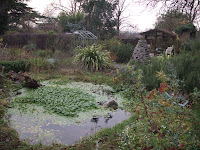
between two musical cultures can give rise to an altogether new musical form. And for me, the presence of two distinct groups, such as certain Muslims and certain ecologists can give its own unique edge experience! Naturally, the meeting point between two systems or social groups is also a vulnerable place where there is potential for tension, though if each system is also given its own space, this provides conditions which can enhance resilience.

A good dose of edge-ness can thus be a blessing, whilst too much, or at least edge without room to breathe, might make us… edgy, I suppose! 

The Qur’ an points to the importance of edge in the context of cultural diversity through the following verse:

O men! Behold, We have created you all out of a male and a female, and have made you into nations and tribes, so that you might come to know one another. (Qur’ an: 49:13)

Islam also values another kind of edge. That is the edge within daily cycles, the junction points between times of the day, such as during sunset and dawn, for example. These points of transition are, for Muslims, a time to
punctuate worldly activity with formal worship through salaat. Performed with presence, it is a step towards the unity behind cultural and natural diversity, the constancy behind change, the unseen behind the seen. A frequent dose of such an experience nurtures an attitude of compassion, something that is essential if the meeting between elements from two worlds is to be a healthy one.

As well as outwardly, there are inner edges. For instance, an over-guarded edge can create in me walls of separation, and herein lies a fragmented consciousness. Yet, if I begin to reflect on how different beliefs I hold exist in the context of each other and deeper levels of my self, then I am opening myself up for new ideas and inspiration. My thinking can become more whole.


What Space to Reflect?

Through the financial and ecological crises, strands connecting different areas of life have become more visible. The financial system is, as our relationship with the earth – it is unsustainable - and indeed our financial system, entrenched in money creation, interest-based lending and growth is a core contributor to resource depletion, pollution, climate catastrophe and violence. Simultaneously, with the increasing rate of change that such an economy brings, our attention is like a feather on a stormy day, blown from place to place with no time to settle. Thus, the essential space needed to reflect on experiences, on what it means to live according to the fitrah, for insights to emerge, and to create a world that is more meaningful is being constrained by the world as it is.


Finding the Doors and Walking through

Yet, opportunities for transformation can form with only slight adjustments to our way of life. These opportunities are contained, for instance, in situations in which wisdom and insights can be shared, when skills or talent that any of us has can find their ways to others. This is the nature of many traditions, and skills-sharing has also become common in Transition initiatives, a movement originating in Kinsale, Ireland, that aims to respond to the twin challenges of peak oil and climate change. Thus, a dinner invitation can be modified into a pot-luck experience coupled with the sharing of skills or a passion. On the same occasion that we savour some culinary delights, a close friend might teach us how to mend clothes, weave a basket out of items we might otherwise throw away, or grow our own mint on the windowsill. Another friend might share some poetry, be inspired to play out a meaningful sketch, or teach calligraphy.

Thus, a simple and common social event, such as having dinner together can through almost no extra effort become even more sociable and fun, whilst helping to create a more wholesome world. This would be analogous to the example described earlier, of one pond having more edge than another of exactly the same size, simply by virtue of being a different shape. There is greater scope for interaction, drawing out diversity, creativity and resilience. In the social context, it can mean in the example given, deeper human relationships, a move from consumerism to sharing, from corporations to community, and the opening of innumerable doors from which further possibilities can emerge.


The Problem is the Solution

With the environmental crises being widely recognised, green has become the colour of the day – and can thus be a safe paint to use, particularly in a society in which we feel we must struggle hard to be accepted. It is my prayer that our becoming green couples itself with the kind of transformations that are needed to be truly green. With simple changes that enrich relationships, as one important dimension, we can begin to move through the challenges of our time. Thus, by increasing the community ‘edge’, we can help turn crises into transformative, soul nurturing opportunities. It is not always new technologies that we will need, and we must be mindful of the attraction of green consumerism. Ultimately more powerful, more available, and yet more easily overlooked is the poorly tapped potential of the human soul and community spirit, through solutions that we can implement without corporate involvement, solutions that help us better see and appreciate what and who has been there all along.

© Muzammal Hussain 

A version of this article was published in the Oct 2009 edition of Emel magazine.

Wisdom In Nature have organised an Islam & Permaculture Introduction day on Sat 27th March 2010 in Tooting, London. To find out more, please click here


16 Dec 2009

My Visit to a LINE Meeting

by Caroline Ugbo

On Sunday 10th August 2009 I went to a meeting of the London Islamic Network for the Environment (LINE) - now named Wisdom In Nature. The founder of the group, a medical doctor, Muzammal Hussain, was giving a talk for group discussion about the Earth Activist Training he had recently been on. He had been under canvas for two weeks in a very wet West Country camp, and that had been an experience in itself, but he persevered because he found the content of the seminars and the mix of people so fascinating.

I had met Muzammal, his wife and several other members of LINE at a weekend at the Franciscan Friary at Hilfield in Dorset, where there is a growing environmental project making use of the land and resources they have to produce organic vegetables and experiment with sustainable projects. They have speakers for weekends to explore environmental and peace initiatives. The weekend we met we discussed Islamic and Christian approaches to the environment and did some practical work together on the site.

It was good to meet them all again and be part of their discussion.

We started the meeting with a welcome and then the first Surah of the Quran was recited in Arabic followed by a short time of silent prayer and reflection. After that Muzammal talked to us about what he had learnt at the camp about permaculture and sustainable communities.

Permaculture was just a word to me, but as Muzammal explained it, it is the organizing of human habitats, mirroring nature where (as in organic gardening or forest gardening) things are grown together and live together in fruitful harmony. The aim is earth care, human care and fair shares, things we would all like to see. What fascinated me was that you start by observing what is already there, and don’t just plunge in with your own ideas to impose on the environment and people. After observing ‘the land’ you make the least change for maximum effect and using biological solutions to problems wherever possible. I can’t see myself at this stage in my life starting even an organic garden, but I can learn from the reasoning behind this to incorporate these principles into my everyday life: to observe first, patiently, and to work with what is there and what is natural to the environment.

He also spoke about sustainable communities and non-hierarchical and consensus organization. We discussed quite extensively the idea that a sustainable community is best with four generations living together. There was some debate about the conservative element in this for good and bad.

There followed plans for activities and meetings to come. Once more the first Surah of the Quran was recited followed by silent prayer. Then we all went out to a café for further sharing of ideas and stories.

If I tell you that people had come from Bath, Dorset, Brighton and Reading for the meeting, and that all but two of us were under forty I hope you will be surprised and impressed. I was. There were at least six nationalities there. It occurred to me afterwards, that many of those who formed the Muslim communities in our cities must have come from rural or semi-rural communities in their own country and had to adapt to city life as well as a new culture. Here are the next generation taking their place in concern for the environment, not now just for their own survival, but for the survival of all people.
--
Workshop: Sat 27th March 2010: Islam & Permaculture Introduction Day