“Come to the edge, he said.
They said: We are afraid.
Come to the edge, he said. They came.
He pushed them…and they flew.”
Guillaume Appollinaire
The Cultural Commute
Being an ecologist and a Muslim, I often experience what seem to be two distinct worlds. The first is the world of low carbon lifestyles, non-hierarchical decision making, and compost toilets in which you can’t pee, interspersed with questions like “are you sure it’s vegan?” The other is the world of high carbon jumaa’s, and a string of questions such as “where’s the lamb bro?”, and “what do the scholars say about that?”
Enriching though this cultural commute might be, the overhanging cloud that moves with me is that I often do not feel like a true citizen of either world. Rather, I feel like someone who gets a kick out of living in lands in which I understand the language, but am unable to properly speak it – and whilst I admit that I have to an extent generalised in my description of these two worlds, there are nonetheless elements of reality I have experienced that fit the cultural outlines rather well.
It’s not that I don’t strive for a low-carbon life-style, or that I wouldn’t refer to a scholar, or that I don’t see the value of non-hierarchical organising, for example (I do and would on all three accounts!), but more that associated with the cultures in which these behaviours and comments are norms, can be a cargo of assumptions. These assumptions, like any that are deep-rooted enough, can give rise to blind-spots to perspectives which need wider awareness if those perspectives are to be perceived, given breathing space, and dialogued with.
The Meeting of Worlds
My personal journey, is guided I hope by spirituality, by Islam, and the knowledge that Islam is intrinsically ecological, that the world of a ‘Muslim’ is in truth, inseparable from the world of an ‘ecologist’. However, a commute of the kind I described earlier is inevitable for me on at least two accounts - firstly because of a role I have landed in, as an activist, student and mentor in an Islamic environmental network, and secondly because of my belief that the meeting of worlds can be a place of richness and beauty. Thus, I can find myself conversing with a hard-core anarchist, a mosque regular, a rep from an NGO driven by funding targets and a member of the Transition Town Network all within the space of a few days.
A conversation with a member of any one of the above groups might make me feel both inspired and humbled. In some instances, however, I might feel less an equal party to a conversation and more like a recipient of a robotic sermon from an over-zealous citizen of another world. Whilst after the latter experience, my belief that a meeting of worlds is a great thing could benefit from gentle resuscitation, both instances are nonetheless examples of what permaculturists might call ‘the edge’.
The Scope of the 'Edge': Permaculture & Islam
‘The edge’ was explained to me during a two week permaculture and activism course I participated in during the summer of 2009 in Devon. One of the course instructors was a woman called Starhawk. A humble character, she is the author of about a dozen books, and also has a wealth of experience in activism, including on the Middle East, corporate globalisation, environmentalism as well as on economic justice. Her approach is such that she is committed to creating the kind of world she wants to live in, rather than simply campaigning against the one she doesn’t. What particularly impressed me about Starhawk (as though the above wasn’t enough!) was her understanding of diversity issues that I had picked up through some of her writings. She seemed be one of the few ecologists in the North who really knew what it was like to be in a marginalised group, and how to be inclusive to those who were.
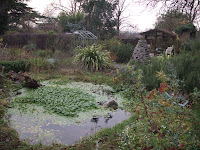
The other lead instructor, Andy Goldring, in his deliciously animated and energetic style, explained that in terms of natural systems, ‘the edge’ is an area where two eco-systems come together to form a third. For example, this could be where a forest meets with a meadow, or a lake with woodland, or a pond with grassland. Because they contain species from both eco-systems, edges are areas of dynamism, diversity and creativity. Hence, this is why spiral and curved shapes are common in systems based on permaculture principles. A spiral shaped pond offers several times more edge than a rectangular or round one of equal size. This allows for greater interaction and hence gives more opportunity for biodiversity to develop.
Starhawk then followed by pointing out the cultural ‘edge’. In music for instance, the meeting point, or edge
between two musical cultures can give rise to an altogether new musical form. And for me, the presence of two distinct groups, such as certain Muslims and certain ecologists can give its own unique edge experience! Naturally, the meeting point between two systems or social groups is also a vulnerable place where there is potential for tension, though if each system is also given its own space, this provides conditions which can enhance resilience.
A good dose of edge-ness can thus be a blessing, whilst too much, or at least edge without room to breathe, might make us… edgy, I suppose!
The Qur’ an points to the importance of edge in the context of cultural diversity through the following verse:
O men! Behold, We have created you all out of a male and a female, and have made you into nations and tribes, so that you might come to know one another. (Qur’ an: 49:13)
Islam also values another kind of edge. That is the edge within daily cycles, the junction points between times of the day, such as during sunset and dawn, for example. These points of transition are, for Muslims, a time to

punctuate worldly activity with formal worship through salaat. Performed with presence, it is a step towards the unity behind cultural and natural diversity, the constancy behind change, the unseen behind the seen. A frequent dose of such an experience nurtures an attitude of compassion, something that is essential if the meeting between elements from two worlds is to be a healthy one.
As well as outwardly, there are inner edges. For instance, an over-guarded edge can create in me walls of separation, and herein lies a fragmented consciousness. Yet, if I begin to reflect on how different beliefs I hold exist in the context of each other and deeper levels of my self, then I am opening myself up for new ideas and inspiration. My thinking can become more whole.
What Space to Reflect?
Through the financial and ecological crises, strands connecting different areas of life have become more visible. The financial system is, as our relationship with the earth – it is unsustainable - and indeed our financial system, entrenched in money creation, interest-based lending and growth is a core contributor to resource depletion, pollution, climate catastrophe and violence. Simultaneously, with the increasing rate of change that such an economy brings, our attention is like a feather on a stormy day, blown from place to place with no time to settle. Thus, the essential space needed to reflect on experiences, on what it means to live according to the fitrah, for insights to emerge, and to create a world that is more meaningful is being constrained by the world as it is.
Finding the Doors and Walking through
Yet, opportunities for transformation can form with only slight adjustments to our way of life. These opportunities are contained, for instance, in situations in which wisdom and insights can be shared, when skills or talent that any of us has can find their ways to others. This is the nature of many traditions, and skills-sharing has also become common in Transition initiatives, a movement originating in Kinsale, Ireland, that aims to respond to the twin challenges of peak oil and climate change. Thus, a dinner invitation can be modified into a pot-luck experience coupled with the sharing of skills or a passion. On the same occasion that we savour some culinary delights, a close friend might teach us how to mend clothes, weave a basket out of items we might otherwise throw away, or grow our own mint on the windowsill. Another friend might share some poetry, be inspired to play out a meaningful sketch, or teach calligraphy.
 Thus, a simple and common social event, such as having dinner together can through almost no extra effort become even more sociable and fun, whilst helping to create a more wholesome world. This would be analogous to the example described earlier, of one pond having more edge than another of exactly the same size, simply by virtue of being a different shape. There is greater scope for interaction, drawing out diversity, creativity and resilience. In the social context, it can mean in the example given, deeper human relationships, a move from consumerism to sharing, from corporations to community, and the opening of innumerable doors from which further possibilities can emerge.
The Problem is the Solution
With the environmental crises being widely recognised, green has become the colour of the day – and can thus be a safe paint to use, particularly in a society in which we feel we must struggle hard to be accepted. It is my prayer that our becoming green couples itself with the kind of transformations that are needed to be truly green. With simple changes that enrich relationships, as one important dimension, we can begin to move through the challenges of our time. Thus, by increasing the community ‘edge’, we can help turn crises into transformative, soul nurturing opportunities. It is not always new technologies that we will need, and we must be mindful of the attraction of green consumerism. Ultimately more powerful, more available, and yet more easily overlooked is the poorly tapped potential of the human soul and community spirit, through solutions that we can implement without corporate involvement, solutions that help us better see and appreciate what and who has been there all along.
© Muzammal Hussain
A version of this article was published in the Oct 2009 edition of Emel magazine.
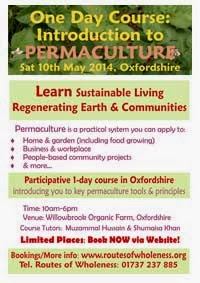
Wisdom In Nature have organised an Islam & Permaculture Introduction day on Sat 27th March 2010 in Tooting, London. To find out more, please click here
 This
is an introductory day that promises to be fun, educational and transformative!
There will be opportunities for networking with other course
participants.
This
is an introductory day that promises to be fun, educational and transformative!
There will be opportunities for networking with other course
participants.


