Pages

6 Apr 2011

An Islamic Ecological Activism: Uniting the Strands

Inter-connectedness

A core quality of an authentic spiritual tradition is that it offers practices and guidance for its followers that can reveal holistic solutions to the challenges of the time. I believe that this is true of Islam, yet I also believe that there is much work to be done to uncover the essence of the tradition, such that will allow its beauty and relevance to be known in the challenging times we find ourselves in.

In my own life, I find myself in a process of re-evaluating and gathering the different strands that represent my own core values and the different facets of my existence. Whilst one of these strands is the spiritual, however hard I look I can find no separation between this and other strands that represent me - my relationships with others, my means of gaining income, the passions to which I give my time, and so on. Neither can I separate these aspects of me from the wider community and political landscape. Life is just too interconnected.

This process of gathering is also reflected in my journey of initiating and co-participating within the UK’s first local Islamic ecological activist group.

Whilst my journey into initiating Wisdom In Nature arose in part out of my noticing the need for more ‘environmental’ awareness, more fundamentally it emerged out of sensing more intimately that we live in an inter-connected world - that humanity is not separate from nature, but is a part of it. My increasing appreciation of the latter has strong resonance with my deepening appreciation of the Islamic concept of tawhid, of Oneness or Unity. Ultimately everything arises from a single source, and to attempt to engage in life’s challenges by compartmentalising them - albeit convenient and with some limited use - cannot lead to real, long-term solutions and would go against the true nature of things.

This interconnectedness is increasingly self-evident in a world in which communication can travel wide and far so rapidly, and in which we have developed powerful, albeit questionable, technologies, both at the macro and the micro level, which very quickly can have profound far-reaching consequences - from the genetic modification (GM) of food, to advertising and nuclear technologies for instance. Thus, any awareness that inter-connectedness is a fundamental truth of existence is being amplified by the state of the world today.

To me, ecological activism - which is the activism that I strive to participate in - is activism that is guided by an awareness of this interconnectedness. It includes the so-called ‘environmental’ but is not limited to it.  With the principle of tawhid being such a core concept in Islam, activism that is Islamic must also, I believe, be ecological. We must act in a way that honours the relationship between the different strands of existence however much our cultural norms might choose to differentiate between them.


The name to reflect the reality

Hence, whilst I concede that Wisdom In Nature was initially called the ‘London Islamic Network for the Environment’ (LINE), the word ‘environment’ - which can imply separate-ness, as well as a competing of issues rather than their integration with respect to the natural order – was amongst the main factors that led us to re-evaluate and change that name. Indeed, the ecological challenges we face and the potential solutions are, in one sense, not bound by the environment but are in us. We have caused the problem, and thus it is our consciousness and patterns that must be transformed. It is for us to become the solution.

Consequently the word ‘nature’ in our new name, Wisdom In Nature, refers in part to our innate nature, or as in the Qur’an, to the fitrah. By living according to the fitrah or our natural disposition - which necessitates inner work and getting to grips with the nafs or ego and its disguised compulsions – we can with more ease live in harmony with the wider creation, or the ‘environment’.

Simultaneously, the laws and principles in nature can offer insights and inspiration that can move us to wholesome solutions in tune with the principles in creation that creatively nurture life. The Qur’an continually guides us to witness and observe the natural world which it refers to as ayat or ‘signs’ that when reflected on with receptivity can simultaneously draw us closer to God, and open us to reconnect to the fitrah.

In addition, having had Islam in our name easily led to assumptions about who we are and what we do. If we are an Islamic group, what does that really mean? Are all ‘Islamic’ groups very similar, or are they more diverse than we might like to think? We were also aware that we were sometimes wrongly considered a ‘Muslim’ only group by those somewhat over-enthusiastic to compartmentalise, yet we enjoy and are grateful to have the presence of participants that do not call themselves Muslim. The process, thus, of defining and re-articulating what we call ourselves was helpful in re-establishing what we are really about, what we understood to be the core values of Islam, rather than simply slotting the term into a name.


The means and the end

Whilst the grassroots and activist nature of the group can be seen in what we do, less visibly yet more importantly it is intrinsic to our process – i.e. how we do things. Rather than being led from the top-down, we lean strongly to using consensus-based, bottom-up processes that draw out the diverse voices, creativity, and wisdom of the group. We might also consciously bring in awareness around gender, power relations, privilege and class for example, helping to build cohesiveness and community as we move forward with our ecological work.

We used these kinds of processes within the numerous meetings we had to complete our colour photo-booklet ‘Islam & Climate Change ~ A Call to Heal’. This took considerable time, but we gained a strong sense of ownership that helped take it to completion. None of our members were, or wanted to be paid (that includes myself!), to complete the project, and with minimal funds in our account we still beat the odds to finish it. The end-product clearly reflects the value we hold dear and the care that has gone into it.

Another aspect of our grassroots ethos is that we do not accept donations from government or corporations. Indeed our day-to-day funding comes entirely from donations from individuals. Whilst we need and are actively inviting more individuals to donate regularly, we remain true to our principles, despite there being the attractions of numerous external sources to whom we could go.

Thus, we have discovered ourselves to be a group that in its understanding of the term ecological, aims to weave together the different strands of activism - the inner, social, process, economic and ‘environmental’, within a common value system. Rather than simply campaigning for people to recycle more for instance, valuable though that is, we work to link issues and look deeper into them 


Opening the potential

There is a huge potential waiting to be born out of joining together theological knowledge and spiritual maturity with practical work to connect to the land and awareness of grassroots organising and social change. This is a potent combination that draws together the desire for social change within a world view of compassion and love. Separating the spiritual from the outer and the active is an illusion, and this is touched on in Surat Al-Ma ‘un, Chapter 107, in the Qur ‘an.

Our intention with Wisdom In Nature is to continue working within this integrated framework, a natural extension of which is to support, where we are able, the development of local initiatives that feel comfortable working in a similar way. Our community food project with Spitalfields City farm is an early example of this effort.

With our main geographical focus being in London and more recently in Brighton, as we draw more willing volunteers as well as funding from individuals, we look forward to collaborations and a growing contribution to an ecological activism as we further our work in these locations.

In whatever way you can, we invite you to join in.
----


This is a version of an article that was originally published on the Muslim Institute website. 

26 Mar 2011

Islamic ecology in the classroom


Ecology and community cohesion

Rokeby School's collaboration with the Climate Change Youth Development Trust (CCYDT) gave 20 of their pupils the opportunity to participate in weekly workshops on faith climate perspectives. One of the faith perspectives was to be the Islamic, and I had received invitation to deliver that week's workshop at this East London school. Alongside motivating action through faith, the aim, was to simultaneously nurture community cohesion. This conveniently resonated with my own value system of viewing the social ecology as inseparable from the wider one. I was excited to be a part of this.


Facilitator's homework

Prior to the workshop, I had been well primed as to the range and nature of the pupils
by the director of CCYDT, Sabino Miranda: I knew that the pupils would be boys, mostly Muslim, but also Hindu, Christian and no formal faith, within an age range of 13-15 years, with a few a little older. 

Most workshops I had delivered have been for adults and so I decided to reach out to my good friend and colleague across the pond, Mohamad Chakaki, to explore and hear ideas. Mohamad has given many more workshops to school age children than myself and I value his thoughts.

My ideas following these interactions were as follows: Keep it varied, keep it moving, and allow for some healthy disorder! 


Making it universal

I had 1½ hours.
We began with a go-round ice-breaker so everyone spoke from the start. Then, rather than going straight into any Islamic eco-theology, I had decided it might work better to explore principles through exercises that stimulated each participant to connect with their own inner compass/sense of ethics first, and then being given a chance to share. I attempted to frame this in a universal language to support inclusively. 

Such a foundation can, I feel, potentially lend itself to the terminology and principles associated with any faith tradition. The group would thus be better equipped to look at what initially emerged in an open way, and then later in the workshop, within the framework of core Islamic concepts that underlie the outward aspects of the faith, including action to restore ecological balance. 


The first exercise was the 'spectrum line', which is designed to draw out viewpoints and discussion on different issues. Participants choose to stand anywhere along the length of an imaginary line according to how strongly they agree or disagree with a statement. E.g. "Can we have too much of a good thing?" (to later explore the idea of mizan/balance). Varied ideas sprung from this exercise allowing for a healthy spread of viewpoints.

Then, using a numbering system, the pupils were divided into four groups, each taking on one of two questions for discussion (e.g. "Think 'natural world'. Think 'human communties'. Does the natural world have anything to teach us?"). They had fifteen minutes for this which I thought this might end up being too short. However, they got their ideas down faster than I anticipated. Their presentations were both intersting and varied in content. 

 
Weaving it together

Afterwards I attempted to weave into a short talk what had emerged from the exercises whilst drawing on key Islamic concepts. I followed this with a five minute slide-show on Muslims engaged in ecological action (Although they can have a place, I like to avoid too many visuals preferring instead to be more directly relating with those present). There was then space for questions, a bit of last minute sharing, and then the distributing of the WIN photo-booklets on Islam & Climate Change for the pupils.  

All in all, it was a fulfilling day, and although I am sure I had the luxury of a pretty focussed group of children, I'm looking forward to to engaging more with a younger age group as I am able.

 
Post workshop reflections
 
Here are some reflections/ideas/'things' I feel I want to make note of for myself following this workshop. Happy to hear anyone else's reflections on any of these areas as well..
  • With children, short varied exercises can engage them better than something that goes on for too long or too much of the same. 
  • Taking a group of children deep into Islamic eco-theology in a short time can be challenging, and is indeed impossible at 5pm when they've been at school since 8! On the other hand, giving a flavour of 2 or 3 basic concepts such as fitrah (natural disposition/innate goodness, which some seemed to grasp really well), mizan (balance), and tawhid (unity/oneness) is feasible to weave effectively into a single workshop on climate change dynamics and taking action. 
  • I found I could have addressed key themes/topics - that were raised by the children within the workshop - better than i did during my short talk at the end. What I might do next time in a similar situation is actually note down keywords as the themes/topics came up, and glance and reflect on them at appropriate times before I give a talk. 
  • A certain level of disorder is to be expected from time-to-time - not everyone can stay focussed the whole time. Thus, a limited degree of chaos or 'play' alongside the intended sequence of events seemed to act as a healthy release that then allowed a more naturally guided return to the formal thread of activities. That's how it felt with this kind group, but I'd be interested to hear of anyone else's experiences!? How much 'disorder' is healthy?...
  • I arrived at the school just 5 minutes before the workshop (due to a misunderstanding over timings) so had less time to organise e.g. pre-prepare some flip-charts, familiarise myself with the space etc... than I had imagined. This however pushed me to think more in terms of essentials and go more with instinct, which I have found can be a strength. On other occasions though, I am aware that too little time to settle before a workshop does little to help me be present.
  • With regards the 'spectrum line' exercise, after drawing out some thoughts from a group of participants bunched close together, thought-provoking questioning can tap into deeper layers. This of course needs balancing with the comfort level of the person being questioned and drawing our a variety of viewpoints in the time available.
So that's it for now. Whilst I always like to reflect on and learn from any workshop, I hadn't written such  reflections on a public forum, but I thought I'd give it a go to see if might be useful. So this is it! 

16 Mar 2011

Personal Story 3, by Amnah Ali: Islamic Community Food Project at Spitalfields

Arriving at Spitalfields City farm on a sunny Sunday morning armed with a rainproof jacket and impractical boots, I had little preconception of what the Islamic Community Food Project would entail. But the chance to create with my own two hands was incentive enough to go.


I had been thinking about growing my own food for awhile but my inability to sustain indoor plants for longer than a few weeks usually dimmed my hope. If I couldn’t keep a little plant alive would I be able to manage tomatoes; marrows; or even basic herbs. My success rate with coriander was abysmal and I couldn’t bear thinking about the chives.


However, being able to weave my desire to grow with Islamic principles of patience; adab (etiquette); taqwa (God consciousness); and beauty was enticement. As was being able to do it all under supervision of Wisdom In Nature members; Muzammal and Wasi, and the lovely Naomi Glass!


So I arrived, uncertain but relaxed, ready to take on any task given to me. First the boots were discarded; and the bag; a pair of wellies embraced. Then I was raking soil; clearing weeds; replanting rosemary; chitting potatoes; and getting acquainted with a handful of militant spiders. I named them all Henry and hoped none had decided to journey home with me that evening. I was even given my first sprig of lemon balm (a ‘natural air freshener’ as the gutters were being cleaned and emitting a not-so-fragrant smell).


After a morning of sun soaked toiling, we had a group lunch where once again I witnessed the generosity of the group. Being as usual, slightly disorganised and forgetting to bring lunch to share, the group kindly decided to feed me. I realised the importance of community and the bounteousness of sharing. It again made me think of the way we chose to live today: the isolated ‘me’ culture with the one-two person meals from your local supermarket, ingested by you in your home, whilst your unknown neighbours do the same. Meanwhile the ingredients for your meals come from a range of countries; communities who may not have the resources to eat the food they put on your plates. Is there any pleasure to be had in food that comes from discord or sorrow? Whilst I was aware my choices were affecting many people rarely did it feel tangible as it did in that moment.


I saw and felt firsthand that growing the food you eat changes your relationship with food. In my mind’s eye the food is suddenly imbued with blessings: the love; time; affection you gave to it in its growing phase. The process of growing it and then allowing it to nourish you and your beloved community is God consciousness in action. Is it possible not to be grateful when the food you’ve grown is ingested by you? The mercy that it grew, under your protection, when you were nervous it wouldn’t, and now it nourishes your dearest?


We had workshops – wonderful, free, organic workshops – in the afternoon which challenged our perceptions and called for us to really look at how responsible we were when it came to food. I realised that my middle classed upbringing and lifestyle gave me the freedom to make choices – to be fair-trade; organic etc. Yet, I still was unable to really take action. Since then I have ventured baby steps into home gardening. My balcony now supports coriander; chives; and basil. I look at them tenderly and consistently, like an overzealous new mother, hoping that they might survive the spring chill and that my sabr and taqwa will generate nourishment: physical and, spiritual.

11 Mar 2011

Filling the 'fertile void'

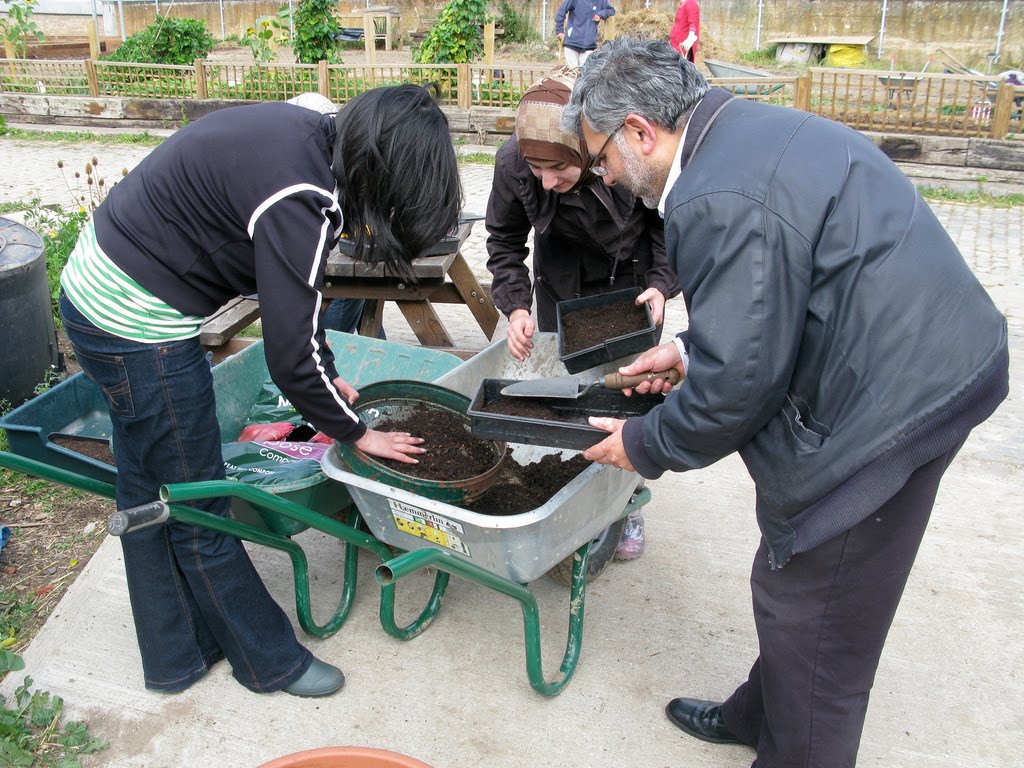
A couple of weekends ago, I found myself, once more, down on the farm.  Spitalfields City Farm, that is.  For the latest meeting of the Islamic Community Food Project.  As with other meetings we’d had, I really enjoyed the day - enjoyed interacting with new people, and others who had been a part of the project since the beginning; loved being back down on the farm, surrounded by the honking of the geese (who really own it) and the smells of other animals; and revelled in getting my hands properly dirty as I helped mix soil and compost for a new plant bed to be made in an old holey wheel-barrow.

As we chatted about what we had done to date, the phrase ‘fertile void’ was mentioned, and I immediately latched on to the brilliance of this as a description of the many possibilities that the project could fulfil.  It also reminded me, though, of a project that’s been bubbling in my mind for a few years now.

Behind our block of flats, there is a sort of court yard. It might once have been a tennis court, or maybe a children’s playground, whatever - whatever it was, it no longer is, as it has been locked up for the past...5 years? 10 years?  We’ve lived here nearly 20 years now, and I can’t remember when it was open, and what it was used for back then.  Right now, it’s overgrown with weeds, and full of various bits of trash - a broken chair, a trolley that’s unlikely to see its supermarket ever again, an old hula hoop all bent out of shape.  It’s an eyesore, and just a massive shameful waste of space.

And when I first heard about guerilla gardening a few years back, an idea started forming…  What if we took this space, reclaimed it, and turned it into a space where the estate could plant and grow?  Where people could sit and enjoy the sight of blooming plants, and kids could maybe learn a bit about where their food comes from, other than the local supermarket.  And maybe butterflies would tend the blossom, and the place would become the central hub for our whole community. Yeah, and throw in a rainbow and a couple of unicorns there too!  OK, so maybe I had a slightly rosy, overoptimistic view of what could become of the courtyard.  But thinking realistically, I still believed something could be done with the place.

So, I come back to this idea of the ‘fertile void’.  Imagine filling that?  This neglected dumping ground, that’s basically just an eyesore, waiting to be further vandalised and dumped in.  How amazing is the potential of this place!  Maybe it won’t become a massive community garden and a safe haven for all of the area’s wildlife.  But maybe it could be somewhere where maybe just one or two people will come, and clear up a little.  Maybe put out some young plants, and tend them.  And maybe, a few others, looking out of their windows, and seeing something new, positive, will be encouraged to join in, or just curious to know what’s going on.  And maybe they’ll come down and ask a few questions.  And perhaps those neighbours who we’re still only on nodding acquaintance with will become those neighbours who have a friend that has a few spare seeds, or knows where to get some great compost, or has a few old tyres lying around.  And maybe, just maybe, the seeds of community could flourish in what for now is just an empty space, but one  that is, I feel, absolutely brimming with opportunity.

7 Feb 2011

Sun 27th Feb: Islamic Community Food Project (London)

Connecting with the earth ~ Connecting with people

"On the earth there are Signs for those of inner certainty, as also within your own selves..."
(Qur' an 51: 20-21)


Next Event: Sunday 27th Feb 2011: Registration details below
Time: 11am-4pm
Venue: Spitalfields City Farm, Buxton Street, London, E1 5AR (near Brick Lane). Nearest tubes: *Use either Bethnal Green or Liverpool Street* (both on the central Line and still walking distance) as other local lines are scheduled to be closed during the weekend. Buses D3. Map & Directions: http://tiny.cc/l0nrw

Organised by Wisdom In Nature (WIN) with Spitalfields City Farm

  • Open to people of all faiths and beliefs; Tower Hamlets residents especially welcome.
  • Be empowered: Practicals on the land & grassroots organising with like-minded participants.
  • Develop experience in social change & facilitation - life-enhancing skills so vital in today's world.
  • Hear and share ideas & stories - take small, vital steps to make the imagined real.
  • Bring a team spirit & the yearning of your soul to create a sustainable, more compassionate world for all!..

  • WHO IS THE EVENT FOR?
    Anyone seriously thinking about being involved with the ongoing project. Also present will be those already involved.
    A background in community organising or Islamic ecological activism is a plus, but is not essential.

    As more people organise from the grassroots, community food initiatives are on the rise. These small steps not only empower, but offer alternatives to the globalised food system that favours multinationals. At the same time, within Muslim communities awareness is growing that Islam offers ecological principles that extend beyond the term 'halal'. This project aims to contribute to a more holistic paradigm - one that empowers individuals, helps build resilient communities, and genuinely draws us towards a sustainable and more compassionate world.

    Through this project, you will part in hands-on practicals, be empowered to co-learn together and engage in grassroots decision-making & organising followed up with action. The project is ongoing, and this event will lead to further opportunities to connect, organise and take action with like-minded participants.

    The programme will include:
    A workshop on taking action together, facilitated by Wisdom In Nature; and a practical on the land with Spitalfields City Farm.

    Please dress for the weather and bring sturdy footwear. Tea/coffees/refreshments will be provided. Please bring food to share for lunch.


    COST FOR EVENT: £5 per person. Reduced rate for unemployed/regular WIN donors/regular participants (£2).
    REGISTER: To reserve your place, please send an email titled 'Register', with your full name to: communityfood_AT_wisdominnature.org.uk (replacing _AT_ with @ ) ; Note that registration is for the full day.

    Project Blog Posts:
    www.wisdominnature.blogspot.com/search/label/icfp ; More info: Wisdom In Nature: tel 0845 456 3960 (local rate).

    13 Dec 2010

    Sun 23rd Jan: Register for Islamic Community Food Project: Upcoming Event

    Awareness, Grassroots Organising, & Action..

    Date: Sunday 23rd January 2011
    Times: 11am-4pm
    Venue: Spitalfields City Farm, Buxton Street, London, E1 5AR (near Brick Lane). Nearest tubes: *Use either Bethnal Green or Liverpool Street* (both on the central Line and still walking distance) as other local lines are scheduled to be closed during the weekend. Buses D3. Map & Directions: http://tiny.cc/l0nrw


    Organised by Wisdom In Nature (WIN) with Spitalfields City Farm

  • Open to people of all faiths and beliefs; Tower Hamlets residents especially welcome.
  • Be empowered: Practicals on the land & grassroots organising with like-minded participants.
  • Develop experience in social change & facilitation - life-enhancing skills so vital in today's world.
  • Hear and share ideas & stories - take small, vital steps to make the imagined real
  • Bring a team spirit & the yearning of your soul to create a sustainable, more compassionate world for all!..

  • As more people organise from the grassroots, community food initiatives are on the rise. These small steps not only empower, but offer alternatives to the globalised food system that favours multinationals. At the same time, within Muslim communities awareness is growing that Islam offers ecological principles that extend beyond the term 'halal'.

    With a deeper food ethic waiting to emerge more fully, there is much that spiritual traditions can offer and each of us can do, to contribute to a more holistic paradigm - one that empowers individuals, helps build resilient communities, and genuinely draws us towards a sustainable and more compassionate world.

    Through this project, participants take part in hands-on practicals, are empowered to learn from each other and engage in grassroots decision-making & organising followed up with action. The project is ongoing, and the approach is both contemplative and active.

    The programme will include:
    A workshop with Wasi Daniju & Muzammal Hussain from Wisdom In Nature.
    A practical on the land with Naomi Glass from Spitalfields City Farm.

    Please dress for the weather and bring sturdy footwear. Tea/coffees/refreshments will be provided. Please bring food to share for lunch.
    COST FOR EVENT: £5 per person to be paid in advance. Reduced rate for regular donors to Wisdom In Nature and regular participants. See registration form for more details.

    REGISTER: There are a limited number of places. Registration is essential (except for existing participants) and is for the full day. The registration form can be found via the Wisdom In Nature website, or you can download from here: http://www.wisdominnature.org.uk/Action/Events/events2011/ICFP_Jan11_RegForm.doc

    Wisdom In Nature - Islamic Ecological & Community Activism: www.wisdominnature.org.uk ; tel 0845 456 3960 (local rate).

    9 Dec 2010

    Reflections Across the Pond: Green, Muslim and American

    The flying question

    It was 2004. I was at a public meeting on climate change. The lecture hall was buzzing with energy. Ideas, questions and answers were exchanged between the audience - mostly students - and the speakers, one of whom was Mayer Hillman. 

    Mayer is the author of the informative 'How We Can Save the Planet', and during the course of this event did not hesitate in showing his distaste to flying. He also made it more personal and correspondingly more uncomfortable. 

    "Who will now commit to never flying again?" 

    He threw the question at us with force, like a long-standing campaigner who believed it was now or never. As he asked this, I checked in with myself and found myself grappling internally. I was aware that the warming effect of flying can be several times greater than other forms of transport because greenhouse gases have more of an impact at high altitude. Also, the distances we fly tend to be large with flying being a cheap and time-saving travelling option. The place that aviation takes with regards social norms and its contribution to climate change is hard to over-emphasise, which is why there is a necessary movement resisting its expansion.

    In response to Mayer's question, a surprising number of people put up their hand. The part of me that wanted to be seen as righteous wished I was one of them, but I would have been lying if I did. With dozens of close friends and relatives in other continents, uncomfortable though it felt with Mayer's glare piercing the room, I had to keep my hand down. Although I had, by that time, virtually made an internal commitment to not flying for leisure holidays - and even in other situations to use coach, train or boat, for example - I could not commit to never flying again.

    It was Autumn 2010. Here was another moment when I grappled with the flying question. My wife is from the US and I had not seen most of her immediate family for three and a half years. At the same time, she would be in the States for a significant period of time to complete her PhD. Was I to also go? Over a few weeks of consideration and weighing things up in my awareness, I began to move towards the idea of joining her and her family in New Jersey for part of that time. I also felt I could squeeze more from that one trip by also connecting with friends in nearby states.

    In November, thus, I did set off, travelling by plane, for three weeks in the US. It so happened that whilst I was there I also managed to meet with some inspiring individuals in the US Green Islam movement. Here, I share some of these experiences as well other parts of my trip.

    DC Green Muslims

    Within a few days of my landing, I visited Washington DC to catch up with an aunt and uncle. I found out from my friend Mohamad Chakaki, co-founder of DC Green Muslims, that Sarah Jawaid from the group was speaking at an inter-faith climate change meeting on the day I was due to arrive! This sounded perfect, and I managed to make it just in time for this event, being met at the local metro station by Ryan Strom, another member of the DC Green Muslims team.

    On the panel along with Sarah, was a Christian and Jewish speaker. Plenty of ideas were shared. Some of the more memorable comments included one from the Jewish speaker, Josh Tulkin, Founding Board Member of the Baltimore Jewish Environmental Network, who pointed out the disconnect between our actions and climate impacts - that when we start our car, for example, it's not that we're literally putting a gun to someone's head, yet the accumulative effect of these seemingly innocent actions build up to cause loss of life, which goes against all faith traditions.

    Another memorable comment came from Sarah, who described an innovative means by which the DC Green Muslims had stimulated people to be more present in themselves and to their surroundings. She and her co-organisers had invited people to a Green Dinner event. Shortly before the start time, the windows to the room were boarded up, and cardboard was balanced vertically on the tables to prevent people, once they had arrived and taken their seat, from seeing their neighbour. The idea was to wake people up to the space they were in and to notice how it made them feel, however awkward or uncomfortable. 

    Sarah added that the state of the altered room was basically a metaphor for what we often experience daily in our lives, yet become desensitised to. Following a period of being present to this altered room, the participants were then given a chance to re-arrange it themselves to their liking! The DC Green Muslims have impressed me with their imaginative grassroots approach, and this is but one example.

    Park 51

    Back in New Jersey, my wife and I took a day trip to New York absorbing some of Manhattan. It was a Friday and we stopped for prayers at the Park 51 Community Centre, a couple of blocks away from Ground Zero. 

    The sermon (khutba) was given by Imam Feisal Abdul-Rauf, and was one of the most liberating I had experienced. It wasn't just the content, but the way it was delivered - with love and presence, opening up a space that was much bigger than just words being spoken . The content itself was about compassion, and inviting Muslim to move beyond the label 'Muslim' to what the term actually points to, the surrendering of the self  to the Divine - and to reflect on what that means including in our caring for those who might have different viewpoints to our own. I left the centre with a feeling of gratitude and hope.

    Green Deen

    That same evening, we were fortunate to be able to meet Ibrahim Abdul-Matin and to attend a workshop he was facilitating at Columbia University in New York. Ibrahim is the author of the newly released and very readable book Green Deen - What Islam Teaches About Protecting the Planet. 

    At his workshop, there were about 30 participants, mostly students. After some mostly seated exercises, Ibrahim got us moving - we took positions in different corners of the room according to where we stood in response to questions he threw at us. We then shared with those standing with us, and then with the wider group. It was a well run, engaging workshop, and Ibrahim's background in community organising was evident. 

    One of the comments he made to the group that stayed with me went something like this, 

    "You have value not because of what you own, what you wear, nor because of what you earn. You have value simply because God created you". 

    This wasn't academic stuff, rather a way - albeit pitched for those who believe in God - of getting to the basis of our self-worth that necessarily brings down the walls of an artificial value-system which society imposes onto us, and out of which arises consumerism and the compulsive pursuit of status. 

    Massachusetts

    It was the last week of my trip and I spent a couple of days in Boston, Massachusetts. From there, I visited Cambridge to connect with Mohamad Chakaki, a friend whom I mentioned earlier and with whom I thoroughly enjoy hearing and sharing ideas. I also met with Misha, a close relative and outstanding student, who is at Harvard, and an Auntie on my mother's side. This was my second time in Cambridge, having visited nineteen years previously after a period of working in Canada during a summer. The area I visited - around Harvard Square - was certainly much busier, with plenty more cars, but I could still sense some of the quality of intimacy that I had experienced the previous time. 

    Progressive New York Radio 

    After an extended  seven hour coach journey back to New Jersey, I took to the phone to be interviewed by Saadia Aslam from Radio Tahrir. Radio Tahrir is a weekly programme about the Arab and Muslim Community and is broadcast on the independent New York radio station, WBAI Radio. 

    Saadia asked me about the work Wisdom In Nature is doing in the UK. I talked about our new booklet, Islam & Climate Change: A  Call to Heal, our Islamic Community Food Project, and our emphasis on process and  working in a holistic way that includes consciously integrating social ecology into our work. Saadia was also keen to hear my experiences of the Green Islam movement in the US. I enjoyed sharing and am impressed by the dedicated work the radio station is doing. 

    The podcast of my interview can be found on the following webpage - It's the November 23rd 2010 broadcast, and the interview starts at about 30 minutes after the music piece by Maher Zain.

    Progressive Muslims

    During the course of my trip, on several occasions I heard the name IMAN. IMAN or the Inner-City Muslim Action Network is an organisation that Ibrahim Abdul-Matin profiles in his book, and which Mohamad Chakaki also enthusiastically talked to me about in Cambridge. 

    I discovered that IMAN aims to weave together social justice with the arts, and to also bring in the environmental. One of their projects is called Project Green Reentry. This involves supporting ex-offenders in Chicago with on-the-job training as they essentially construct their own homes sustainably. This is meant to help them to socially integrate whilst simultaneously respecting the earth. As a keen believer in a holistic approach - I increasingly feel that isolated environmentalism, or indeed isolated activism of any kind, is ultimately self-defeating as it will work against the interconnected nature of things - I am keen to learn more about the intelligent work that IMAN is doing.

    The two sides of the Pond

    So, how does the 'Green Islam' movement in the US compare with that in the UK? 

    Whilst I haven't explored the movement in the US sufficiently enough to give a confident answer, it was clear that the folks I met there hold alot of respect for the work going on here! Whilst it's true, however, that we've been working with this for a longer period, perhaps they underestimate what they have achieved in such a short space of time. 

    My own sense about the movement in the US, from direct contact with a few key individuals, is that it has set in motion a creative energy and quality of work that is refreshing. There also seems to be a healthy experimenting with ways, verbally or otherwise, to express Islamic principles so they can be practical and alive to those of us growing up in contemporary western culture. I felt that our more 'mature' movement in the UK can certainly take inspiration and lessons from the movement there. 

    At the same time, we have a grounding and a history through which many lessons have been learnt and a certain degree of resilience developed. All in all, there appears to be much scope for a mutually nurturing relationship, whose benefits can and must extend beyond our immediate space and time.

    Back in the UK


    Now in the UK, I am soon met by the graceful dance of snowfall, and the corresponding clumsiness of our predictable inability to cope well with it! I am grateful for having had the privilege of being able to travel to the US. The technology we have today can make vast distances appear small and I am acutely aware of the need to take time to reflect and to be grateful, and to also acknowledge that there are physical limits to the pace of consumption that our planet can take. Although I have not chosen never to fly again, I have consciously chosen to not take flying for granted. 

    So, now it's also time to get some more work. The economic situation. Hmm, that's another aspect which, in this inter-connected world, needs co-healing...

    © Muzammal Hussain

    14 Oct 2010

    A Journey through the first event: Islamic Community Food Project

    An hour before midday, after registering their arrival at Spitalfields City Farm, the eager looking, fresh-faced participants took part in a hands-on practical coordinated by the energetic Naomi Glass. Myself and Wasi also joined in.

    One group concentrated energies on the meditative task of careful seed-sowing. Another group flexed their muscles to dig some manure into the earth.


    Having developed a team-spirit through these joint efforts, we all reached for the delicious soup that Naomi had prepared only a few moments earlier using mostly ingredients from the farm itself. As we sipped and let the warmth down, we began to talk philosophy, food and much else.


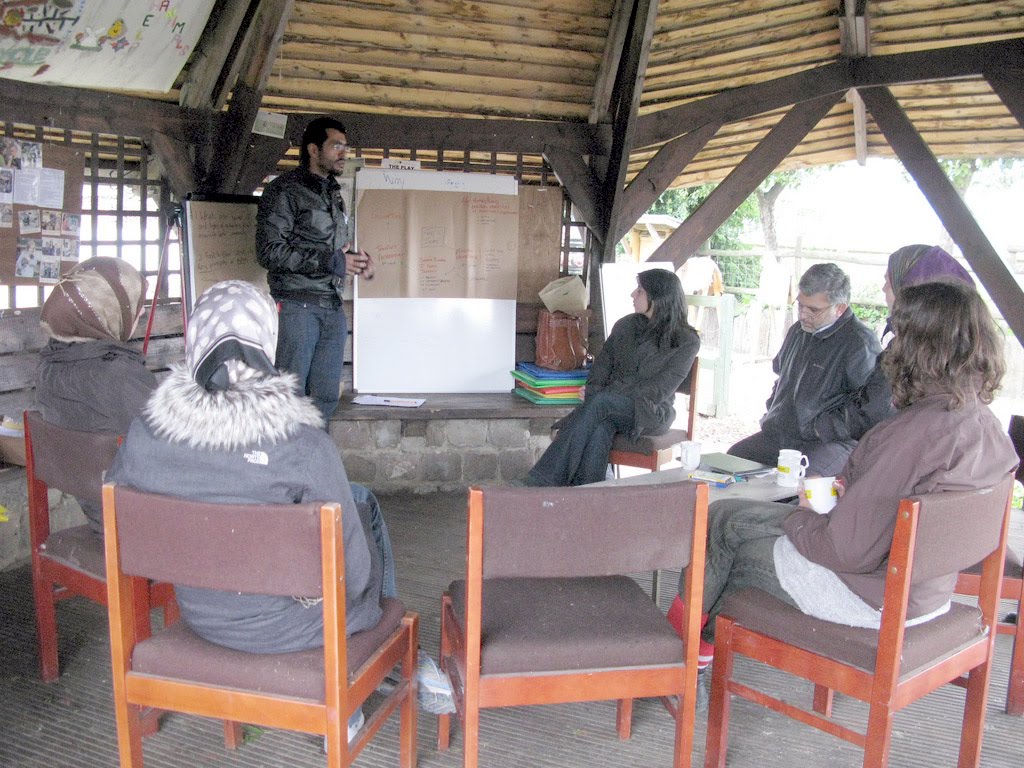
    After eating, and following an optional midday contemplative prayers (zuhr), it was time for the workshops. We gently touched down on a couple of introductory ice-breakers elegantly facilitated by Wasi, and then explored food, community, decision making through consultation (shura), and some of our own stories - what we bring to give a few examples. As a co-facilitator, I had the pleasure of working with a fantastic group of people. Some of the exercises were done as whole group, others in sub-groups. We had put quite alot of thought into how we would frame the workshop exercises - what would enable new participants to experientially and collectively get a sense of the idea of an Islamic community food project, whilst giving them space to think creatively and to be empowered? We felt our work paid off, and was supported by the creativity and humility that the participants brought.

    One subgroup explored some of the qualities and types of activities associated with 'community'. The flip chart on the left captures some of their ideas. Another subgroup reflected on some key principles or values expressed through Islam around food. The photo on the right captures some of their ideas. (Clicking on the photos should enlarge them).
     
    The final session of the day involved considering possibilities for our next steps. Where might we go next? Some ideas began to emerge, whilst others were yet to evolve into a more tangible form, a process that will be supported by time and further reflection.

    The exciting journey we are travelling on together continues, and we look forward to welcoming newcomers who feel called to join us at follow-up events.
    ---

    You may also like to read a personal perspective of the first event by participants, Saira Khan, and Ali Ajaz.

    All Photos © Wisdom In Nature

    Personal Story 2, by Ali Ajaz: Islamic Community Food Project at Spitalfields

    "Disenchanted with biased globalised food system" – check!
    "Tired of seeing a new Tesco Express opening up 5 minutes from the old Tesco Express" – check!
    "Unhappy about seeing the old Tesco Express in the first place" –check!
    "Interested in exploring alternatives" – check!
    "A community food initiative sounds good" – check!

    Having been aware of the important work that Wisdom in Nature have been involved with, I’d been meaning to be a part of this interesting movement for some time now. But events came and went as the toils of this world seemed to get the better of me and my ‘free’ time. However, upon hearing about an Islamic Community Food Project, I was determined to attend hoping to learn something tangible from this grassroots, progressive movement which was based upon the underpinnings of Islamic principles. What could sound better than this?

    This first meeti
    ng was held at Spitalfields City Farm and although I live less than a few miles away, I had no idea that it existed. Neatly tucked away amongst the urban hustle and bustle, it provided a very welcoming distraction to the all too familiar commotion of the Sunday market in East London. The day started off by helping out with a number of duties on the farm. Now this may sound somewhat daft but I experienced a hint of apprehension about doing something on a farm. I attributed this to my urbanised upbringing and limited connection/neglect of the natural environment around me. I was therefore surprised by the degree of tranquillity obtained from just pulling weeds on this cool Sunday morning. More of this was what I needed!

    The afternoon session initially focused upon getting better acquainted with the other members of the group and it became apparent very quickly that there was a common enthusiasm shared by all. Individuals from various backgrounds, seemly united by a hope to be part of something exciting, something meaningful. The group dynamics were allowed to evolve naturally by the expert guidance from Muzammal and Wasi. Concepts of food and community in an Islamic context were explored by the group and by the end of the afternoon, I felt an optimistic vibe reverberating though the group, this despite the ever falling temperature. This Islamic Community Food Project has the potential to grow and bloom into something special and I am looking forward to being a part of it.

    Ali Ajaz

    All Photos © Wisdom In Nature

    Personal Story 1, by Saira Khan: Islamic Community Food Project at Spitalfields

    Food For Thought

    The “Islamic Community Food Project”, my eyes glazed over a little bit as I read the b
    riefing sheet on my way to Spitalfields City Farm. Hailing from the concrete jungle that is London I’m not sure I had ever set foot on a farm before. Yet on one particularly cold September day I found myself trudging through a farm, trawling through compost, planting seeds, and trying to stare down some uber cool geese strutting around me with what I am convinced was the theme to Saturday Night Fever in the background … I’m not sure I won that stare battle, I got the feeling that they kind of run the place, like some sort of bird Mafia. Not only did I never imagine I would be doing all of the above, but I found that I was actually thoroughly enjoying myself!

    I must confess that it was with more than a pinch of trepidation that I volunteered to be part of this project. I wasn’t exactly clear on what it was all about, but this was actually a blessing in disguise because I found that the atmosphere of encouragement, empowerment and participation meant that as the day went on and as the group undertook various discussions and exercises, it became clear that on some level we already knew what we wanted to achieve and the project could in effect be what we collectively wanted it to be. Consequently in a kind of “wax on wax off” moment, the excellent facilitators, Muzammal and Wasi (of Wisdom In Nature) and Naomi (of Spitalfields City Farm), gently prodded our collective knowledge and experience in order to give us the realisation of what our objectives were in developing the project and how we could each contribute to it’s future development. It really is an exciting prospect and I’m looking forward to seeing how it develops.

    As for the people involved, I honestly can’t speaking highly enough of the facilitators and the attendees at the project. Each person came with their own story and a great deal of enthusiasm and energy. I felt that this group of like minded people who found themselves laughing, praying, meditating, conversing and eating delicious food together could really be part of something extraordinary.

    So, to conclude, I’m glad to report that following our first meeting the Islamic Community Food Project is now up and running. They say that each journey begins with the first step, and I can honestly say that I thoroughly enjoyed making that step and look forward to the future leaps and bounds!

    Saira Khan


    All Photos
    © Wisdom In Nature

    19 Sept 2010

    Thurs 28th Oct: Faith and the Environment (London)


    I find Transition initiatives an exciting community-led idea, and have on occasion witnessed individuals tirelessly working to complete inspiring projects that have rippled to empower the local community. There is much to be said in today's world, about people owning their power by organising together. It takes passion, patience, the ability to work authentically in groups, and with inner work can be used as a vehicle for spiritual growth. 

    This public seminar in Kingston, is organised by Kingston interfaith Forum along with the local Transition initiative and Kingston Council. An area that some Transition initiatives are looking more closely at is that of diversity. I'm honoured to have been invited to speak at this collaborative event, and look forward to meeting and engaging with fellow speakers, workshop leaders and participants.

    Date:  Thursday 28 October 2010
    Time:  6pm-8.30pm 
    Venue: Guildhall Council Chamber, Kingston, KT1 1EU; Map & Directions 

    A free public seminar organised by Kingston Inter Faith Forum in partnership with Transition Town Kingston and the Royal Borough of Kingston upon Thames

    REGISTER YOUR PLACE: This event is open to all who reserve a place with Jean Cousens tel. 020 8547 5023 email: jean.cousens@rbk.kingston.gov.uk by 8th October 2010.
    Refreshments provided. 

    ‘Never doubt that a small group of thoughtful, committed citizens can change the world. Indeed, it is the only thing that ever has.’ (Margaret Meades) 

    Speakers: 
    Dr Muzammal Hussain, Founder of ‘Wisdom in Nature’, on: Engaged Spirituality and Diversity in an Age of Transition: with an Islamic Perspective.
    Dr Laurie Michaelis, Co-ordinator of Living Witness: Quakers for Sustainability.
    Chaired by the Leader of the Council, Councillor Derek Osbourn

    Click here for more info

    1 Sept 2010

    Can You Help Us? Financial APPEAL for Print Copies of Islam & Climate Photo-booklet


    Whilst we have finally launched the online version of our popular colour booklet, Islam & Climate Change ~ A Call to Heal, (downloadable for free), we still haven't yet had our first batch of copies printed. The reason is simple: Finances. As a grassroots organisation we need money from people like You to be able to do this.

    To get the first batch printed (we are going for recycled paper, using a printing company with
    a strong ethical stance) we need at least an additional £800 for one-thousand copies of the 20-page colour booklet. We ask if you would be willing to help us reach this amount so we can have copies available as soon as possible. They would be distributed for free with donations suggested (which will help cover the next batch and so on! - this would make it sustainable in the longer run!)

    Our bank account details are on our donate page

    If you have any questions please contact us, or feel free to use the comments tag at the bottom of this blog post.

    With thanks from the Wisdom In Nature team for any financial help you can give us.