Pages

28 Apr 2013

Peace News Summer Camp 2013: Taking a Lead from the Global South, 25-29July, Norfolk

 Here's info about a progressive annual camp organised by our friends at Peace News (Note: It is during Ramadan)....
 ----------

PEACE NEWS SUMMER CAMP 2013: TAKING A LEAD FROM THE GLOBAL SOUTH
Thurs 25 July - Mon 29 July 2013, near Diss, Norfolk

Book your tickets online here: http://tinyurl.com/pnsummercamp2013tickets

This year’s camp is organised by activists of colour/people with a global majority heritage. We invite you to join us and others from across the broad spectrum of the peace movement and radical activism for five days of workshops, entertainment and network building!

Taking a Lead From the Global South will be a core strand of the workshop programme, which will include:

- Standing our ground: Peace Communities nonviolently taking back their land in Colombia
- Between NATO, the warlords and the Taliban: Peace activism in Afghanistan
- Finger on the trigger: Western nuclear terrorism since 1945
- Demonising Muslims: Why Islamophobia is more popular than ever
- After Chavez: Social movements in Venezuela
- Turning the world upside down: Global feminisms
- Deschooling society: A Black perspective
- A culture of resistance: The story of Pan-Africanism

ABOUT THE CAMP
When: 25 – 29 July 2013
Where: Near Diss, Norfolk

Peace News Summer Camp is an annual five-day, family-friendly event that attempts to embody many of the characteristics of the future society towards which we’re working – inclusive, democratic, participatory, renewably-powered and environmentally sustainable. It’s an opportunity for a broad spectrum of activists working for radical social change to come together and develop our goals, priorities, knowledge, strategy, skills and networks in support of our different movements, be they anti-capitalist, anti-cuts, anti-racist, anti-war, counter-militarist, disability, environmental, feminist, LGBTQ, or other movements for liberation.

There will be workshops and discussions, practical skills sessions, delicious vegan food, music, film, and participatory entertainment, a bar, a campfire, and activities and facilities for kids and families.

The theme for this year’s camp is TAKING A LEAD FROM THE GLOBAL SOUTH. We’ll be creating opportunities to:

- celebrate what movements in the Global South have contributed to movements in the UK
- discover what movements in the North can learn from those in the Global South
- make global connections between local struggles
- think about what it means to build real solidarity with activists in the Global South

BLACK LEADERSHIP

For this fifth Peace News Summer Camp, for the first time the organising committee are all of global majority heritage. This is an expression of the commitment of Peace News, and of the Summer Camp, to work against racism, and to give an opportunity for new ideas and voices to enter. The new organising collective has added these dimensions to the agenda of the camp:

- celebrating what global majority activists have accomplished in struggles for social change around the world
- helping us better understand and overcome the racism of the societies in which we live
- helping us to understand the connections between racism and other forms of oppression, including those based on disability, class, gender, sexuality and age
- giving us an opportunity to learn more about how racism is affecting our struggles and ourselves and to think about how we can move forward in rooting it out

Peace News Summer Camp is an inclusive event, open to everyone who’s been before, and to everyone else – from all racial and cultural backgrounds – who would like to explore radical ideas and share social change skills.

TICKETS & FOOD

The camp costs £20-£70 depending upon income (for those over 14). Payment can be made by cheque, online or by phone:
- online purchases here [http://peacenews.info/civicrm/event/register?reset=1&id=6]
- 0207 278 3344 for purchases by phone
- Send cheques (payable to “Peace News” to Peace News, 5 Caledonian Rd, London N1 9DY), explaining how many tickets you’re purchasing and at which rates

Food (3 meals a day and drinks) will cost £6-£11 a day for over-14s, depending on income, and should be ordered before the camp starts. Individuals meals will be available to buy at the camp. Food tickets will be available from late April. 


22 Apr 2013

Deepening Facilitation: Report Back on 'Facilitating Change' Week in Wales


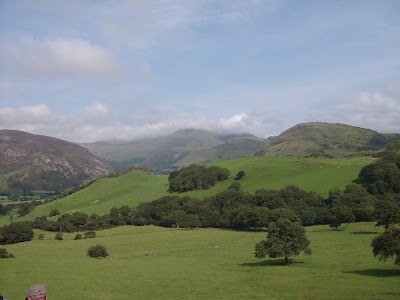
A Photo from a previous visit to a nearby area in Wales
 

We the People, We the material 

It's been about a month since I returned from a challenging, yet exhilarating week in rural Wales. There were about 25 of us - most of us were from the UK, and some from other parts of Europe. When people come together, I am excited about the possibilities that exist, and the extent to which those possibilities are tapped depends, in part, on how the group is facilitated. 

At this gathering, called 'Facilitating Change' we had come to explore deeper, more inclusive ways to facilitate groups. It felt like a landmark event, whose ripples are yet to be widely felt. It was organised by Seeds for Change, Rhizome, and Tripod

Everyone participating had some experience in facilitating groups. Some participants also had experience in training others to facilitate. However, perhaps the most profound difference between this gathering and other facilitation training I have been on, was not the level of experience of participants - even though the level here was high - but that at this gathering we focussed almost entirely on the relationships between our selves: WE were the material! - living together, eating together, facilitating together, reflecting on our and each other's patterns, and participating together - for a whole week.

The Magnifying Glass: Mainstream, Margins, and more..
 
A central focus during this rich time we spent together was reflecting on mainstreams and margins within groups, focussing not on groups out there, but on our group that had gathered for the week. What are the mainstream values, attitudes and behaviours, for example, in our group? And which values, attitudes, and behaviours are being marginalised... perhaps unconsciously? 

Related to this, we explored rank, power and privilege, developing awareness of our own rank in the group, how we used our power, or allowed others to step into theirs. I am speaking here from my own understanding.

There was no set formula, and a range of approaches were used to experientially explore the concepts: from 'Process Work', to 'Forum theatre', to Joanna Macy's 'The Work that Reconnects', to the various methods more commonly used in the tool-kit of grassroot facilitators, whether small group work, paired work or exercises within the larger group. Some sessions hit the mark more than others. But each offered much learning. The variety made it both interesting, and for me, very effective.
  

Participants become the facilitators
 
The sessions on the first day-and-a-half were facilitated by the organisers. Thereafter, much of the facilitation was passed to us, the participants, and we would facilitate in pairs. After the previous session had ended, there would be space for some feedback to the pair who had facilitated it. The group as a whole would then consider where we are at now: "What is the diagnosis?", What is emerging right now? And what is being silenced? 

These kinds of questions would help inform us, and in particular the next pair, stimulating us to reflect on what approaches and exercises might further the group now. The next pair were chosen by picking two names from an envelope - this was a time when I think we all felt quite anxious - in particular because the pair would then have just half an hour, or so, to prepare their session!

Diving Deeper into the Process

Whether you were facilitating, or participating, the week was challenging! The process was 'alive' throughout - our attention was frequently directed towards considering where the group was at in any given time, and what was needed to take the group (i.e us!) further. 

Conflict was drawn out. Not all significant conflict. Differences were acknowledged. Not all significant differences either - we were far from 100% successful  - but the important thing for me was that it became more ok to express within the group things that would usually be more difficult - not that it became easy either! 

One helpful approach used at least a couple of times after something especially difficult had happened, was some kind of re-enactment - a few people playing different roles, helping to bring up different themes or emotions that had been acutely felt, even if not expressed. This often carried with it a quality of humour, which softened the tension, and made communication easier. It was wonderful to witness this, and for me, this helped to bridge differences and draw me closer to other participants. 


The week also created a context that supported greater awareness of my own pain and patterns, helped strip away some of my social mask - and related to that - deepened my relationship with others. Out of this experience, I am more aware how easy it can be for action groups to just travel on the surface, going through the motions. I want to dive deeper. I want to glide underwater, into the unknown, and experience the depths, the richness that is there. And I want to support others to be able to do the same.

While there was plenty of time spent in the company of one another, whether during formal sessions or during the evening, I felt it important to have some time alone. My spiritual practises that I immersed myself into several times a day were really helpful to me, helping to reduce some of the mental noise and process some of the emotions that were arising. 

I also felt that a few more exercises of a meditative or contemplative nature within the formal workshops would have been really helpful. There were certainly strong emotions that arose for many of us, and practises that expanded the 'inner container' that held 'emotional content' would, I think, have really helped our individual and collective processing of that content.


The Question of Resistance

So, was nobody in the group resisting the process? The answer is that there was plenty of resistance. Particularly at the beginning. We were being pushed to go deeper, to be real, to stop being polite that would otherwise hold us back from talking about the difficult stuff. This resistance tried to defend its ground, but eventually - after some pain - things began to open up.   

There were also the later stages of the week. In retrospect, I sense that I became a little complacent during these even though I never stopped journeying. However, I have wondered if I could have voiced a little more that I was feeling within, during the later stages, and which might thus add fuel for more growth. Or maybe I intuitively felt there was enough already being processed: too much fuel can also smother a fire. I'll be reflecting more on this.


Some Personal Insights

Some personal insights that became more real for me during the week were as follows:

-Within a groups, it can be fine to ditch the agenda (or to be prepared to).
-The fastest journey is not necessarily the seemingly shortest route.
-Emotions hold wisdom, and wisdom informs.

-------------


For anyone who is interested, below is some of the pre-gathering reading that went round.... 
 
"We wanted to give you a bit of background, to give you a an idea where this project has come from and to help you get into a state of mind which will help us have a productive week together. Hopefully you'll get a wee bit of time away from your busy lives, while travelling if not before, to reflect on why you were attracted to come to this event, your hopes and expectations…

This was a project that was dreamed up a few years ago that we've been working hard on ever since. It came out of noticing that despite the great increase in the use of facilitation in the grassroots social change and campaigning scenes in the UK, in part through the Training for Action trainings in advance of the Scottish G8 and through the Camp for Climate Action, we still participate in some really bad meetings! So despite this increased capacity, both of facilitators formal and informal, and of general meeting skills, what happened? Why are meetings sometimes drawn out and overly painful? How come facilitators from time to time fail to support fairness and creativity in our processes?

Well, this set us thinking (when we say us, we mean a loose set of experienced activist-facilitators from different places). Was the problem that we'd focussed too much on certain skills without allowing our intuition to develop? Are there secrets out there in different cultures and approaches that we've 'missed? What are the attitudes or understandings that are lacking, or is it something else? What is the place of values in all this? Are there values behind good facilitation? Is good facilitation about helping a group uncover their values and work to them?

We're sure you've got more questions too, and some answers. And it's in this spirit that we're all getting together. It is not just about learning new tools and exercises, though I'm sure we'll all learn some along the way, maybe even develop new ones. Its about working out how we can develop the state of mind and express the values that underpin our practice as intuitive facilitators. It's a chance for all the great people who are taking part to bang our heads together, to think, to dream, to feel, and to see what we come up with and where we get to; and wherever we do get to, it'll be a start. Hopefully together we will advance how grassroots facilitation is practiced, for ourselves, for other facilitators, and for all we work with."

Ameen,

Love, Muzammal
---

WIN's workshops: click here


26 Mar 2013

Video of WIN talks: Interconnectedness & Relationship: Basis for an Islamic Ecology


Earlier this month, WIN Reps Shumaisa Khan and Muzammal Hussain spoke at an Inclusive Mosque Initiative event. 

The topic was: 'Interconnectedness and Relationship: Basis for an Islamic Ecology'

The talks were followed by a discussion.

Areas covered included: Nature as a teacher, Permaculture, Interconnectedness between campaigns/issues, Economy, Islamic ecological concepts, technology, intentional communities, and the challenge of deeper group work.

You can watch the full video below:


18 Feb 2013

Event: Interconnectedness & Relationship: Basis for an Islamic Ecology: Sun 3rd March 2013, London

We are very happy to be speaking at this exciting event hosted by the Inclusive Mosque Initiative.
 
 ---


The Inclusive Mosque Initiative invites you to:
 
INTERCONNECTEDNESS & RELATIONSHIP: BASIS FOR AN ISLAMIC ECOLOGY
 
Date: Sunday 3rd March 2013
Time: 2pm-4pm
Venue: St Johns Church, 73 Waterloo Road, London SE1 8TY; Map: Click here
 
With Shumaisa Khan & Muzammal Hussain of 'Wisdom in Nature'

Talks followed by question/answer session.
 
Registation is requested with a suggested donation of £5 on the day, if you can afford more then please feel free to do so. This covers the venue and speakers costs.  


27 Jan 2013

Permaculture: Growing Food in a Small Space

Just 10 years ago, 'permaculture', was a term known to just a tiny minority of people. Today, the term is known much more widely, with more and more people getting trained up in this remarkable approach of designing sustainable systems and applying it in their own lives and communities. 

While I initially heard of permaculture in the late '90's, it wasn't for another 10 years (i.e. in 2008), that I took any formal training in it - a weekend course run by Naturewise that both inspired me and made me thirsty for more...

The following year, I applied to get onto Earth Activist Training  - a two week residential intensive, while camping at Landmatters eco-community in Devon, that weaves together a full Permaculture Design Course (PDC) with sustainable activism and spirituality. One of the powerful ingredients of this course was the presence of some experienced activists in the direct action movement in the UK. It was a privilege to have been on it and I describe it a little within this post here


When I returned from the EAT course, one of the first projects I completed was converting a small area of land in our garden into a productive growing space


In the Beginning: Start with Observation..
  
One thing we permaculturisits like to do before designing a system is to observe it - and an aspect of observation involves recognising potential 'threats' or 'constraints' to the site. Through creative design, we might then consider how to work around (or within) those constraints. This cute creature seen basking in the sun lived above us. She enjoyed certain activities on our small piece of land. Although she probably didn't realise it herself, her digging holes to relieve herself was seen as a bit of a 'constraint' in getting some things growing on the land! So, I wanted to find a way around this...

To work around her behaviour, (or intrinsic characteristic), I decided to protect the site with netting. This actually had the added beneficial effect of preventing snails from getting to the veggies! I also put a layer of compost onto the soil, which you can see in the photo, the idea being to increase soil fertility and further cover any existing cat poop. Some of the compost was bought, and some was worm compost that we produce from organic kitchen waste.


Additonally, I chose to work on the site without digging, which would otherwise  disturb the soil layers and microbiology, and would bring weed seeds to the surface. This would inevitably increase the need to dig in the future, setting up a viscious cycle. Instead I would hoe out any weeds at the surface,and let them lie on the soil. Letting the weeds rest on the soil in this way  better mirrors principles in nature, and allows the weeds to breakdown where they directly feed the land.


Permaculture Principle: Make the least change for the greatest effect


I then covered the compost with a layer of straw. This was for a couple of reasons: firstly, to help prevent the compost drying out, and secondly to reduce the chances of any weed seeds that may be present near the soil surface from germinating.


Maximise growing space by 'Stacking'

Rather than making expensive interventions with potentially harmful consequences, permaculture is more about maximising the relationship between existing resources - this means working with what is already there in a harmonious way. Thus, using a permaculture principle called 'stacking', taller plants can be grown close to shorter ones - the taller ones are positioned furthest from the sun, and the smaller ones closer to it. This minimises competition for sunlight and means greater overall yields for the same area. 

This particular form of stacking is called 'vertical stacking'. We can also stack in time e.g. by growing crops that occupy the same space in different seasons so the land is productive throughout the year; or if we share the same living space with someone else but use  it at different times of the day. (Permaculture can help design social systems as well as gardens! Indeed it can help integrate the two!) In the photo, the tall plant against the back south-facing wall is a beautiful climbing french bean, called Blauhilde. Yet, even though it is at the back, it still gets plenty of sunlight by nature of its height. There's also a few tomato and perpetual spinach plants in the photo, as well as RosemarySo, lots of diversity in a small space.


 Here's a few of the purple french beans being harvested. The plant is high yielding and the beans are delicious! They also have this unusual characteristic that while purple when raw, they turn green when cooked! The plant also has wonderful tiny purple flowers that you can see more easily by enlarging the photo.  


Here is a close up of a perpetual spinach plant (protected by netting). What I love about perpetual spinach is, you plant it once and it provides yield for months on end. I'm surprised more people don't grow it. Even with just a few plants we  often had more than we could eat, and would often enjoy sharing the harvest with our neighbour.


Also planted were broad beans. These were actually harvested before the other crops. 


Permaculture Pricniple: The Problem is the Solution


In this picture are potatoes being chitted indoors to get them started early, before planting them in the soil outdoors. This particular variety came from Seedy Sunday.


There is a permaculture principle that 'the problem is the solution'. To make good use of space, I managed to secure some unwanted used tyres (the 'problem') from a local store, and used them to grow the potatoes (i.e the solution!).


As the potato plants grew, I would put another tyre on top of the existing ones, added some compost and topsoil, and thus made greater use of vertical space. This meant getting a greater yield for the same land surface area. 


Here's a sample of the harvest of potatoes


So that's a brief outline of a few permaculture principles that can be used by anyone, to grow food even in a small urban space. 


Permaculture Workshops

If you feel permaculture could be useful for your group and are interested in a workshop with Wisdom In Nature, click here for more information.


Further Reading 

 Here's a short selection of books that I've found useful and inspiring alongside course that I've attended...

The Permaculture Way / Also, The Permaculture Garden: Both by Graham Bell  
Two very readable books by the same author. Both are useful in their own right.

Permaculture: A Beginners Guide, By Graham Burnett
A wonderful little book provides an excellent introduction to the permaculture approach.

The One Straw Revolution: By Masanobu Fukuoka 
Not explicitly about permaculture but an inspiration to many permaculture practitioners.


The Earth Care Manual: By Patrick Whitefield
Comprehensive, and very well written. For Britain and other Temperate Climates.


Muzammal Hussain

22 Jan 2013

Islamic Group: Away from GM Crops - Towards Holistic Approaches Aligned with Core Islamic Principles


 WIN's Position on GM Food 


Away from GM Crops -
Towards holistic approaches aligned with core Islamic Principles 
  

"At WIN, through our research, discussions and reflections, we believe that the release of GM organisms into the wider ecology should, from an Islamic perspective, be opposed.
 

Furthermore, we believe that there are approaches - such as permaculture, organic farming and agroforestry - that have fewer risks, are based on a greater recognition of the interconnectedness of life, and which instead of undermining relationships, draw on principles that nurture them. They thus are more in alignment with core principles from the spiritual traditions including Islam. 


We ask Muslim communities around the world to wake up to the fact that industrial farming practices, of which GM is a part, do not fit with core Islamic values. In the same light, we cannot turn a blind eye to the fact that GM crops are fed to animals destined for halal slaughter. 


If the 'halal' stamp is incapable of defining what is Islamic, we must move beyond the false comfort zone the term 'halal' has provided, for it is now beyond any doubt that a more authentic 'Islam' needs to emerge, one that is alive to the challenges of our time, yet remains in union with the spirit of this beautiful tradition.


Also, we believe that as we move away from large scale industrial farming towards smaller scale decentralised food production, this would not only be more compatible with a sustainable, life supporting future, but would also lead to greater empowerment. Such a move will also draw people, land, livelihood and traditional local knowledge together, enriching biodiversity and nurturing community.


Witnessing the small, but growing numbers of Muslims working at the grassroots with fellow citizens of the world to create a new, more wholesome paradigm gives us much hope.


We have produced the GM section on our website in a style that we hope is readable, while outlining key background information to help readers appreciate the reasoning and principles leading us to take the clear position we have.


We received no funding for this project, and the production of this part of the website was completed entirely through voluntary efforts.


Wisdom In Nature is open to collaboration and partnerships with like-minded people, networks and organisations. Applications for volunteering are also welcome. Please get in touch!"

--------------


Visit the
GM & Islam section on
Wisdom In Nature's website>> 


13 Jan 2013

Seedy Sunday: UK's Biggest Seed Swap!: Sun 3rd Feb 2013, Brighton

Seedy Sunday Brighton, the UK's biggest and longest-running community seed swap event.
Date: Sunday 3rd February, 10am - 4.00pm 
Venue: Brighton Corn Exchange, Church Street, BN1 1UE.
Seedy Sunday is the UK's biggest community seed swap. The event takes place every February in Brighton and Hove, in southern England. Seedy Sunday is also a campaign to protect biodiversity and protest against the increasing control of the seed supply by a handful of large companies.

Entry to Seedy Sunday is just £3, concessions £2, children free. Come and enjoy more than 50 stalls, lots of talks, demonstrations and children's activities as well as the community seed-swap.
Seedy Sunday is supported by The Heritage Seed Library and The Millennium Seed Bank and generously sponsored by Infinity Foods. 
More info: www.seedysunday.org
Location Map: Click here

Seedy Sunday Talks Programme 2013

Every year Seedy Sunday aims to provide a stimulating, challenging and entertaining series of talks during the day and this year we're very excited to have some great speakers joining us to discuss some very important topics. Whether you're interested in politics and campaigning or horticulture and sowing the seeds you've swapped, there are talks on this year's programme for everyone.  Each talk will be followed by an opportunity for questions and discussion. 
(Check the programme on the day for final details)

  • ‘Open Pollinated Seeds, Our Key to Seed Sovereignty’, Peter Brinch, The Open Pollinated Seeds Initiative
  • ‘Not Weeds But Resources’, Roy Vickery, South London Botanical Institute and editor of www.plant-lore.com 
  • ‘Are you a first time seed-sower? An introduction to basic sowing and growing for the absolute beginner, Steve Bustin, local garden writer. 
  • ‘Saving Seeds from Corporate Control’, Patrick Mulvaney, UK Food Group.
  • James Wong, TV Botanist and science presenter and author of new book ‘James Wong’s Homegrown Revolution’.

More info: www.seedysunday.org  
Location Map: Click here

12 Jan 2013

Two Faith-based Nonviolence Events- London, Jan 21st & 22nd 2013

WIN would like to draw attention to two upcoming events in London focusing on non-violence, that resonate with the underpinning Engaged Surrender strand of WIN: 


1) The Need for Faith Inspired Non-Violence Today
Monday January 21, 2013 6-9pm
St Ethelburga's Centre for Reconciliation and Peace
78 Bishopsgate London, EC2N 4AG
A Public Seminar on the legacy and influence of Martin Luther King with guest speaker Dr Qamar al Huda. Moderator Dr S. Ayse Kadayifci-Orellana. In association with the Cordoba Foundation.

Registration required - see http://www.stethelburgas.org/civicrm/event/info?id=481&reset=1


2) Seminar: Non Violence and Peace Building in Islam
Tuesday January 22, 2013 10:30am - 4pm
Initiatives of Change Centre
24 Greencoat Place, London, SW1P 1RD 


Organised by The Cordoba Foundation, Islamic Relief Worldwide, Initiatives of Change and Salam Institute for Peace and Justice.


A public seminar that will focus on addressing the Islamic traditions of nonviolence and peace-building, with talks from:

 * Professor Mohammed Abu Nimer (Salam Institute for Peace and Justice / American University)
 * Dr Qamar ul Huda (United States Institute of Peace)
 * Dr Ayse Kadayifci-Orellana (Georgetown University / Salam Institute for Peace and Justice)


Registration required - see  http://www.thecordobafoundation.com/events.php?id=1&art=93


7 Jan 2013

GM Food Website Section coming soon...

GM Food has been a hot issue for quite a few years. Back in 1996, GM Soya products were being imported unlabelled into the UK, which meant that it made it difficult to avoid eating them. The anti-GM movement began to grow, and the issue exploded when Dr Arpad Pusztai announced results of GM feeding trials he had been conducting on rats and said that he would not eat GM foods. It seems that politicians got involved, and he was gagged. It was announced that he was confused, but this turned out to be false. 

A few Muslims were involved in campaigning against the genetic modification of our foods at the time, including myself through writing letters, giving talks, producing literature, mobilising for a march and putting together the occasional article. 

The GM debate is coming back on the scene with the UK government seemingly pretty pro-GM. As well as debate around GM, there are some bigger questions: 

For example, "What kind of food systems are best placed to provide people with sufficient good quality food, while also nurturing the land, and empowering and nurturing local communities?"; and "Given that there is more than sufficient food to feed everyone on the planet, why are people going hungry?"

Maybe, if we reflected on  questions like this, leaving aside corporate interests, we would move closer to understanding viable solutions to key challenges.

Over recent months, at WIN, we've been working hard to develop a GM Food & Islam section for our website. Within it, we look at fundamental questions like the ones above. We also raise important questions for Muslim communities, for as a social group we must take responsibility for having largely turned a blind eye to the wider context around food and farming. There is a need thus for serious reflection on the state of the world, as well as on ethical principles outlined in teachings that we hold dear.  We are in the final stages before we launch the website, and hope that it will not only be informative but will also encourage dialogue and positive action.  

Stay tuned!...

22 Nov 2012

Islam & Climate Booklet: Now Available Outside UK!


We are now able to take orders for our colour photo-booklet, Islam & Climate Change~A Call to Heal, from countries outside the UK. 
 
This inspiring booklet was produced by our small team of activists with attention to both process and outcome. No corporate nor government funding. Powered by the People!
 
The booklet is both informative and inspiring. It is ideal for groups, congregations, schools etc..  
 
For more information: Click here
 
You can also download the online PDF for free from here
 
Please feel free to share with relevant contacts.


24 Sept 2012

The Challenges of Lessening Hierarchy: WIN Changes its Structure

One of the challenges for any group that strives to work without or with a minimal concentration of power is, how it can ensure accountability when there is no 'leader' or 'supervisor' for members to report to, and thus the absence of the typical structure prevalent in most organisations.

Another challenge is, how the group will make its key decisions, when there is no one person who will make the final decision for the group, and when we want to value all views including those of minorities (and which thus rules out majority voting).

As WIN is a group that  has always strived to minimise hierarchy, developing workable mechanisms for accountability and effective processes for inclusive group decision making were important challenges we had to face. 


An attempt at a horizontal structure: Adaptation needed

With regards to accountability, due to considerably varying levels of commitment and attendance - especially in the early stages of the group forming - and with a quite limited degree of face to face contact amongst members, we found that an entirely horizontal structure was not working for us. Not everyone was committed to completing their agreed tasks and not everyone was committed to exploring this, making it harder to talk about and thus resolve. We thus decided to open up two roles: A 'Chair' role, and a 'Support to Chair' role. 

Accountability

Those in these roles would have primary responsibility to help guide issues or conflict within the group to a point of resolution. While useful, the challenge was then as to how the Chair and Support could themselves be held accountable to their responsibilities within their respective roles as such, and otherwise.  We created somewhat of a framework for this by lessening their power: the Chair and Support could not dictate to the group (although they could through consulting between themselves make quickly needed minor decisions not significantly affecting the group), and were only to be in their role in certain situations. We also ensured a regular space at our review meetings for members of the group to raise anything that might be troubling them. Facilitation at these meetings would, to varying extents, be shared by several individuals. 

We thus had an approach that whilst not perfect, was certainly  workable, and did to a reasonable extent serve the group well, indeed much better than the original vague structure. 


Group Decision Making

In terms of group-decision-making, as we were not going to use majority voting and did not want anyone to 'dictate', we had to work hard with faith and patience, and we were pushed to be more creative. Through facilitation training, research and group experience, we developed a form of consensus-decision-making that drew on qualities of spaciousness and reflection ensuring a foundation for rich and creative decision-making for WIN. 

I was surprised with the results: meetings in which we used this approach typically left us feeling incredibly liberated and empowered. It felt like a real democracy, and to me is in accordance with core Islamic principles. Ultimately, religion, must be liberating if it is authentic.


The Horizontal wish remains

Although I was Chair of the group, and was satisfied that the above setup was appropriate for our group at the time, I ideally wished for the group to be in a situation in which we could let go of the need for its Chair and Support role and work more as a co-op type structure.

Over recent months, triggered by my wish to step down as Chair, we had several discussions within the group as to what action or structural changes we make within the group. After much deliberation, and with courage, the group has now decided that we are letting go of these roles. So, we now have no 'Chair' and no 'Support to Chair' roles for WIN, thus reducing hierarchy within the group.


The Fruits of Dialogue

I was both surprised and relived that we came to this decision, and am grateful to my fellow WIN Reps, Elizabeth and Shumaisa for recognising the individual and collective responsibilities needed for our new set-up. While we need to give time to consider how our new structure functions best, I am also grateful that we continue to have strong self-examining qualities, and that while we strive to act in the world, which we are a part of, with some success we also work on ourselves to mirror the world we want to live in. 

Cheers both!