The last few months for WIN has been a time of reflection, processing, and considering next steps - within the changing landscape of activism, electronic media, and our local and global communities. The question has also been asked what extent is WIN still needed. Confusion has been present, and we have allowed it to be - allowing we pray for an authentic clarity to emerge - and which thanks to a Higher reality, seems to now be happening.
Also during this time, there have been various conversations taking place between WIN Reps and colleagues in other networks. The emerging Occupy movement has also had an invigorating effect, re-affirming to us the universal value of a process-oriented approach, something we have worked with and been delighted in staying with at a practical hands-on level (yet within a contemplative framework), for considerable time. It is clear that there is an emerging activism, which an organisation such as WIN - that has a policy of not accepting donations from corporations or government, and that knits issues together (we have often been hard to classify by those who like the word 'environmental'!), values 'process' and a bottom up democracy - shares something fundamental with. Recently, we announced our statement of official support for this emerging movement.
We've also been contemplating how to articulate a clearer framework for what WIN represents. Internally, we've cultivated a clear ethos - (important in an age in which principles can become diluted over time). Yet, there was a sense that more still needed to be done, including externally.
On the one hand it is possible to be too open yet lacking in focus; and on the other hand, it is possible to be too focussed to the point of being reductionist. We are beginning to find what seems like a healthy balance between focus and openness - and this has been supported by the moving 'away from' / moving 'towards' strands of Fast for the Planet, which we initiated a few years ago. We are adapting it to a form more specific for WIN's direction in today's world, also with an additional explicit statement pointing to an underpinning Islamic reference point. We'll be sharing the provisional version of this framework soon (and comments will be welcome), but to get a flavour, (and this is already on our main website) it outlines very simply: Earth & Community, Deep Democracy, Whole Economics, and Climate Justice.
Coupled with the above, in the near future, we intend to also put out a more formal process for volunteering within WIN - a clear notice, and an application form for those interested. We hope this will help draw more coherent and consistent energy to WIN's developing activities (although it will need time-input to coordinate).
31 Oct 2011


30 Oct 2011
WIN Announces Support to 'Occupy' Movement
As a group grounded in the unifying principles of Islam, Wisdom In Nature supports the intention underpinning Occupy London, Brighton and other Occupy spaces around the world – economic justice, participative democracy, and the means being as important as the end - principles that we hold dear. We stand alongside sincere people of all faiths and those of no faith who share these universal values.
The dominant economic system based on fictitious money and compound interest is a system that is broken and does not serve us or our planet. Rather than a system that concentrates power among the few, we need one that is fair.
We value the energy of people coming together to listen to each other as a means of drawing out consensus and attempting to actualise a more equal and just world for all - a world in which the welfare of our diverse communities and the planet supersedes self-interest and materialism.
Wisdom In Nature: www.wisdominnature.org.uk
Facebook: Click here
17 Oct 2011
WIN - Cultivating Contemplative Activism within Islam
Wisdom in Nature (WIN) is a contemplative activism group grounded in Islamic principles. What does contemplative mean in the context of an activist group? Contemplative activism, as we practice it, means that as far as is possible we give space for reflection before we act – for example, we start our meetings with a short period of silence. This practice helps draw out inner wisdom that influences the extent to which we can wisely and sustainably engage in activism ‘out there’. A contemplative approach also draws on and cultivates wholeness - the idea that various domains are interconnected - social issues, the economy, and the environment; the inner and the outer; and the means and the ends. With regard to the last point, we emphasize that the means is just as important as the end and actually serves as a goal in itself.
The implications of a process orientated approach can also be seen in terms of funding. From party politics to published scientific literature, sources of funding are recognized as having an influence over values and outcomes. While WIN depends on donations, we focus on individuals and have managed to work without financial support from corporations or government. Such an approach also facilitates the cultivation of cooperative relationships with other groups and the use of existing assets and resources. Our emphasis on process is also reflected in the means through which we make decisions. We have found that creating the space and investing time into decision-making that draws out consensus enables greater ownership over decisions by those involved and contributes to a deeper democratic process. Such an approach can also be seen in movements developing across the world – democracy movements in North Africa, the real democracy movement in Spain, Occupy Wall Street (and other occupy movements) in the US, and Climate Camp here in Britain.
The aspects of contemplative activism that I have mentioned above are not necessarily confined to faith-based activism (and not all faith-based groups apply contemplative approaches); secular groups also use such approaches. But contemplative activism does have a tradition and basis in Islam that has been undervalued, and that we are trying to revive. We articulate our approach through a framework consisting of four strands, each of which involves a turning away from destructive patterns and a turning toward ways that nurture our world and its diverse communities. These are: earth and community; deep democracy; whole economics; and climate justice – all of which are underpinned by a contemplative dimension within the framework of Islam. Our activities include educational workshops and training, participation in demonstrations, and practicals on the land.
©Shumaisa Khan
The implications of a process orientated approach can also be seen in terms of funding. From party politics to published scientific literature, sources of funding are recognized as having an influence over values and outcomes. While WIN depends on donations, we focus on individuals and have managed to work without financial support from corporations or government. Such an approach also facilitates the cultivation of cooperative relationships with other groups and the use of existing assets and resources. Our emphasis on process is also reflected in the means through which we make decisions. We have found that creating the space and investing time into decision-making that draws out consensus enables greater ownership over decisions by those involved and contributes to a deeper democratic process. Such an approach can also be seen in movements developing across the world – democracy movements in North Africa, the real democracy movement in Spain, Occupy Wall Street (and other occupy movements) in the US, and Climate Camp here in Britain.
The aspects of contemplative activism that I have mentioned above are not necessarily confined to faith-based activism (and not all faith-based groups apply contemplative approaches); secular groups also use such approaches. But contemplative activism does have a tradition and basis in Islam that has been undervalued, and that we are trying to revive. We articulate our approach through a framework consisting of four strands, each of which involves a turning away from destructive patterns and a turning toward ways that nurture our world and its diverse communities. These are: earth and community; deep democracy; whole economics; and climate justice – all of which are underpinned by a contemplative dimension within the framework of Islam. Our activities include educational workshops and training, participation in demonstrations, and practicals on the land.
©Shumaisa Khan
16 Oct 2011
How We Can Reclaim Our Food System (Oct 20th, Brighton)
Organised by World Family
Wisdom In Nature will be having a stall and a shout at this event on Thursday!
Date: Thurs 20th Oct 2011
Time: 6pm (for 6.30pm) til 11pm
Venue: Friends Meeting House, Ship Street, Brighton.
An evening of talks discussion and good food.
A panel of speakers from four continents:
Colin Tudge ( Campaign for Real Farming, UK),
Hellen Yego (NGOMA Campaign, Kenya),
Sarath Fernando (MONLAR, Sri Lanka)
Dr Roberto Caballero (ACTAF, Cuba)
Sue Dibb, chair of the Brighton & Hove Food Partnership, will be sharing their experience and expertise in Brighton on October 20th.
The discussion will focus on Food Sovereignty - the right of peoples to democratically define their own food and agricultural systems without harming other people or the environment – what is already happening and what are the next steps we need to take to attain it. There will be time to discuss the issues with the speakers, enjoy good food and - to round off the evening - music and songs of Luke Concannon (Nizlopi).
Cost: £6/5 (not including food, though food available to purchase). Best for us if you can reserve a seat by contacting Jocelyn on 01273 702847 - but tickets will also be available on the door.
Cost: £6/5 (not including food, though food available to purchase). Best for us if you can reserve a seat by contacting Jocelyn on 01273 702847 - but tickets will also be available on the door.
WIN Supporters at 'Occupy London'
Yesterday, WIN supporters organised non-violently with hundreds of others, at the London occupation against the unjust economic system. Looking for a way into the financial centre, the gathering of quite a diverse bunch of people eventually settled outside St Paul's cathedral. There was hope for a better world, music, & sit-down sessions to work out the nuts and bolts of the movement's next steps. There is no doubt that something significant is taking shape.
NOTE: The occupation will need support including some basic necessities as people camp and organise. 1 way to find out more: http://occupylondon.org.uk/
And here's a blog post from a WIN supporter: http://wasi-somewhere-in-between.blogspot.com/2011/10/day-occupation-came-to-town.html
Update: The vicar of St Paul’s came out to welcome occupation – he said they could stay, and asked the police to leave. Well done to St Paul's for supporting peaceful occupation against economic injustice, and thus demonstrating Christianity's core values by example.
NOTE: The occupation will need support including some basic necessities as people camp and organise. 1 way to find out more: http://occupylondon.org.uk/
And here's a blog post from a WIN supporter: http://wasi-somewhere-in-between.blogspot.com/2011/10/day-occupation-came-to-town.html
Update: The vicar of St Paul’s came out to welcome occupation – he said they could stay, and asked the police to leave. Well done to St Paul's for supporting peaceful occupation against economic injustice, and thus demonstrating Christianity's core values by example.
9 Oct 2011
'Identities in Transition' Seminar - Leicester
---
'IDENTITIES' IN TRANSITION' SEMINAR
**Registration essential**
Date: Friday 14th October 2011
Time: 9.30 for 10.00am til 5pm
Venue: University of Leicester: Garendon Room on the Fourth floor of the Charles Wilson Building on the main University of Leicester campus. A campus map and travel directions can be found at http://www2.le.ac.uk/maps.
Registration: The event is free, and lunch is provided: but a place must be reserved in advance. More info including to register:
The seminar, part of the series “Sustainability Transitions: rethinking everyday practices, identities and livelihoods”, starts from the premise that many of the identities that individuals claim for themselves today in the Global North have been shaped by consumption practices fuelled by the high carbon economy. We also know that there are links between poverty, racism and gender inequalities and the people most likely to experience the most detrimental impacts of climate change and resource scarcity. This workshop explores the role of the high carbon economy in shaping these social identities and questions how they might be reconfigured through the process of transition to a sustainable, low carbon future. It focuses on three interlinked themes:
- How contemporary identities have been shaped by the high carbon economy
- How those identities might change and be reconfigured through the process of transition to a sustainable, low carbon future
- What it means to identify with (movements for) sustainability transitions.
Programme
09.30 Registration and coffee
10.00 Identities in Transition: some observations and questions
Speakers: Gavin Brown and Jenny Pickerill
10.15 Introductions and goals What do you want out of today?

Speaker: Jon Anderson
Questions
11.30 Panel discussion: Addressing diverse identities in climate change activism and advocacy
Speakers: Michelle Bastian; and Shumaisa Khan (Wisdom In Nature)
Questions and discussion
12.30 Lunch, An opportunity for informal discussion
13.30 Workshop: “Permaculture” and the escape into Whiteness: Sustainable Transition and Racialism
Speaker: Joseph De Lappe
Discussion
14.30 The Footpaths project: facilitating low carbon lifestyles
Speakers: Jill Fisher and Emily Hodgkinson
Questions and discussion
15.30 Coffee
15.45 Transitioning to Lower-carbon Identities: Three Tales from the "Everyday"
Speaker: Robyn Dowling
16.45 Questions
17.00 Closing discussion
Finish
-----
18 Sept 2011
WIN Rep talks at Lambeth Palace: Summary of speech
Below is a summary of a talk I gave at Lambeth Palace in March this year, at a national Interfaith conference on sustainability. Attending the conference was a valuable experience for me. I observed some inspiring and thought provoking talks, as well as a number of small group discussions. At the same time, I noticed that 'power' and the extent to which it can be centralised in faith groups was something that a number of small groups showed some resistance to reflecting on.
The conference was on a selection basis (as opposed to first come, first serve) in a prestigious venue, and no doubt many of the people who attended were probably in positions of privilege in their faith communities. Might it be that some might ultimately lose some of that privilege if the issue of power was brought more fully to awareness? This is something I have thought about. Amongst a bunch of other things, I'm looking at writng a piece focussing more on my experience of the day, but for now here's that summary of the talk I gave at the conference!...
------
An Islamic Ecological Engagement: Uniting the Strands
By Muzammal Hussain, Founder of Wisdom In Nature
The Outer and the Inner
The faiths – by providing a framework that re-orient life from the material to the spiritual – offer a means of lessening our attachment to the physical world, to materialism and to wealth accumulation. Faiths can thus offer a quality that is of profound value to environmental care.
We are spiritual beings. However, we also have the gift of a body - a vehicle to help bring wholeness into the world. Along with the concept of stewardship expressed in a number of faith traditions, the fact that we physically exist places on us a responsibility. In Islam, this role of a ‘steward’ is called khalifah.
Yet, if faith traditions re-orient us to the inner whilst placing an outer responsibility, what kind of approach might we take outwardly? How might it be distinct from an approach which disregards the inner?
Nature, social ecology & an interconnected world
One quality might be that with a spiritual or Divine centre, we are able to act without ‘our issue’ becoming an idol in the marketplace of competing issues.
We might also look to nature. The Qur’an guides people to contemplate nature which it refers to as ayat or ‘signs’ - the same term used to describe verses in the Qur’ an. For Muslims, thus, nature is a ‘sign’ of the Divine; and can offer inspiration that moves us to wholesome solutions. In nature we can witness mutually supportive relationships, and multi-directional processes rather than linear ones.
If we can apply the lessons of nature to environmental care, we might take an approach that is co-nurturing and ultimately more resilient. Rather competing with issues, our approach might integrate the social, economic and ‘environmental’. Indeed some say that the economic system - based on fictitious money, usury and unending growth on a finite planet - is at the heart of the environmental crisis. There is no absolute separation, and to make any would go against the nature of things in a world where things are inter-connected.
To me, ecological activism - the activism that I strive to participate in - is activism that values interconnectedness - honouring the relationship between different strands of existence however much cultural norms differentiate between them.
From a social perspective, it means awareness around class, gender, culture, power and privilege, for example. Without an appreciation of social diversity, so everyone - with our unique stories, hurts and hopes - can feel and is included, how effectively can we work in communities as we take our work forward?
Ultimately a joined-up, integrated approach, whose centre is the Divine is one, which I believe, was embodied by the Prophets, who were compassionate and holistic as they engaged outwardly.
Wisdom In Nature: Islamic grassroots activism
The group I am involved with, Wisdom In Nature, attempts an integrated approach. We used such processes to complete our photo-booklet ‘Islam & Climate Change ~ A Call to Heal’.
Also, we do not accept donations from government or corporations. Indeed our day-to-day funding comes only from individuals.
A natural extension of our work is to support local initiatives. Our Islamic community food project at Spitalfields City Farm is an example of this. Participants connect with the earth, train in facilitation using inclusive processes whilst also discovering their own direction – all within a framework that values spirituality.
With a presence in London and more recently in Brighton, we look forward to collaborations and community building as we further an integrated approach in these locations.
© Muzammal Hussain
14 Sept 2011
Mobile Phones: Appreciating Another World Out there
With mobile phones being such an integral part of modern culture, it takes a courageous person to raise questions about their use. One such person is my friend Geoff Robinson.
In his late thirties, Geoff's health took a major down-turn near the end of last year, upsetting almost every aspect of his life - and which he was privately told "was probably" triggered by taking a course of a licensed antibiotic, Ciprofloxacin (though possibly exacerbated by also taking two other medicines within a few days of the antibiotic). Although somewhat better, Geoff is still recovering and dedicating a significant amount of time to questioning the safety of certain things we take for granted.
Turning his attention to mobile phones, Geoff recently posted a general information link on social media concerning the potential health risks they posed. Pleased that someone else I knew was highlighting another side to this technology, I began to feel courageous enough to share additional thoughts I had about wider aspects of mobile culture. Using the medium of this blog, this is one place where I will contribute some of my thoughts, with the intention of wrapping this up in a short piece, hopefully sufficient to capture some key points that may or may not resonate.
My three points for this post are as follows:
 1) Many of us find it easy to accept that mobile phones can be a social convenience (and convenient for activism too), but it seems hard for many of us to acknowledge that they can also end up being a social nuisance, especially when used without restraint. On the one hand they allow us so much more freedom to roam while also being available, yet, this strength can also become a weakness - making them potential candidates for invading intimate conversations, stripping our relaxation time, and startling us with the latest ring tones.
In his late thirties, Geoff's health took a major down-turn near the end of last year, upsetting almost every aspect of his life - and which he was privately told "was probably" triggered by taking a course of a licensed antibiotic, Ciprofloxacin (though possibly exacerbated by also taking two other medicines within a few days of the antibiotic). Although somewhat better, Geoff is still recovering and dedicating a significant amount of time to questioning the safety of certain things we take for granted.
Turning his attention to mobile phones, Geoff recently posted a general information link on social media concerning the potential health risks they posed. Pleased that someone else I knew was highlighting another side to this technology, I began to feel courageous enough to share additional thoughts I had about wider aspects of mobile culture. Using the medium of this blog, this is one place where I will contribute some of my thoughts, with the intention of wrapping this up in a short piece, hopefully sufficient to capture some key points that may or may not resonate.
My three points for this post are as follows:
1) Many of us find it easy to accept that mobile phones can be a social convenience (and convenient for activism too), but it seems hard for many of us to acknowledge that they can also end up being a social nuisance, especially when used without restraint. On the one hand they allow us so much more freedom to roam while also being available, yet, this strength can also become a weakness - making them potential candidates for invading intimate conversations, stripping our relaxation time, and startling us with the latest ring tones.2) This one is a question: Why do some mobile phone users assume that those, like me, who choose not to use one are hard to contact? In every instance where this belief is held, I've found that the effort to make a call doesn't seem to have been made. Yet, it isn't infrequently that many of us hear the following statements when unable to communicate with a mobile phone contact:
a) "Oh so sorry - I wanted to return your call but my phone got stolen and I lost your number. Can you text it me?"
b) "My battery ran out, I didn't get your message until it was too late".
and of course...
c) "So sorry, man. I ran out of credit, and wasn't able to get my voice mail."
I would go so far as to say that being contactable has less to do with the technology we carry, or not, and more to do with an attitude of mind!
Onto point 3!
3) Sometimes mobile phone non-users are pressured by their mobile phone buddies to get one, or pressure one another to keep their mobile on in all circumstances! Thus, if as a user, you are tempted to pressurise your friend to get a mobile or to always have it on, please do be mindful that in today's world those of us who tend not to use a mobile phone, or only use one wisely are a minority. We've probably been feeling the pressure to get one for a while, if we haven't already done so bearing in mind the glossy, repetitive, corporate advertising flung at us, and have thus probably made our decision with due thought.
Another approach that may be more interesting to consider for each of us would be to ask how it might be possible to accommodate everyone of all beliefs and lifestyles as best possible. To consider this, we may want to switch off our mobile phone for a few minutes, take a deep breath, go within to introduce the question mindfully and then let go. Quite possibly some kind of clarity will eventually come...
One thing I respect from many friends who have a mobile and which helps welcome those, like me who tend not to use one, is when they appreciate the sky high costs of calling their mobile phone from most landlines. Remember, if we don't use a mobile, a landline's what we use! These friends who deserve this given praise will either give me a landline number I can call them on (much more cheaply), or they'll call me back using their free minutes. And if they do I'll do my best to excuse any potential connection issues due to a poor signal!
Thank you for reading. May we honour Unity in multiplicity. May Peace be with you :)
Article text © Muzammal Hussain
2 May 2011
Peace News Summer Camp 2011
From Peace News...
---
28 July - 1 August 2011
near Shrewsbury, Shropshire
More info: www.peacenewscamp.info
Strands include:
- Cuts and Community Organising: Building Stronger Communities of Resistance
- People Power & Solidarity: Learning from Movements in the Middle East and Beyond
- Building Skills, Sharing Skills: Including nonviolence direct action training
Workshops include:
- Red Pepper's Alex Nunns (co-editor of new book "Tweets from Tahrir") on the Egyptian uprising
- "Harry Potter and Resistance" with Susan Clarkson (Oxford Catholic Worker)
- Ewa Jasiewicz (Free Gaza) on organising with and for migrant workers
- Author and activist Greg Muttitt (www.fuelonthefire.com) on oil and politics in occupied Iraq
PLUS: masculinity and militarism, abolishing war, DSEi 2011: resisting Britain's biggest arms fair, participatory entertainment, food from the wonderful Veggies of Nottingham (www.veggies.org.uk), music from SEIZE THE DAY (www.seizetheday.org) and TRACEY CURTIS (www.myspace.com/traceycurtis), and much more.
Join people from across the broad spectrum of the British peace movement and radical activism for five days of exploration, celebration and empowerment.
ABOUT PEACE NEWS SUMMER CAMP
WHAT PEOPLE SAID ABOUT LAST YEAR'S CAMP
"Wonderful workshops and a wide range of people with which to exchange ideas"
"Safe, friendly, interesting, happy, useful, accepting, great for networking, well thought out and set up. Thank you for organising and creating a lovely village"
"It was a great holiday for me and I loved meeting new people. To become aware of the work that people are doing all over the country"
---
28 July - 1 August 2011
near Shrewsbury, Shropshire
More info: www.peacenewscamp.info
Strands include:
- Cuts and Community Organising: Building Stronger Communities of Resistance
- People Power & Solidarity: Learning from Movements in the Middle East and Beyond
- Building Skills, Sharing Skills: Including nonviolence direct action training
Workshops include:
- Red Pepper's Alex Nunns (co-editor of new book "Tweets from Tahrir") on the Egyptian uprising
- "Harry Potter and Resistance" with Susan Clarkson (Oxford Catholic Worker)
- Ewa Jasiewicz (Free Gaza) on organising with and for migrant workers
- Author and activist Greg Muttitt (www.fuelonthefire.com) on oil and politics in occupied Iraq
PLUS: masculinity and militarism, abolishing war, DSEi 2011: resisting Britain's biggest arms fair, participatory entertainment, food from the wonderful Veggies of Nottingham (www.veggies.org.uk), music from SEIZE THE DAY (www.seizetheday.org) and TRACEY CURTIS (www.myspace.com/traceycurtis), and much more.
Join people from across the broad spectrum of the British peace movement and radical activism for five days of exploration, celebration and empowerment.
ABOUT PEACE NEWS SUMMER CAMP
Bring your contribution to a hothouse of creativity, a small self-governed society run by democratic camp meetings, a viable example of the kind of world we are trying to bring about. The Peace News Summer Camp helps build a radical movement for the future by building a living community today.
We are camping in a family-friendly and renewably-powered way from 28 July to 1 August in the beautiful grounds of Crabapple Community, near Shrewsbury in Shropshire.
Activities include: workshops and discussions, practical skills sessions, delicious vegan food cooked by Veggies of Nottingham, music, film, fun and participatory entertainment, a bar, campfires, and activities and facilities for kids and families.
TICKETS & FOOD
The camp costs £15 - £65 depending upon income. Payment can be made by cheque, online or by phone:
- http://tinyurl.com/summercamptickets for on-line purchases
- 0207 278 3344 for purchases by phone
- Send cheques (payable to "Peace News" to Peace News, 5 Caledonian Rd, London N1 9DY), explaining how many tickets you're purchasing and which rates
Food (3 meals a day and drinks) will cost £6 - £11 a day for adults, depending on income, and should be ordered before the camp starts. Individuals meals will be available to buy at the camp.
WHAT PEOPLE SAID ABOUT LAST YEAR'S CAMP
"Wonderful workshops and a wide range of people with which to exchange ideas"
"Safe, friendly, interesting, happy, useful, accepting, great for networking, well thought out and set up. Thank you for organising and creating a lovely village"
"It was a great holiday for me and I loved meeting new people. To become aware of the work that people are doing all over the country"
25 Apr 2011
slowing down
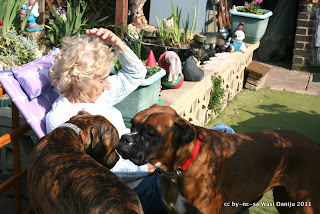
i am sitting writing this in the sun, in a plastic chair in the back garden. at my feet, one of the dogs is giving herself a wash, and the other is having a barking contest with the duck. We've just had a chat with the neighbours about their tree - her mum's looking out for seedlings so my foster mum can plant one too. after a tour of my foster mum's greenhouse, and a pause to spot a newt in the frog pond, and marvel at how many tadpoles there are, and how big, we've sat down to chat about planting seedlings in the cardboard from toilet rolls (something i've heard from another friend), and how i've maybe left it a little late to plant seeds, so maybe will have to go for seedlings instead. still, it might be worth trying a few, and my foster mum promises to give me some runner bean seeds from her crop last year to have a go at planting. 'you've got up to may the 25th to plant your beans, as my uncle used to tell me' she says 'keep them well moist - they like a lot of water, beans'.
she is sitting, relaxing from a morning of working on the garden, extending the space they have for planting. she wants to be able to grow more of her own food, she tells me. i spot a turtle-shaped pot plant i bought for her when i was still a child - she tells me: 'it has a plant in it every year - i always think of you when i put something in there'. from indoors, my foster dad jokes about needing 'grecian 2000' for his hair, while he boils the kettle for the day's 5th pot of tea. he sits down with the crossword, stays in the shade. i am sitting, wearing one of his t-shirts and cardigan - i did some cleaning this morning, and it took the last wear out of the one top i brought with me. the dog settles, lays across my feet. the pond waterfalls splash and trickle, and inside its pen, the duck quacks a reminder of its presence.
i have been reading a blog about minimalism recently (mnmlist.com) and enjoying a lot of what it has to say, wondering how i can hold on to the calm and contentment of this past few days once i go back home, to london, and once i go back to work. i've been ignoring my phone a lot since i've been down here, and the last money i spent was on saturday morning, when i bought an ice-lolly. i suppose it helps that i've barely left the house since i came down on friday.
except for a friend's wedding. it was the loveliest and happiest wedding i've been to in a long while - and being nigerian, i go to a lot of weddings!
on friday afternoon, i joined the bride and groom to be, along with a group of their friends, part of the decoration squad. their reception was to be the next day at the local village hall. over the course of the afternoon and evening, we hung bunting and fairy lights, prettified tables with jam jars of flowers from the back garden. and all around their were other brilliant home-made touches: a giant purple heart, made to match the bunting, a present from the groom's sister; table names held in place by blocks cut by the groom's dad; a hand-made cardboard suitcase to hold wedding cards and gifts.
on the day, the bride wore a dress she'd bought on e-bay ('only used once'!), and the registrar was a friend of the family. myself and another friend sang and read, and another orchestrated the photos afterwards. the wedding breakfast was provided by a local caterer (delicious salads, some quiche and salmon, and three choices of praise-showered desserts - i opted for the double chocolate fudge cake…).
as the day became dusk became dark, the dj took over from the home-made music mix, people hit the dance floor, and the joy that had bubbled up throughout the day spilled over into un-self-conscious jumping and gyrating, shimmying and shaking - joy dance-onified.
and i'm overwhelmed by how much everyone talked to everyone else. and how blatantly people enjoyed each others company. it didn't seem ridiculous that i felt i left with new friends. people i'd never met before with whom i now have plans to organise a piano based sing along at their not yet found new home. people i'd never met before who i've arranged to meet for tea next time i'm in their town. it was a brilliant, lovely day.
in the reflection of my laptop screen, i see a bird alight on the duck pen - look around, and fly off again. and as i look up, i swear i see a swallow heading west. the sun warms my ears, throws dark shapes across the lawn, and my foster parents discuss their grand-children as they pat the dogs.
i am not surprised by my contentment here, by how little i miss the movement and bustle of london. i'm definitely not surprised by how little i miss work. inklings of the possibility of packing it all in now (rather than sensibly saving and waiting until next year) play around the edges of my mind. perhaps it's a short -term thing, but it feels good not to be rushing to this or to that. it feels good to sit and not worry about what next. it feels good to have been able to put all the usual clutter and worry out of my head - for now. i'm hoping i can hold onto this when i go home. hoping i can find it increasingly easy to minimalise, detach a little more. just slow down.


she is sitting, relaxing from a morning of working on the garden, extending the space they have for planting. she wants to be able to grow more of her own food, she tells me. i spot a turtle-shaped pot plant i bought for her when i was still a child - she tells me: 'it has a plant in it every year - i always think of you when i put something in there'. from indoors, my foster dad jokes about needing 'grecian 2000' for his hair, while he boils the kettle for the day's 5th pot of tea. he sits down with the crossword, stays in the shade. i am sitting, wearing one of his t-shirts and cardigan - i did some cleaning this morning, and it took the last wear out of the one top i brought with me. the dog settles, lays across my feet. the pond waterfalls splash and trickle, and inside its pen, the duck quacks a reminder of its presence.
i have been reading a blog about minimalism recently (mnmlist.com) and enjoying a lot of what it has to say, wondering how i can hold on to the calm and contentment of this past few days once i go back home, to london, and once i go back to work. i've been ignoring my phone a lot since i've been down here, and the last money i spent was on saturday morning, when i bought an ice-lolly. i suppose it helps that i've barely left the house since i came down on friday.
except for a friend's wedding. it was the loveliest and happiest wedding i've been to in a long while - and being nigerian, i go to a lot of weddings!
on friday afternoon, i joined the bride and groom to be, along with a group of their friends, part of the decoration squad. their reception was to be the next day at the local village hall. over the course of the afternoon and evening, we hung bunting and fairy lights, prettified tables with jam jars of flowers from the back garden. and all around their were other brilliant home-made touches: a giant purple heart, made to match the bunting, a present from the groom's sister; table names held in place by blocks cut by the groom's dad; a hand-made cardboard suitcase to hold wedding cards and gifts.
on the day, the bride wore a dress she'd bought on e-bay ('only used once'!), and the registrar was a friend of the family. myself and another friend sang and read, and another orchestrated the photos afterwards. the wedding breakfast was provided by a local caterer (delicious salads, some quiche and salmon, and three choices of praise-showered desserts - i opted for the double chocolate fudge cake…).
as the day became dusk became dark, the dj took over from the home-made music mix, people hit the dance floor, and the joy that had bubbled up throughout the day spilled over into un-self-conscious jumping and gyrating, shimmying and shaking - joy dance-onified.
and i'm overwhelmed by how much everyone talked to everyone else. and how blatantly people enjoyed each others company. it didn't seem ridiculous that i felt i left with new friends. people i'd never met before with whom i now have plans to organise a piano based sing along at their not yet found new home. people i'd never met before who i've arranged to meet for tea next time i'm in their town. it was a brilliant, lovely day.
in the reflection of my laptop screen, i see a bird alight on the duck pen - look around, and fly off again. and as i look up, i swear i see a swallow heading west. the sun warms my ears, throws dark shapes across the lawn, and my foster parents discuss their grand-children as they pat the dogs.
i am not surprised by my contentment here, by how little i miss the movement and bustle of london. i'm definitely not surprised by how little i miss work. inklings of the possibility of packing it all in now (rather than sensibly saving and waiting until next year) play around the edges of my mind. perhaps it's a short -term thing, but it feels good not to be rushing to this or to that. it feels good to sit and not worry about what next. it feels good to have been able to put all the usual clutter and worry out of my head - for now. i'm hoping i can hold onto this when i go home. hoping i can find it increasingly easy to minimalise, detach a little more. just slow down.


17 Apr 2011
May 2011 Gathering of the Islamic Community Food Project (London)
Community organising with the earth in mind
"On the earth there are Signs for those of inner certainty, as also within your own selves..." (Qur' an 51: 20-21)
Next gathering : Sun 8th May 2011: Registration details below
Organised by Wisdom In Nature (WIN) with Spitalfields City Farm
Open to people of all faiths and beliefs; Tower Hamlets residents especially welcome. Be empowered: Practicals on the land & grassroots organising with like-minded participants. Develop experience in social change & facilitation - life-enhancing skills so vital in today's world. Hear and share ideas & stories - take small, vital steps to make the imagined real. Bring a team spirit & the yearning of your soul to create a sustainable, more compassionate world for all!..
WHAT TO BRING
COST: £5 per person. Reduced rate for unemployed/regular WIN donors/regular participants (£2).
REGISTER: To reserve your place, please send an email titled 'Register', with your full name to: communityfood AT wisdominnature.org.uk (replace AT with @ & delete the gaps); You will then receive confirmation and further info. Note that each person must register for her/himself only, and registration is for the full day.
Past Posts: www.wisdominnature.blogspot.com/search/label/icfp ; More info: Wisdom In Nature: tel 0845 456 3960 (local rate).
"On the earth there are Signs for those of inner certainty, as also within your own selves..." (Qur' an 51: 20-21)
Next gathering
: Sun 8th May 2011: Registration details belowTime: 11am-4pm
Venue: Spitalfields City Farm, Buxton Street, London, E1 5AR (near Brick Lane). Nearest tubes: *Use either Bethnal Green or Liverpool Street* (both on the central Line and still walking distance) as other local lines are scheduled to be closed during the weekend. Buses D3. Map & Directions: http://tiny.cc/l0nrw
Organised by Wisdom In Nature (WIN) with Spitalfields City Farm
Some people call it a 'food growing project'; others, like Corporate Watch describe it as 'part of a rising social movement that can shake...the global corporate food system'. So, what happens in the Islamic Community Food Project? Who is it for? And what will you be doing if you join in?...
As more people organise from the grassroots, community food initiatives are on the rise. These small steps not only empower, but offer alternatives to the globalised food system that favours multinationals. At the same time, within Muslim communities awareness is growing that Islam offers ecological principles that extend beyond the term 'halal'. This project aims to contribute to a more holistic way of thinking - one that empowers individuals, helps build resilient communities, and genuinely draws us towards a sustainable and more compassionate world.
WHO IS THE EVENT FOR?
-Anyone seriously thinking about being involved with the ongoing project. All kinds of experience and backgrounds are welcome. Also present will be those already involved.
- A background in community organising or Islamic ecological activism is a plus, but is not essential. The project caters for anyone motivated to contribute. You will have more to offer than you may now imagine!
EVENT CONTENT
-This is the fourth gathering.
-We will participate in a hands-on practical on the land with Spitalfields City Farm.
-There will also be a workshop with Wisdom In Nature: Existing participants will give a brief presentation about the project to help everyone get up to speed. We will then get creative, yet realistic, as we co-organise our next key step on our journey - a stimulating, fun, open event for July on the theme of the project: We will ask ourselves, what would we like to see there? And what can we each offer? (The outline so far centres on: a campfire, picnic, workshops, talks). The collective spirit in organising will be of co-learning and being empowered, which will include taking responsibility. The project is ongoing, and for those who want to continue there will be follow-up activities for organising and taking action together.
WHAT TO BRING
Please dress for the weather and bring sturdy footwear. Tea/coffees/refreshments will be provided. Please bring food to share for lunch.
COST: £5 per person. Reduced rate for unemployed/regular WIN donors/regular participants (£2).
REGISTER: To reserve your place, please send an email titled 'Register', with your full name to: communityfood AT wisdominnature.org.uk (replace AT with @ & delete the gaps); You will then receive confirmation and further info. Note that each person must register for her/himself only, and registration is for the full day.
Past Posts: www.wisdominnature.blogspot.com/search/label/icfp ; More info: Wisdom In Nature: tel 0845 456 3960 (local rate).
Gathering Momentum with the ICFP...
Our next gathering of the Islamic Community Food Project (i.e. ICFP!) is due on May 8th. So, let's take a look at of some of the ideas that are brewing..!
Firstly, we've been brainstorming ways of keeping the creativity and energy going between the gatherings at Spitalfields. We went through a facilitated exercise a couple of weeks ago and captured ideas that were shared on this very topic. See flip chart, below. To enlarge, simply click on the photo...

We'll develop this further and have already started to act on it as a team.
Participants in the project are also excited about jointly organising a potential action in July, in the form of a stimulating, fun, open event on the theme of the project. At the May gathering we will carry this forward and ask ourselves, what would we like to see at this July event? And what can we each offer?
The outline so far centres on: a campfire, picnic, workshops, talks. These, and other ideas raised, were caught on this next flip chart:

So, the next step will be the next gathering, where we will share more ideas, get organised and make the imagined real! The date for this is Sunday 8th May 2011, and it will be at Spitalfields City farm. We'll be putting a post up about this very soon. Stay tuned, and come join in if you want to be part of this movement for organised social change...!
Firstly, we've been brainstorming ways of keeping the creativity and energy going between the gatherings at Spitalfields. We went through a facilitated exercise a couple of weeks ago and captured ideas that were shared on this very topic. See flip chart, below. To enlarge, simply click on the photo...

We'll develop this further and have already started to act on it as a team.
Participants in the project are also excited about jointly organising a potential action in July, in the form of a stimulating, fun, open event on the theme of the project. At the May gathering we will carry this forward and ask ourselves, what would we like to see at this July event? And what can we each offer?
The outline so far centres on: a campfire, picnic, workshops, talks. These, and other ideas raised, were caught on this next flip chart:

So, the next step will be the next gathering, where we will share more ideas, get organised and make the imagined real! The date for this is Sunday 8th May 2011, and it will be at Spitalfields City farm. We'll be putting a post up about this very soon. Stay tuned, and come join in if you want to be part of this movement for organised social change...!
6 Apr 2011
An Islamic Ecological Activism: Uniting the Strands
Inter-connectedness
A core quality of an authentic spiritual tradition is that it offers practices and guidance for its followers that can reveal holistic solutions to the challenges of the time. I believe that this is true of Islam, yet I also believe that there is much work to be done to uncover the essence of the tradition, such that will allow its beauty and relevance to be known in the challenging times we find ourselves in.
 In my own life, I find myself in a process of re-evaluating and gathering the different strands that represent my own core values and the different facets of my existence. Whilst one of these strands is the spiritual, however hard I look I can find no separation between this and other strands that represent me - my relationships with others, my means of gaining income, the passions to which I give my time, and so on. Neither can I separate these aspects of me from the wider community and political landscape. Life is just too interconnected.
 This process of gathering is also reflected in my journey of initiating and co-participating within the UK’s first local Islamic ecological activist group.
Whilst my journey into initiating Wisdom In Nature arose in part out of my noticing the need for more ‘environmental’ awareness, more fundamentally it emerged out of sensing more intimately that we live in an inter-connected world - that humanity is not separate from nature, but is a part of it. My increasing appreciation of the latter has strong resonance with my deepening appreciation of the Islamic concept of tawhid, of Oneness or Unity. Ultimately everything arises from a single source, and to attempt to engage in life’s challenges by compartmentalising them - albeit convenient and with some limited use - cannot lead to real, long-term solutions and would go against the true nature of things.
This interconnectedness is increasingly self-evident in a world in which communication can travel wide and far so rapidly, and in which we have developed powerful, albeit questionable, technologies, both at the macro and the micro level, which very quickly can have profound far-reaching consequences - from the genetic modification (GM) of food, to advertising and nuclear technologies for instance. Thus, any awareness that inter-connectedness is a fundamental truth of existence is being amplified by the state of the world today.
To me, ecological activism - which is the activism that I strive to participate in - is activism that is guided by an awareness of this interconnectedness. It includes the so-called ‘environmental’ but is not limited to it. With the principle of tawhid being such a core concept in Islam, activism that is Islamic must also, I believe, be ecological. We must act in a way that honours the relationship between the different strands of existence however much our cultural norms might choose to differentiate between them.
To me, ecological activism - which is the activism that I strive to participate in - is activism that is guided by an awareness of this interconnectedness. It includes the so-called ‘environmental’ but is not limited to it. With the principle of tawhid being such a core concept in Islam, activism that is Islamic must also, I believe, be ecological. We must act in a way that honours the relationship between the different strands of existence however much our cultural norms might choose to differentiate between them.
The name to reflect the reality
Hence, whilst I concede that Wisdom In Nature was initially called the ‘London Islamic Network for the Environment’ (LINE), the word ‘environment’ - which can imply separate-ness, as well as a competing of issues rather than their integration with respect to the natural order – was amongst the main factors that led us to re-evaluate and change that name. Indeed, the ecological challenges we face and the potential solutions are, in one sense, not bound by the environment but are in us. We have caused the problem, and thus it is our consciousness and patterns that must be transformed. It is for us to become the solution.
Consequently the word ‘nature’ in our new name, Wisdom In Nature, refers in part to our innate nature, or as in the Qur’an, to the fitrah. By living according to the fitrah or our natural disposition - which necessitates inner work and getting to grips with the nafs or ego and its disguised compulsions – we can with more ease live in harmony with the wider creation, or the ‘environment’.
Simultaneously, the laws and principles in nature can offer insights and inspiration that can move us to wholesome solutions in tune with the principles in creation that creatively nurture life. The Qur’an continually guides us to witness and observe the natural world which it refers to as ayat or ‘signs’ that when reflected on with receptivity can simultaneously draw us closer to God, and open us to reconnect to the fitrah.
In addition, having had Islam in our name easily led to assumptions about who we are and what we do. If we are an Islamic group, what does that really mean? Are all ‘Islamic’ groups very similar, or are they more diverse than we might like to think? We were also aware that we were sometimes wrongly considered a ‘Muslim’ only group by those somewhat over-enthusiastic to compartmentalise, yet we enjoy and are grateful to have the presence of participants that do not call themselves Muslim. The process, thus, of defining and re-articulating what we call ourselves was helpful in re-establishing what we are really about, what we understood to be the core values of Islam, rather than simply slotting the term into a name.
The means and the end
Whilst the grassroots and activist nature of the group can be seen in what we do, less visibly yet more importantly it is intrinsic to our process – i.e. how we do things. Rather than being led from the top-down, we lean strongly to using consensus-based, bottom-up processes that draw out the diverse voices, creativity, and wisdom of the group. We might also consciously bring in awareness around gender, power relations, privilege and class for example, helping to build cohesiveness and community as we move forward with our ecological work.

We used these kinds of processes within the numerous meetings we had to complete our colour photo-booklet ‘Islam & Climate Change ~ A Call to Heal’. This took considerable time, but we gained a strong sense of ownership that helped take it to completion. None of our members were, or wanted to be paid (that includes myself!), to complete the project, and with minimal funds in our account we still beat the odds to finish it. The end-product clearly reflects the value we hold dear and the care that has gone into it.
Another aspect of our grassroots ethos is that we do not accept donations from government or corporations. Indeed our day-to-day funding comes entirely from donations from individuals. Whilst we need and are actively inviting more individuals to donate regularly, we remain true to our principles, despite there being the attractions of numerous external sources to whom we could go.
Thus, we have discovered ourselves to be a group that in its understanding of the term ecological, aims to weave together the different strands of activism - the inner, social, process, economic and ‘environmental’, within a common value system. Rather than simply campaigning for people to recycle more for instance, valuable though that is, we work to link issues and look deeper into them
Opening the potential
There is a huge potential waiting to be born out of joining together theological knowledge and spiritual maturity with practical work to connect to the land and awareness of grassroots organising and social change. This is a potent combination that draws together the desire for social change within a world view of compassion and love. Separating the spiritual from the outer and the active is an illusion, and this is touched on in Surat Al-Ma ‘un, Chapter 107, in the Qur ‘an.
 Our intention with Wisdom In Nature is to continue working within this integrated framework, a natural extension of which is to support, where we are able, the development of local initiatives that feel comfortable working in a similar way. Our community food project with Spitalfields City farm is an early example of this effort.
 With our main geographical focus being in London and more recently in Brighton, as we draw more willing volunteers as well as funding from individuals, we look forward to collaborations and a growing contribution to an ecological activism as we further our work in these locations.
In whatever way you can, we invite you to join in.
----
This is a version of an article that was originally published on the Muslim Institute website.
26 Mar 2011
Islamic ecology in the classroom
Ecology and community cohesion
Rokeby School's collaboration with the Climate Change Youth Development Trust (CCYDT) gave 20 of their pupils the opportunity to participate in weekly workshops on faith climate perspectives. One of the faith perspectives was to be the Islamic, and I had received invitation to deliver that week's workshop at this East London school. Alongside motivating action through faith, the aim, was to simultaneously nurture community cohesion. This conveniently resonated with my own value system of viewing the social ecology as inseparable from the wider one. I was excited to be a part of this.
Facilitator's homework
Prior to the workshop, I had been well primed as to the range and nature of the pupils by the director of CCYDT, Sabino Miranda: I knew that the pupils would be boys, mostly Muslim, but also Hindu, Christian and no formal faith, within an age range of 13-15 years, with a few a little older.
Most workshops I had delivered have been for adults and so I decided to reach out to my good friend and colleague across the pond, Mohamad Chakaki, to explore and hear ideas. Mohamad has given many more workshops to school age children than myself and I value his thoughts.
My ideas following these interactions were as follows: Keep it varied, keep it moving, and allow for some healthy disorder!
Making it universal
I had 1½ hours. We began with a go-round ice-breaker so everyone spoke from the start. Then, rather than going straight into any Islamic eco-theology, I had decided it might work better to explore principles through exercises that stimulated each participant to connect with their own inner compass/sense of ethics first, and then being given a chance to share. I attempted to frame this in a universal language to support inclusively.
Such a foundation can, I feel, potentially lend itself to the terminology and principles associated with any faith tradition. The group would thus be better equipped to look at what initially emerged in an open way, and then later in the workshop, within the framework of core Islamic concepts that underlie the outward aspects of the faith, including action to restore ecological balance.
The first exercise was the 'spectrum line', which is designed to draw out viewpoints and discussion on different issues. Participants choose to stand anywhere along the length of an imaginary line according to how strongly they agree or disagree with a statement. E.g. "Can we have too much of a good thing?" (to later explore the idea of mizan/balance). Varied ideas sprung from this exercise allowing for a healthy spread of viewpoints.
Then, using a numbering system, the pupils were divided into four groups, each taking on one of two questions for discussion (e.g. "Think 'natural world'. Think 'human communties'. Does the natural world have anything to teach us?"). They had fifteen minutes for this which I thought this might end up being too short. However, they got their ideas down faster than I anticipated. Their presentations were both intersting and varied in content.
Weaving it together
Afterwards I attempted to weave into a short talk what had emerged from the exercises whilst drawing on key Islamic concepts. I followed this with a five minute slide-show on Muslims engaged in ecological action (Although they can have a place, I like to avoid too many visuals preferring instead to be more directly relating with those present). There was then space for questions, a bit of last minute sharing, and then the distributing of the WIN photo-booklets on Islam & Climate Change for the pupils.
Afterwards I attempted to weave into a short talk what had emerged from the exercises whilst drawing on key Islamic concepts. I followed this with a five minute slide-show on Muslims engaged in ecological action (Although they can have a place, I like to avoid too many visuals preferring instead to be more directly relating with those present). There was then space for questions, a bit of last minute sharing, and then the distributing of the WIN photo-booklets on Islam & Climate Change for the pupils.
All in all, it was a fulfilling day, and although I am sure I had the luxury of a pretty focussed group of children, I'm looking forward to to engaging more with a younger age group as I am able.
Post workshop reflections
Here are some reflections/ideas/'things' I feel I want to make note of for myself following this workshop. Happy to hear anyone else's reflections on any of these areas as well..
- With children, short varied exercises can engage them better than something that goes on for too long or too much of the same.
- Taking a group of children deep into Islamic eco-theology in a short time can be challenging, and is indeed impossible at 5pm when they've been at school since 8! On the other hand, giving a flavour of 2 or 3 basic concepts such as fitrah (natural disposition/innate goodness, which some seemed to grasp really well), mizan (balance), and tawhid (unity/oneness) is feasible to weave effectively into a single workshop on climate change dynamics and taking action.
- I found I could have addressed key themes/topics - that were raised by the children within the workshop - better than i did during my short talk at the end. What I might do next time in a similar situation is actually note down keywords as the themes/topics came up, and glance and reflect on them at appropriate times before I give a talk.
- A certain level of disorder is to be expected from time-to-time - not everyone can stay focussed the whole time. Thus, a limited degree of chaos or 'play' alongside the intended sequence of events seemed to act as a healthy release that then allowed a more naturally guided return to the formal thread of activities. That's how it felt with this kind group, but I'd be interested to hear of anyone else's experiences!? How much 'disorder' is healthy?...
- I arrived at the school just 5 minutes before the workshop (due to a misunderstanding over timings) so had less time to organise e.g. pre-prepare some flip-charts, familiarise myself with the space etc... than I had imagined. This however pushed me to think more in terms of essentials and go more with instinct, which I have found can be a strength. On other occasions though, I am aware that too little time to settle before a workshop does little to help me be present.
- With regards the 'spectrum line' exercise, after drawing out some thoughts from a group of participants bunched close together, thought-provoking questioning can tap into deeper layers. This of course needs balancing with the comfort level of the person being questioned and drawing our a variety of viewpoints in the time available.
16 Mar 2011
Personal Story 3, by Amnah Ali: Islamic Community Food Project at Spitalfields
Arriving at Spitalfields City farm on a sunny Sunday morning armed with a rainproof jacket and impractical boots, I had little preconception of what the Islamic Community Food Project would entail. But the chance to create with my own two hands was incentive enough to go.
I had been thinking about growing my own food for awhile but my inability to sustain indoor plants for longer than a few weeks usually dimmed my hope. If I couldn’t keep a little plant alive would I be able to manage tomatoes; marrows; or even basic herbs. My success rate with coriander was abysmal and I couldn’t bear thinking about the chives.
However, being able to weave my desire to grow with Islamic principles of patience; adab (etiquette); taqwa (God consciousness); and beauty was enticement. As was being able to do it all under supervision of Wisdom In Nature members; Muzammal and Wasi, and the lovely Naomi Glass!
So I arrived, uncertain but relaxed, ready to take on any task given to me. First the boots were discarded; and the bag; a pair of wellies embraced. Then I was raking soil; clearing weeds; replanting rosemary; chitting potatoes; and getting acquainted with a handful of militant spiders. I named them all Henry and hoped none had decided to journey home with me that evening. I was even given my first sprig of lemon balm (a ‘natural air freshener’ as the gutters were being cleaned and emitting a not-so-fragrant smell).

After a morning of sun soaked toiling, we had a group lunch where once again I witnessed the generosity of the group. Being as usual, slightly disorganised and forgetting to bring lunch to share, the group kindly decided to feed me. I realised the importance of community and the bounteousness of sharing. It again made me think of the way we chose to live today: the isolated ‘me’ culture with the one-two person meals from your local supermarket, ingested by you in your home, whilst your unknown neighbours do the same. Meanwhile the ingredients for your meals come from a range of countries; communities who may not have the resources to eat the food they put on your plates. Is there any pleasure to be had in food that comes from discord or sorrow? Whilst I was aware my choices were affecting many people rarely did it feel tangible as it did in that moment.
I saw and felt firsthand that growing the food you eat changes your relationship with food. In my mind’s eye the food is suddenly imbued with blessings: the love; time; affection you gave to it in its growing phase. The process of growing it and then allowing it to nourish you and your beloved community is God consciousness in action. Is it possible not to be grateful when the food you’ve grown is ingested by you? The mercy that it grew, under your protection, when you were nervous it wouldn’t, and now it nourishes your dearest?
We had workshops – wonderful, free, organic workshops – in the afternoon which challenged our perceptions and called for us to really look at how responsible we were when it came to food. I realised that my middle classed upbringing and lifestyle gave me the freedom to make choices – to be fair-trade; organic etc. Yet, I still was unable to really take action. Since then I have ventured baby steps into home gardening. My balcony now supports coriander; chives; and basil. I look at them tenderly and consistently, like an overzealous new mother, hoping that they might survive the spring chill and that my sabr and taqwa will generate nourishment: physical and, spiritual.
Subscribe to:
Posts (Atom)


