Pages

Showing posts with label democracy. Show all posts

28 Apr 2013

Peace News Summer Camp 2013: Taking a Lead from the Global South, 25-29July, Norfolk

 Here's info about a progressive annual camp organised by our friends at Peace News (Note: It is during Ramadan)....
 ----------

PEACE NEWS SUMMER CAMP 2013: TAKING A LEAD FROM THE GLOBAL SOUTH
Thurs 25 July - Mon 29 July 2013, near Diss, Norfolk

Book your tickets online here: http://tinyurl.com/pnsummercamp2013tickets

This year’s camp is organised by activists of colour/people with a global majority heritage. We invite you to join us and others from across the broad spectrum of the peace movement and radical activism for five days of workshops, entertainment and network building!

Taking a Lead From the Global South will be a core strand of the workshop programme, which will include:

- Standing our ground: Peace Communities nonviolently taking back their land in Colombia
- Between NATO, the warlords and the Taliban: Peace activism in Afghanistan
- Finger on the trigger: Western nuclear terrorism since 1945
- Demonising Muslims: Why Islamophobia is more popular than ever
- After Chavez: Social movements in Venezuela
- Turning the world upside down: Global feminisms
- Deschooling society: A Black perspective
- A culture of resistance: The story of Pan-Africanism

ABOUT THE CAMP
When: 25 – 29 July 2013
Where: Near Diss, Norfolk

Peace News Summer Camp is an annual five-day, family-friendly event that attempts to embody many of the characteristics of the future society towards which we’re working – inclusive, democratic, participatory, renewably-powered and environmentally sustainable. It’s an opportunity for a broad spectrum of activists working for radical social change to come together and develop our goals, priorities, knowledge, strategy, skills and networks in support of our different movements, be they anti-capitalist, anti-cuts, anti-racist, anti-war, counter-militarist, disability, environmental, feminist, LGBTQ, or other movements for liberation.

There will be workshops and discussions, practical skills sessions, delicious vegan food, music, film, and participatory entertainment, a bar, a campfire, and activities and facilities for kids and families.

The theme for this year’s camp is TAKING A LEAD FROM THE GLOBAL SOUTH. We’ll be creating opportunities to:

- celebrate what movements in the Global South have contributed to movements in the UK
- discover what movements in the North can learn from those in the Global South
- make global connections between local struggles
- think about what it means to build real solidarity with activists in the Global South

BLACK LEADERSHIP

For this fifth Peace News Summer Camp, for the first time the organising committee are all of global majority heritage. This is an expression of the commitment of Peace News, and of the Summer Camp, to work against racism, and to give an opportunity for new ideas and voices to enter. The new organising collective has added these dimensions to the agenda of the camp:

- celebrating what global majority activists have accomplished in struggles for social change around the world
- helping us better understand and overcome the racism of the societies in which we live
- helping us to understand the connections between racism and other forms of oppression, including those based on disability, class, gender, sexuality and age
- giving us an opportunity to learn more about how racism is affecting our struggles and ourselves and to think about how we can move forward in rooting it out

Peace News Summer Camp is an inclusive event, open to everyone who’s been before, and to everyone else – from all racial and cultural backgrounds – who would like to explore radical ideas and share social change skills.

TICKETS & FOOD

The camp costs £20-£70 depending upon income (for those over 14). Payment can be made by cheque, online or by phone:
- online purchases here [http://peacenews.info/civicrm/event/register?reset=1&id=6]
- 0207 278 3344 for purchases by phone
- Send cheques (payable to “Peace News” to Peace News, 5 Caledonian Rd, London N1 9DY), explaining how many tickets you’re purchasing and at which rates

Food (3 meals a day and drinks) will cost £6-£11 a day for over-14s, depending on income, and should be ordered before the camp starts. Individuals meals will be available to buy at the camp. Food tickets will be available from late April. 


24 Sept 2012

The Challenges of Lessening Hierarchy: WIN Changes its Structure

One of the challenges for any group that strives to work without or with a minimal concentration of power is, how it can ensure accountability when there is no 'leader' or 'supervisor' for members to report to, and thus the absence of the typical structure prevalent in most organisations.

Another challenge is, how the group will make its key decisions, when there is no one person who will make the final decision for the group, and when we want to value all views including those of minorities (and which thus rules out majority voting).

As WIN is a group that  has always strived to minimise hierarchy, developing workable mechanisms for accountability and effective processes for inclusive group decision making were important challenges we had to face. 


An attempt at a horizontal structure: Adaptation needed

With regards to accountability, due to considerably varying levels of commitment and attendance - especially in the early stages of the group forming - and with a quite limited degree of face to face contact amongst members, we found that an entirely horizontal structure was not working for us. Not everyone was committed to completing their agreed tasks and not everyone was committed to exploring this, making it harder to talk about and thus resolve. We thus decided to open up two roles: A 'Chair' role, and a 'Support to Chair' role. 

Accountability

Those in these roles would have primary responsibility to help guide issues or conflict within the group to a point of resolution. While useful, the challenge was then as to how the Chair and Support could themselves be held accountable to their responsibilities within their respective roles as such, and otherwise.  We created somewhat of a framework for this by lessening their power: the Chair and Support could not dictate to the group (although they could through consulting between themselves make quickly needed minor decisions not significantly affecting the group), and were only to be in their role in certain situations. We also ensured a regular space at our review meetings for members of the group to raise anything that might be troubling them. Facilitation at these meetings would, to varying extents, be shared by several individuals. 

We thus had an approach that whilst not perfect, was certainly  workable, and did to a reasonable extent serve the group well, indeed much better than the original vague structure. 


Group Decision Making

In terms of group-decision-making, as we were not going to use majority voting and did not want anyone to 'dictate', we had to work hard with faith and patience, and we were pushed to be more creative. Through facilitation training, research and group experience, we developed a form of consensus-decision-making that drew on qualities of spaciousness and reflection ensuring a foundation for rich and creative decision-making for WIN. 

I was surprised with the results: meetings in which we used this approach typically left us feeling incredibly liberated and empowered. It felt like a real democracy, and to me is in accordance with core Islamic principles. Ultimately, religion, must be liberating if it is authentic.


The Horizontal wish remains

Although I was Chair of the group, and was satisfied that the above setup was appropriate for our group at the time, I ideally wished for the group to be in a situation in which we could let go of the need for its Chair and Support role and work more as a co-op type structure.

Over recent months, triggered by my wish to step down as Chair, we had several discussions within the group as to what action or structural changes we make within the group. After much deliberation, and with courage, the group has now decided that we are letting go of these roles. So, we now have no 'Chair' and no 'Support to Chair' roles for WIN, thus reducing hierarchy within the group.


The Fruits of Dialogue

I was both surprised and relived that we came to this decision, and am grateful to my fellow WIN Reps, Elizabeth and Shumaisa for recognising the individual and collective responsibilities needed for our new set-up. While we need to give time to consider how our new structure functions best, I am also grateful that we continue to have strong self-examining qualities, and that while we strive to act in the world, which we are a part of, with some success we also work on ourselves to mirror the world we want to live in. 

Cheers both!

10 Jul 2012

Beyond Expectation: Participating in a Radical Food Movement Event (Food Sovereignty)


Greater than Expectations

This was not my first event on food justice - I had been to dozens. Yet, this one Sunday in July, coming out of Chingford station, walking through woodland that happened to be slippery, slopey and still, I weaved my way to Organiclea, a workers food growing cooperative on the edge of London, to attend a food justice event that went far beyond expectation. Organised by the food sovereignty movement, the gathering exuded warmth, embraced a participative ethos that helped draw out inspiration and wisdom, and produced many moments of humour - it felt a bit like coming 'home'. 

The event was attended by around 100 people - drawing fresh-faced participants, with gentle natures, and who seemed to have vision along with a maturity that enabled them to be good listeners. Whether I expected it, or not (as was the case!), this was a special gathering.


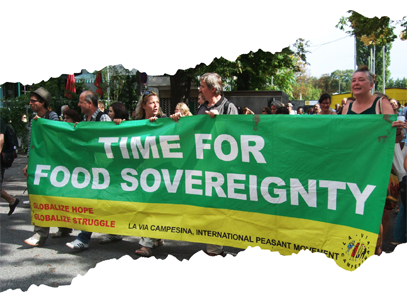
Introducing Food Sovereignty..

Image via: www.theprisma.co.uk
The aim of this event was to further develop the Food Sovereignty Movement - For those who are new to the term (and I too am learning), "food sovereignty is the right of peoples to healthy and culturally appropriate food produced through ecologically sound and sustainable methods, and their right to define their own food and agriculture systems". The movement emerged through mobilisations of small-scale farmers around the world and its ethos can be captured in six pillars: It..


  • focuses on food for people
  • values food providers
  • localises food systems
  • puts control locally
  • builds knowledge and skills
  • & works with nature

(Conveniently(!), these pillars have a strong resonance with several of WIN's s core strands: in particular with earth & community, a deep democracy, climate justice, and engaged surrender.)


Beyond theory: Embodying the pillars

Although the above pillars theoretically articulate a set of principles, it was uplifting to experientially know that this event was an embodiment of them. Much of the delicious food we were served was produced locally and in season, there were plenty of opportunities to share ideas and knowledge, the event was facilitated with awareness and humour, and we were in a food growing project managed through cooperative principles.    


Ideas from small groups

To give an example of one of the sessions on the first day,through sub groups we considered, 'What needed to change?'

After a storming of ideas, a range of discussion and a gathering of the threads that were emerging, our group of around six came up with three key strands: as to 'what needs to change':
1) TIME: the fact that the dominant economic system has a monopoly on people's time;
2)  LAND: The dominant structures restrict (through costs and policies) peoples access to land - in our small group discussion, we also touched on the fact that so much of income can go into paying for a roof over our heads (which feeds into point 1); and
3) VISION: We need more people to have the vision to create an alternative reality: more sharing of skills, knowledge and stories.

This was a two day event and due to pre-existing commitments I attended the first day only - on the second, there were sessions on co-developing actions and strategies.


Leaving Affected..

Through the day, I met some people whom I already knew - people from Brighton, from Earth Activist Training & permaculture, and anti-GM Food campaigning; I heard stories of how people had left the usual 9-5 treadmill, had lessened their expenditures (I spoke with two people who lived on a boat and one in a truck), and had stepped into a place of greater freedom and possibility; I felt affected by the presence of such wonderful people; I prayed zuhr (Islamic midday body-prayer) in a massive greenhouse between rows of edibles, and I left feeling exhilarated, inspired, and looking forward to sharing my experience with and beyond WIN, and excited as to what comes next for myself and grassroots activism, as the juice of this movement expands and spills into the wider consciousness and strands of activism in the UK, Europe and the world.

© Muzammal Hussain

19 Jan 2012

Empowering Communities: The Possibility of Decision Making as a Spiritual Experience

Consensus-decision-making is a process, which through experience, I have developed much faith in.  It's a level of faith which not everyone carries, and indeed some people carry a degree of scepticism, while a few demonstrate a clear aversion to it! The latter, I have found is often due to a misunderstanding about what consensus is (not everything named 'consensus' is 'consensus'!) coupled with an aversion to trying it out with the necessary commitment. 
 
A workshop I delivered a few days ago on consensus-decision-making at a monthly meeting of the Soteria network Brighton group - a group that I am a part of -  was attended by a range of people that held a variety of opinions about the extent to which consensus can work. Comments at the start revealed this, for instance, something like, "I expect it takes a painfully long time", to "dictatorship is best" to " I think it can have something positive to offer". 

My challenge on this occasion was in a number of ways an uphill one. It seemed that nobody in the group of about fifteen had been through a formal consensus process before - and although I had managed to secure an-hour-and-a-half for the workshop, a realistic time-frame in which to take a group through consensus, is at least half a day. 

My co-facilitator for the first part of the workshop, which consisted of an ultra-fast outline of what consensus is, was fellow Soteria member, Yasmin, who I had taken through a more detailed exploration a week earlier. For the latter four-fifths, I was on my own.

After consensus was introduced by the two of us, I facilitated the group through an experience of the consensus process, with the aim of answering a purposeful question - an exercise in its own right - which the group was to make a decision on. The process went smoothly at times and was a struggle at other times - as would be expected particularly given that it was a first for the group - but the result was in some ways better than expected given the challenges.  

The group came close to reaching consensus - we nailed it down to several statements which would have needed time to prioritise and make minor amendments to. Consensus would have been the next natural step. The result from this angle, was a positive one (although at the time I was a little disappointed we didn't quite get there). 

Although, almost all of the group had also given the process a good shot and no doubt gained something from it, whether they use consensus decision making or not will be a choice the group will soon make for itself. Either way, elements of the exercise point to underlying principles and attitudes that can be used to help equalise power and draw out deeper wisdom in a group, even if the formal process is not taken up.

For myself, with time to reflect, I have pinpointed potential ways of improving the workshop. Allowing more spaciousness and time to explore the issues along with a couple more breaks; A co-facilitator (for a group this size, it's a task to capture all ideas onto a flip chart and being present at the same time); Some small group work; And perhaps inviting those who felt they could commit to the process to attempt the exercise, with others quietly observing, on this first occasion, as a way of gently breaking the ice. 

Consensus does take time. It requires of us patience (sabr) and a commitment to the process. "As along as it takes" was a refreshing comment I heard in a subgroup at Occupy LSX. My own experience is that, when combined with a quality of spaciousness and trust, even though consensus is not for all decisions, it is nonetheless a process that can empower a group beyond any other decision making process I have come across. Indeed, the experience can, I believe, be a spiritual one, as we move out of "I"-ness into something more whole.

In the Islamic tradition, decision making through mutual consultation is given its due importance:

"Far better and more lasting is what God will give to those who believe and trust in their Lord; who shun great sins and gross indecencies…..; conduct their affairs by mutual consultation…" (Qur' an: 42:19)

Within many communities, including Muslim ones, there is effort to be made in developing our capacities to engage more fully, more compassionately, in deciding on things that affect us, together - letting go of the "I", and building real communities. I too have a need to nurture this capacity within myself. I am also aware and grateful, that in our present day context, there are movements and people I can learn from. Indeed we have one another, and within a reality of a Higher Presence. In our present day context thus, whilst we might sense dis-ease, we may through contemplative engagement also discover the remedy. 

© Muzammal Hussain


7 Nov 2011

WIN's Second Core Strand: 'Deep Democracy'


The Deep Democracy strand comprises an intention to move:
Away from concentration of power amongst the rich and privileged;
towards
more equalisation of power that honours diversity, draws out consensus and empowers all.


Democracy: Beyond the Superficial

Deep democracy aims to draw out the diverse voices and tap into the wisdom each brings. The protests of various social movements around the world are indicative of the failure of  superficial forms of democracy; the phrase “we are the 99 percent” is a voice representing the masses of people whose lives are exploited at the hands of the 1 percent.   

The concentration of power in the hands of a few leads to marginalization of voices that undermines the wholeness of individuals, communities, and ultimately, our world. Greater wisdom emerges when people actively listen to each other.   Putting the time into processes conducive to deeper dialogue often also saves time in the long run that may otherwise have to be spent on resolving conflicts and undoing damage to people and ecosystems.    


Can Process be Sacred?  

The Qur' an states:
"Far better and more lasting is what God will give to those who believe and trust in their Lord; who shun great sins and gross indecencies…..; conduct their affairs by mutual consultation…" (Qur' an: 42:19)

Read full piece>>