

6 Feb 2014
Sustaining Resistance, Empowering Renewal: Tools for Effective and Sustainable Activism (Devon: June 2014))
A notice from our friends at Seeds for Change...
Sustaining Resistance, Empowering Renewal: Tools for Effective and Sustainable Activism (Devon)
This
workshop offers personal and collective tools to make our activism more
effective. It offers space to reflect and analyse, helping us to stay in it for
the long haul, create personal sustainability and bring continuity to our
movement building. The workshop aims to help us stay
inspired, nourished, empowered and creative. It aims to help ensure the
collective dimensions of our activism exemplify the values we struggle
for.
The workshop will use ecological/systems thinking, radical analysis and participatory learning methods to help explore our activism and how we can create strong social movements. It offers practical methods for engaging in the inner work that underpins effective social change work. The workshop venue, on the edge of Dartmoor, provides ideal conditions for reflection, healing and renewal.
The course is offered by the ecodharma collective (www.ecodharma.com) and Seeds for Change (www.seedsforchange.org.uk).
Bursaries may be available. Places are limited.
Application deadline: 3rd March 2014. For more information or an application form please call 01865 403 134 or email: Kathryn [AT] seedsforchange.org.uk
Sustaining Resistance, Empowering Renewal: Tools for Effective and Sustainable Activism (Devon)
A 9 day residential workshop in rural Devon, 17th-26th June
2014
The workshop will use ecological/systems thinking, radical analysis and participatory learning methods to help explore our activism and how we can create strong social movements. It offers practical methods for engaging in the inner work that underpins effective social change work. The workshop venue, on the edge of Dartmoor, provides ideal conditions for reflection, healing and renewal.
The course is offered by the ecodharma collective (www.ecodharma.com) and Seeds for Change (www.seedsforchange.org.uk).
Bursaries may be available. Places are limited.
Application deadline: 3rd March 2014. For more information or an application form please call 01865 403 134 or email: Kathryn [AT] seedsforchange.org.uk
9 Jan 2014
Register Now! Permaculture Intro Course (Oxfordshire): Sat May 10th 2014
We live in times that require the building of wholesome and resilient alternatives. Permaculture is a way of supporting us to do just that.
We are delighted to publicise the following course which takes place at Willowbrook Organic Farm in Oxfordshire in May 2014.
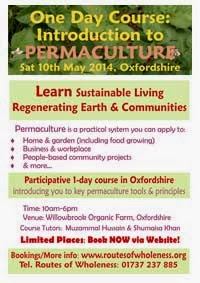 This
is an introductory day that promises to be fun, educational and transformative!
There will be opportunities for networking with other course
participants.
This
is an introductory day that promises to be fun, educational and transformative!
There will be opportunities for networking with other course
participants.
Venue: Willowbrook Organic Farm, Hampton Gay, Oxfordshire.
Date:: Saturday May 10th 2014
Times: 10am-6pm
(Advance Booking Only: see link below)
Permaculture is a practical system for sustainable living, based on observing principles and patterns in nature. By maximising relationships in living systems, permaculture has empowered people worldwide to develop dynamic, resilient projects that work with nature, rather than against it. Whatever scale or aspect of human living, whether the home and garden, community or congregation space, or one’s own life and career, permaculture can be applied to each situation.
This interactive taster day will introduce you to some of the fundamental tools and principles that can be used to design sustainable, resilient projects.
The course content will include:
Course fees £55 standard rate / £45 concessionary rate
(Advance Bookings Only)
Food: Teas will be provided; Participants will need to bring a packed lunch/any snacks.
Visit 'Routes of Wholeness' for More info / to Book: www.routesofwholeness.org
To support a rich learning space, we are limiting participant numbers to a small group size. If you know you want to participate on the course, we recommend you book as soon as possible in order to secure your place.
-------------
We are delighted to publicise the following course which takes place at Willowbrook Organic Farm in Oxfordshire in May 2014.
Learn
Principles for Sustainable
Living
& Regenerating the Earth &
Communities:
INTRODUCTION TO PERMACULTURE: ONE-DAY
COURSE
Organised by 'Routes of
Wholeness', at Willowbrook Organic Farm in Oxfordshire. Venue: Willowbrook Organic Farm, Hampton Gay, Oxfordshire.
Date:: Saturday May 10th 2014
Times: 10am-6pm
(Advance Booking Only: see link below)
Permaculture is a practical system for sustainable living, based on observing principles and patterns in nature. By maximising relationships in living systems, permaculture has empowered people worldwide to develop dynamic, resilient projects that work with nature, rather than against it. Whatever scale or aspect of human living, whether the home and garden, community or congregation space, or one’s own life and career, permaculture can be applied to each situation.
This interactive taster day will introduce you to some of the fundamental tools and principles that can be used to design sustainable, resilient projects.
The course content will include:
- What is permaculture?
- Introduction to permaculture ethics and principles
- Nature observation
- Social permaculture
- Permaculture as a design system
- Applying permaculture
- Next steps
Course fees £55 standard rate / £45 concessionary rate
(Advance Bookings Only)
Food: Teas will be provided; Participants will need to bring a packed lunch/any snacks.
Visit 'Routes of Wholeness' for More info / to Book: www.routesofwholeness.org
To support a rich learning space, we are limiting participant numbers to a small group size. If you know you want to participate on the course, we recommend you book as soon as possible in order to secure your place.
-------------
27 Dec 2013
What We Got Up To In 2013: Islamic Ecology ~ Permaculture ~ Facilitation
Peace
all,
Over the past few weeks, we've been worming away, developing the fertility of the soil (both literally and metaphorically!), preparing it to receive seeds as the world moves into the next solar cycle.
Over the past few weeks, we've been worming away, developing the fertility of the soil (both literally and metaphorically!), preparing it to receive seeds as the world moves into the next solar cycle.
We will share our news, events, collaborations and courses as developments manifest, God willing, in 2014. Please stay tuned. We ask you to support us as you are able, participate where you can, raise ideas for collaborations, and keep us in your prayers.
We also would like to share with you some of what took place for WIN over 2013. Below is a summary (with links) to read and share.
ISLAM &
PERMACULTURE
In 2010, we designed and delivered probably the first Islam & Permaculture Course anywhere in the world.
This year (2013), WIN Reps ran several more Permaculture courses and
workshops (in Brighton, Surrey and London) including one on Islam, Sufism &
the Permaculture Approach at the London Permaculture Festival which drew well
over 60 people>> Click here to read a short summary.
VIDEO: INTERCONNECTEDNESS & RELATIONSHIP: BASIS FOR AN ISLAMIC ECOLOGY
VIDEO: INTERCONNECTEDNESS & RELATIONSHIP: BASIS FOR AN ISLAMIC ECOLOGY
WIN Reps spoke at the Inclusive Mosque
Initiative on the above topic. You can watch the Youtube video
here
GM FOOD & ISLAM ON THE WEB
We launched a comprehensive Islam & GM Food web-section (which took us quite a few months work!), with a clear statement as to WIN's position on GM Food!
NON-VIOLENCE & ISLAM: POST WOOLWICH: WIN STATEMENT
GM FOOD & ISLAM ON THE WEB
We launched a comprehensive Islam & GM Food web-section (which took us quite a few months work!), with a clear statement as to WIN's position on GM Food!
NON-VIOLENCE & ISLAM: POST WOOLWICH: WIN STATEMENT
PERMACULTURE BLOG POSTS ON WIN Blog:
Islam & Permaculture, by WIN Rep, Shumaisa Khan
9 Months No-Dig Permaculture in Small Growing Space
Why
No Digging?: Nature as a Teacher
Permaculture: Growing Food in a Small Space
All Permaculture-related Blog Posts>> http://wisdominnature.blogspot.co.uk/search/label/permaculture
Permaculture: Growing Food in a Small Space
All Permaculture-related Blog Posts>> http://wisdominnature.blogspot.co.uk/search/label/permaculture
PERMACULTURE PLOT WORK DAYS
We held two work days at our no-dig permaculture plot. A Big thank you again to those who helped.
DEEPENING FACILITATION: FEEDBACK FROM 'FACILITATING CHANGE' WEEK IN WALES
WIN Rep Muzammal Hussain reported on the "challenging, yet exhilarating" 'Facilitating Change' week in rural Wales for grassroot facilitators from the UK and Europe. Read the full post
G8: HUNGER SOLUTIONS: AWAY FROM CORPORATE CONTROL, TOWARDS FOOD SOVEREIGNTY>>
In the leadup to the G8 we put out a statement about world hunger, power, and corporate control>> http://tinyurl.com/mulxakd
ALSO!>>
WIN facilitated a participative 'Ecology and Faith' forum in Bath: WHO CARES? HOW CAN FAITH HELP OR HINDER A MORE SUSTAINABLE WORLD? Some photos
We also switched our elist from
the more corporate Yahoo to the grassroots Riseup! And finally set up a PayPal account
to give more options for you to donate dosh to WIN to
support our work on Islamic ecology, permaculture & facilitation>> http://www.wisdominnature.org.uk/Finance/donate.htm#account
That's all for now!
Wishing you a wonderful end of year.
'til 2014....
25 Oct 2013
Diversity & Oppression in Grassroots Organising (Buckinghamshire & Leeds)
Weekend workshops from Seeds for
Change
15th - 17th November (Buckinghamshire, 25mins from
London)
28th Feb - 2nd March (Leeds)
"If you have come to help me, you are wasting your time; but if you are here because your liberation is bound up with mine, then let us work together." Lila Watson
Social movements in Britain have long talked about being inclusive, anti-oppressive, diverse and non-hierarchical. However, many people who would be part of a strong and diverse movement are currently marginalised, while others aren't yet aware of how their behaviour can exclude others.
Seeds for Change is running two residential, weekend workshops in beautiful locations to explore power with grassroots organisers in the UK. Throughout the weekend, participants will explore questions regarding their own use of power: How we might exclude others or be excluded, and how we can use our power to strengthen the social movements we are part of. It is for people involved in groups working for social change: it is both for those who don't feel totally welcome in the groups they are part of, as well as those who do.
There are limited spaces on the workshop, and we expect it to fill up fast, so please email us oxford [AT] seedsforchange.org.uk (replace [AT] with @ ) asking for an application form asap. The weekend costs £50, which covers food and accommodation. We have some full bursaries and some part bursaries, so please don't let cost put you off – email us and we'll do what we can to make it possible for you to come.
There are two workshop dates, one in the North, one in the South.
In the South...
6pm Friday 15th – 3pm Sunday 17th November 2013, Buckinghamshire. 25 minutes on the train from London
In the North...
6pm Friday 28th February – 4pm Sunday 2nd March 2014, Leeds
We look forward to hearing from you,
Hannah, Kathryn and Richard
28th Feb - 2nd March (Leeds)
"If you have come to help me, you are wasting your time; but if you are here because your liberation is bound up with mine, then let us work together." Lila Watson
Social movements in Britain have long talked about being inclusive, anti-oppressive, diverse and non-hierarchical. However, many people who would be part of a strong and diverse movement are currently marginalised, while others aren't yet aware of how their behaviour can exclude others.
Seeds for Change is running two residential, weekend workshops in beautiful locations to explore power with grassroots organisers in the UK. Throughout the weekend, participants will explore questions regarding their own use of power: How we might exclude others or be excluded, and how we can use our power to strengthen the social movements we are part of. It is for people involved in groups working for social change: it is both for those who don't feel totally welcome in the groups they are part of, as well as those who do.
There are limited spaces on the workshop, and we expect it to fill up fast, so please email us oxford [AT] seedsforchange.org.uk (replace [AT] with @ ) asking for an application form asap. The weekend costs £50, which covers food and accommodation. We have some full bursaries and some part bursaries, so please don't let cost put you off – email us and we'll do what we can to make it possible for you to come.
There are two workshop dates, one in the North, one in the South.
In the South...
6pm Friday 15th – 3pm Sunday 17th November 2013, Buckinghamshire. 25 minutes on the train from London
In the North...
6pm Friday 28th February – 4pm Sunday 2nd March 2014, Leeds
We look forward to hearing from you,
Hannah, Kathryn and Richard
--
01865 403134
www.seedsforchange.org.uk
3 Oct 2013
Why No Digging?: Nature as a Teacher
"Why no digging?"... This important question was recently asked on social media following a post I wrote yesterday titled, '9 Months No-Dig Permaculture in Small Growing Space'.
 I felt the answer to this question deserved a blog post of its own, and which can then be referred to in future posts around no-dig approaches to food growing.
My own understanding of permaculture is that it draws on nature as a teacher. Nature can be an example of how to nourish and regenerate the earth. (A Divine name, for instance, is Ar-Razzaq: The Nourisher, or Ever Provider, and there are many other beautiful ones that could also be relevant here).
Nature demonstrates deep and coherent principles of sustainability, and if through witnessing and reflecting on nature, we can be humble enough to allow nature to be our teacher, there are principles we might discover that nature embodies and that we can apply in creating our own systems, whether this be around food growing, economic systems, or social ones. Of course these can all interact, and that is one of the beauties of this interconnected dynamic world we are part of!
So, back to digging. If we look at nature, we can see that it rarely digs in the sense that it rarely dramatically inverts the soil. Instead, nature tends to work gently. In a forest, for instance, leaves fall, they slowly breakdown on the surface, and are gradually taken to deeper layers, in particular through earthworm activity. This process of organic matter being left on the soil surface and taken down (without digging) is a part of the process that naturally builds the fertilty of the soil and feeds life, a foundation for the creative effortless development and sustenance of a forest and the abundance that comes from it for an incredibly diverse range of life forms.
Permaculture would be not about copying this exactly, but about drawing on these principles to design systems (permaculture is a design approach) that provide for our needs in a sustainable way - which means also caring for our wider family: the earth and our fellow human beings.
Breaking it down a bit more, here are some specific tangible reasons for not digging (or at least minimising it):
While digging is something I would try to avoid where possible, there is an unofficial permaculture principle that underlies all of them, and prevents permaculture from becoming dogmatic. This principle is 'It depends'! After all, there are instances where some kind of digging would be appropriate and helpful (e.g. in heavily compacted soil). The aim, instead of no digging [full stop], is rather to create the conditions that minimise the need to dig, particularly over the longer term, and that means digging as little as possible in the first place. In our case, we have been fortunate whereby we have got away essentially without digging the soil at all.
All the best to everyone who is working (or working less!) to do this, and thank you to all my teachers who have helped me to explore the wonderful approach of permaculture which continues to support me in drawing on principles in nature to inspire my work in all its forms.
And thank you Saimma, for the question!
----
I have found these two books to be really helpful (and both of which have pages about tilling/not tilling the soil):
The Permaculture Garden: by Graham Bell (simpler)
The Earth Care Manual: By Patrick Whitefield (more comprehensive)
I felt the answer to this question deserved a blog post of its own, and which can then be referred to in future posts around no-dig approaches to food growing.My own understanding of permaculture is that it draws on nature as a teacher. Nature can be an example of how to nourish and regenerate the earth. (A Divine name, for instance, is Ar-Razzaq: The Nourisher, or Ever Provider, and there are many other beautiful ones that could also be relevant here).
Nature demonstrates deep and coherent principles of sustainability, and if through witnessing and reflecting on nature, we can be humble enough to allow nature to be our teacher, there are principles we might discover that nature embodies and that we can apply in creating our own systems, whether this be around food growing, economic systems, or social ones. Of course these can all interact, and that is one of the beauties of this interconnected dynamic world we are part of!
So, back to digging. If we look at nature, we can see that it rarely digs in the sense that it rarely dramatically inverts the soil. Instead, nature tends to work gently. In a forest, for instance, leaves fall, they slowly breakdown on the surface, and are gradually taken to deeper layers, in particular through earthworm activity. This process of organic matter being left on the soil surface and taken down (without digging) is a part of the process that naturally builds the fertilty of the soil and feeds life, a foundation for the creative effortless development and sustenance of a forest and the abundance that comes from it for an incredibly diverse range of life forms.
Permaculture would be not about copying this exactly, but about drawing on these principles to design systems (permaculture is a design approach) that provide for our needs in a sustainable way - which means also caring for our wider family: the earth and our fellow human beings.
Breaking it down a bit more, here are some specific tangible reasons for not digging (or at least minimising it):
- By inverting the soil, many microorganisms accustomed to living and functioning at a particular soil depth will die, and this impacts negatively on soil fertility (and increases the need for adding fertilisers/external inputs).
- Digging can bring weed seeds to the surface, increasing the need for further digging and leading to an upward spiral of digging! Instead what we have been doing on our plot is, in part, seeing weeds as a form of life that store valuable nutrients. By just hoeing weeds along the surface of the soil, we leave them on the surface (as mulch) where they suppress further weed growth and break down naturally, gradually releasing nourishment for other life, like leaves do when falling on the soil surface in a forest.
- Soil is a carbon sink. Digging releases the carbon stored in the ground into the atmosphere, so is counter to what we ideally want to be doing to reduce greenhouse gas emissions.
While digging is something I would try to avoid where possible, there is an unofficial permaculture principle that underlies all of them, and prevents permaculture from becoming dogmatic. This principle is 'It depends'! After all, there are instances where some kind of digging would be appropriate and helpful (e.g. in heavily compacted soil). The aim, instead of no digging [full stop], is rather to create the conditions that minimise the need to dig, particularly over the longer term, and that means digging as little as possible in the first place. In our case, we have been fortunate whereby we have got away essentially without digging the soil at all.
All the best to everyone who is working (or working less!) to do this, and thank you to all my teachers who have helped me to explore the wonderful approach of permaculture which continues to support me in drawing on principles in nature to inspire my work in all its forms.
And thank you Saimma, for the question!
----
I have found these two books to be really helpful (and both of which have pages about tilling/not tilling the soil):
The Permaculture Garden: by Graham Bell (simpler)
The Earth Care Manual: By Patrick Whitefield (more comprehensive)
2 Oct 2013
9 Months No-Dig Permaculture in Small Growing Space
I thought I would share a couple of photos to help convey some kind of pictorial overview as to changes that took place on our permaculture plot since we first got it.
Below is the plot as we got it about 9 months ago, in December 2012. The photo is taken from the south east corner of the plot>>
You can see lots of grass and weeds. The plot had not been worked on for many months as the previous holder was suffering from poor health.
After taking stock of the plot and reflecting on how to move forward, we thought that realistically it made sense that we work primarily on about half of it for the first year.
We were also committed to using permaculture principles, no insecticides/herbicides (i.e. organic) and to working with the plot without digging.
So, How did we do?! Let's move to the 'nine months later' mark. Just below is a photo taken from about the same position only a few days ago...
This is the plot near the end of September 2013. Early on, we built a compost structure from reclaimed wooden pallets (top part of photo).The area we've been growing on is about 16 square meters. We divided it into 4 beds, 2 are horse shoe shaped and 2 are rectangular.
Crops that we've been growing on these four beds include: potatoes, perpetual spinach, swiss beet, french beans (Blauhilde and Golden Gate varieties), courgettes, kale, radish, carrots, and squash... and yes, we did manage to work on the weedy site to grow all this food without digging! (A couple of open workdays helped, so thank you to everyone who came down for them).
Hopefully I'll get a chance to share more about how we did this on a future post.
Below is the plot as we got it about 9 months ago, in December 2012. The photo is taken from the south east corner of the plot>>
 |
| DECEMBER 2012 |
You can see lots of grass and weeds. The plot had not been worked on for many months as the previous holder was suffering from poor health.
After taking stock of the plot and reflecting on how to move forward, we thought that realistically it made sense that we work primarily on about half of it for the first year.
We were also committed to using permaculture principles, no insecticides/herbicides (i.e. organic) and to working with the plot without digging.
So, How did we do?! Let's move to the 'nine months later' mark. Just below is a photo taken from about the same position only a few days ago...
 |
| 9 MONTHS LATER>> SEPTEMBER 2013 |
This is the plot near the end of September 2013. Early on, we built a compost structure from reclaimed wooden pallets (top part of photo).The area we've been growing on is about 16 square meters. We divided it into 4 beds, 2 are horse shoe shaped and 2 are rectangular.
Crops that we've been growing on these four beds include: potatoes, perpetual spinach, swiss beet, french beans (Blauhilde and Golden Gate varieties), courgettes, kale, radish, carrots, and squash... and yes, we did manage to work on the weedy site to grow all this food without digging! (A couple of open workdays helped, so thank you to everyone who came down for them).
Hopefully I'll get a chance to share more about how we did this on a future post.
4 Sept 2013
Consensus Decision-Making (CDM) at home
Can you be too young to try using consensus decision-making (CDM)? Recently I facilitated a four and three year old to decide on a joint learning activity using consensus decision-making ...
Let’s look at how a CDM meeting to decide a group’s interest-led learning project may go.
Taking the role of facilitator, gather everyone in a comfortable, equal environment (a circle is good). Have large pieces of paper ready for visible note-taking (including in pictures for non-readers). Note everything!
Go round asking to hear reflections from everyone about the previous group project, with a question beginning, “What was good about ... ?” Then go round asking everyone to share their interests for a group learning project. Read out all the noted ideas and ask, “Does anything else need to be there?” (and add as necessary).
Next circle overlaps in interests, draw links between interests and facilitate discussion around shared interests. Listen closely. (Children of) all ages can be encouraged to talk about why they hold their interests and why they are currently important to them. Try to discover key concerns. People's key concerns are imperative to the solution, which is a project that everyone wants to do. Perhaps ask, “What are the best bits about doing that?” In the answers you may discover several interests that can be woven together into one creative project.
When making links between interests, get consent, for example, “Is it true that there is a link between 'being outside’ and 'rocks and rivers’ and that there could be a link with 'measuring’? ... Thinking about making a group project, are we all okay to group these three as a common interest?” If people offer proposals for group projects now or at any stage, note them down.
Having found common interests, facilitate the group to let go of the individual or irrelevant interests, with direct questions like, “Is this the right season for that?” and, “Does it matter whether you pursue this interest on your own or in a group?” Score out irrelevant interests/ highlight relevant ones.
Now you have got a collection of common interests that may include proposals for group projects. Facilitate discussion about the pros and cons of pursuing these common interests, listen closely for people’s key concerns, and use questions to facilitate creative ideas to emerge and be shaped into clear project proposals. Young children may want to agree on one project unanimously without much discussion - just gently facilitate them to explore finding the most acceptable proposal to everyone. When everyone agrees on the project, you can go on to facilitating the group to plan the action to be taken, who will take it and when.
Older children and adults may choose to use the CDM tool through to the final decision. They can 'vote’ by agreeing fully, agreeing with reservations, pulling out of the project or blocking the proposal. In this case, I strongly recommend further reading about the CDM process and facilitation (see below).
You and your family can find your own models for CDM and in the process get to know each other better as individuals with different individual interests, and as group members with different strengths and role tendencies, and everyone will get the most out of themselves and each other.
CDM is a deeply democratic process. If it is a process you want to see in the world, you can make part of that world in your home too!
... What did the children choose on this occasion? Painting.


Useful reading about CDM and facilitation of groups:
http://www.seedsforchange.org.uk/
http://www.rhizome.coop/
http://transitionculture.org/2011/11/01/new-from-transition-network-a-guide-to-embedding-diversity-and-inclusion-in-transition/
Useful reading about beginning to home educate:
‘The First Year of Homeschooling Your Child’ by Linda Dobson
(This article was published in SISTERS Magazine, Aug 2013 http://www.sisters-magazine.com)
Let’s look at how a CDM meeting to decide a group’s interest-led learning project may go.
Taking the role of facilitator, gather everyone in a comfortable, equal environment (a circle is good). Have large pieces of paper ready for visible note-taking (including in pictures for non-readers). Note everything!
Go round asking to hear reflections from everyone about the previous group project, with a question beginning, “What was good about ... ?” Then go round asking everyone to share their interests for a group learning project. Read out all the noted ideas and ask, “Does anything else need to be there?” (and add as necessary).
Next circle overlaps in interests, draw links between interests and facilitate discussion around shared interests. Listen closely. (Children of) all ages can be encouraged to talk about why they hold their interests and why they are currently important to them. Try to discover key concerns. People's key concerns are imperative to the solution, which is a project that everyone wants to do. Perhaps ask, “What are the best bits about doing that?” In the answers you may discover several interests that can be woven together into one creative project.
When making links between interests, get consent, for example, “Is it true that there is a link between 'being outside’ and 'rocks and rivers’ and that there could be a link with 'measuring’? ... Thinking about making a group project, are we all okay to group these three as a common interest?” If people offer proposals for group projects now or at any stage, note them down.
Having found common interests, facilitate the group to let go of the individual or irrelevant interests, with direct questions like, “Is this the right season for that?” and, “Does it matter whether you pursue this interest on your own or in a group?” Score out irrelevant interests/ highlight relevant ones.
Now you have got a collection of common interests that may include proposals for group projects. Facilitate discussion about the pros and cons of pursuing these common interests, listen closely for people’s key concerns, and use questions to facilitate creative ideas to emerge and be shaped into clear project proposals. Young children may want to agree on one project unanimously without much discussion - just gently facilitate them to explore finding the most acceptable proposal to everyone. When everyone agrees on the project, you can go on to facilitating the group to plan the action to be taken, who will take it and when.
Older children and adults may choose to use the CDM tool through to the final decision. They can 'vote’ by agreeing fully, agreeing with reservations, pulling out of the project or blocking the proposal. In this case, I strongly recommend further reading about the CDM process and facilitation (see below).
You and your family can find your own models for CDM and in the process get to know each other better as individuals with different individual interests, and as group members with different strengths and role tendencies, and everyone will get the most out of themselves and each other.
CDM is a deeply democratic process. If it is a process you want to see in the world, you can make part of that world in your home too!
... What did the children choose on this occasion? Painting.


Useful reading about CDM and facilitation of groups:
http://www.seedsforchange.org.uk/
http://www.rhizome.coop/
http://transitionculture.org/2011/11/01/new-from-transition-network-a-guide-to-embedding-diversity-and-inclusion-in-transition/
Useful reading about beginning to home educate:
‘The First Year of Homeschooling Your Child’ by Linda Dobson
(This article was published in SISTERS Magazine, Aug 2013 http://www.sisters-magazine.com)
15 Jul 2013
London Permaculture Festival 2013: Our stall & workshop experience...
...A
really fulfilling day at the London Permaculture festival yesterday,
with many good conversations and connections around the stall.
The workshop we facilitated titled Islam, Sufism & the Permaculture Approach was more popular than expected, with well over 60 people participating.
 After a short introduction, I invited the participants to introduce themselves to each other in pairs; we then had some zhikr with light percussion followed by a short period of silence; and we then explored relations between the self/individual, the community, nature, the economy, and the Divine all from an Islamic perspective. The photos is of the flipchart which captures key ideas shared by the group.
We then reflected together on the key emphasis/qualities of Sufism in relation to Islam (a BIG question!).
We then considered how the permaculture ethics (earth care, people care and fair shares) as well as several permaculture principles and a Permaculture placement tool relate to Islam & Sufism
The participants comprised a good handful of Muslims dotted around the room amongst people of diverse beliefs. The diversity helped draw out a number of key themes that enriched the sharing. There were wonderful contributions, and much learning for all of us.
Gratitude to all who attended, and to the organisers of the wonderful festival.
We look forward to further collaborations with at least some of the wonderful people we connected with...
The workshop we facilitated titled Islam, Sufism & the Permaculture Approach was more popular than expected, with well over 60 people participating.
 After a short introduction, I invited the participants to introduce themselves to each other in pairs; we then had some zhikr with light percussion followed by a short period of silence; and we then explored relations between the self/individual, the community, nature, the economy, and the Divine all from an Islamic perspective. The photos is of the flipchart which captures key ideas shared by the group.
We then reflected together on the key emphasis/qualities of Sufism in relation to Islam (a BIG question!).
We then considered how the permaculture ethics (earth care, people care and fair shares) as well as several permaculture principles and a Permaculture placement tool relate to Islam & Sufism
The participants comprised a good handful of Muslims dotted around the room amongst people of diverse beliefs. The diversity helped draw out a number of key themes that enriched the sharing. There were wonderful contributions, and much learning for all of us.
Gratitude to all who attended, and to the organisers of the wonderful festival.
We look forward to further collaborations with at least some of the wonderful people we connected with...
10 Jul 2013
Running Great Workshops (Sept 2013, Oxford).
From our friends at Seeds for Change...
Running Great Workshops
13th-15th September 2013
Venue: Oxford
Friday 13th (7-10pm) Saturday 14th (10-6pm) Sunday 15th (10-4pm)
Learning from each other is a building block of successful social
movements. By sharing our skills and knowledge we make our groups stronger and healthier.
This weekend course will help you develop the skills and confidence to design and facilitate engaging, participatory and fun workshops. From guerilla gardening to writing a press release, from mass catering to working in affinity groups, if you have a skill that social movements need, come to this workshop to learn how to share it. If you're a grassroots activist and you'd like to run workshops to help others learn, this is for you.
In the workshop you will get the chance to:
* develop skills and confidence to facilitate good learning
* understand how people learn and design a workshop plan
* prepare and facilitate a short workshop session and receive
constructive feedback from other participants & the workshop
facilitators.
The workshop is free for grassroots activists. If you're coming from a funded organisation, places cost from £125 (depending on your organisation's turnover). Food will be vegan and will cost £20 for the weekend. We can provide crash space for those who need it.
Places are limited to a maximum of 16 participants. There is an application process and the deadline for applications is Thursday 15th August.
If you want to find out more or for an application form please contact oxford_AT_seedsforchange.org.uk (replace the _AT_ with @) or call 01865 403 134.
Best wishes,
Richard & Kathryn
Seeds for Change Oxford
01865 403134
www.seedsforchange.org.uk
Running Great Workshops
13th-15th September 2013
Venue: Oxford
Friday 13th (7-10pm) Saturday 14th (10-6pm) Sunday 15th (10-4pm)
Learning from each other is a building block of successful social
movements. By sharing our skills and knowledge we make our groups stronger and healthier.
This weekend course will help you develop the skills and confidence to design and facilitate engaging, participatory and fun workshops. From guerilla gardening to writing a press release, from mass catering to working in affinity groups, if you have a skill that social movements need, come to this workshop to learn how to share it. If you're a grassroots activist and you'd like to run workshops to help others learn, this is for you.
In the workshop you will get the chance to:
* develop skills and confidence to facilitate good learning
* understand how people learn and design a workshop plan
* prepare and facilitate a short workshop session and receive
constructive feedback from other participants & the workshop
facilitators.
The workshop is free for grassroots activists. If you're coming from a funded organisation, places cost from £125 (depending on your organisation's turnover). Food will be vegan and will cost £20 for the weekend. We can provide crash space for those who need it.
Places are limited to a maximum of 16 participants. There is an application process and the deadline for applications is Thursday 15th August.
If you want to find out more or for an application form please contact oxford_AT_seedsforchange.org.uk (replace the _AT_ with @) or call 01865 403 134.
Best wishes,
Richard & Kathryn
Seeds for Change Oxford
01865 403134
www.seedsforchange.org.uk
21 Jun 2013
Islam, Sufism & the Permaculture Approach: @ LondonPermacultureFestival: Sun 14th July 2013
Wisdom In Nature invites you to:
ISLAM, SUFISM & THE PERMACULTURE APPROACH
A workshop at the London Permaculture Festival

Date: Sunday 14th July
2013
Time: Workshop: 3pm-3.50pm; London Permaculture Festival: 11am-7pm
Venue: Cecil Sharp House, 2 Regent's Park Rd, Camden , London, NW1 7AY. Getting there/Map: Click here
Much could be said about the relationship between these three perspectives. This short workshop will be but a little dip! While we may adapt according to numbers of people and our sense of what is needed, the intended theme will be: 'Relationship', and how this is at the heart of Islam, Sufism and Permaculture. We hope to also include some Sufi chanting (optional participation), and sharing.
Much could be said about the relationship between these three perspectives. This short workshop will be but a little dip! While we may adapt according to numbers of people and our sense of what is needed, the intended theme will be: 'Relationship', and how this is at the heart of Islam, Sufism and Permaculture. We hope to also include some Sufi chanting (optional participation), and sharing.
Workshop Facilitators: Shumaisa Khan (WIN) & Muzammal Hussain (WIN)
Also a chance to find out more about the work of Wisdom In Nature and ways of collaborating.
Cost: £5 / £4 concs (u18's free) entrance to the Permaculture Festival: No additional cost for the Workshop!
Twitter: www.twitter.com/wisdominnature
About Permaculture: Permaculture is as a practical
system for sustainable living, based on observing principles and patterns in
nature. Rather than seeing living systems as disconnected parts, permaculture
helps us to see them as a whole and aims to maximise the relationships between
things. Permaculture has empowered people worldwide to develop projects that
work with nature, rather than against it.
WIN will also have a stall at the festival. Come speak with us!
About the London Permaculture Festival:
The London Permaculture Festival is a non-profit grassroots event and is one of the largest permaculture events in the country.
With Workshops, Storytelling, Music, Kids Dome &
more.
Topics include: Islam, Sufism & Permaculture; Introduction to Permaculture; Surviving climate change; Our own body ecology and health; Systems, Patterns and Principles in Permaculture Design; Sustainability and parenting; Multi-stakeholder co-ops and community share issues; How to grow food in containers; Create a worm composter; Keeping chickens; Natural beekeeping; Growing plants from seed; and others...
Festival Website/More info: http://www.londonpermaculturefestival.com
17 Jun 2013
Start a Regional WIN Group
We are open to new regional Wisdom In Nature
(WIN) groups. If you (or you network) has a sincere interest in developing a
WIN group for your region, this is what you will need to do:

- Firstly, have a scan of our website, and in particular a careful read of the core strands & who are we page.
- Reflect on whether WIN's ethos and approach fits in with your own.
- If it does, great! Email us to get the dialogue going.
13 Jun 2013
Process Focus – Relationships in Allah's Interconnected Creation
In the first of a series of reflections upon process-centred ecological and community activism for SISTERS Magazine, Elizabeth reflected upon relationship-building with Suratul Fatiha
Have We not made the earth (as a place) to draw together? (The Qur'an 77:25)
Suratul Fatiha And Facilitating The Creation Of A Group Mind
Usually when you meet with other people, do you feel aware of the diverse interconnections between individuals and groups that Allah SWT has created within His interconnected ecology? Is space made for creativity and compassion to flourish?
When WIN come together for meetings and workshops, we open and close our gatherings with recitation of Suratul Fatiha followed by space for du'a, dhikr, reflection and focusing during a few moments of silence.
Allah the Exalted had said: I have divided the prayer into two halves between me and my servant, and my servant will receive what he asks. When the servant says: Praise be to Allah, the Lord of the universe, Allah the Most High says: my servant has praised me. And when he (the servant) says: The Most Compassionate, the Merciful, Allah the Most High says: my servant has lauded me. (Excerpt about Suratul Fatiha from Muslim Book 4, Hadith 775)
When we pray to Allah SWT with Suratul Fatiha, we have a dialogue with Allah SWT which facilitates a deep connection between Him and our self, one of surrender to Him SWT.
And when he (the worshipper) says: Thee do we worship and of Thee do we ask help, He (Allah) says: This is between me and my servant, and my servant will receive what he asks for.
(Another excerpt about the special dialogue with Allah SWT that Suratul Fatiha facilitates, as reported in Muslim Book 4, Hadith 775)
When we pray in congregation we make a relationship between ourselves and Allah SWT on a personal and a community level. And the connection feels more powerful, don't you find?
Alhamdulillah, at WIN we have found that by beginning and ending group meetings with reciting Suratul Fatiha, we integrate a group surrender to Allah SWT, and we become mindful of interacting with each other with the gifts of compassion and mercy from The Most Compassionate, the Merciful, with whom we have connected.
We also use facilitation tools like adhering to 'ground rules' that include listening with compassion to each other to maintain a trusting environment. In this environment we feel at ease to offer all ideas without fear of judgement by others. The sharing and bouncing of ideas leads to developing a sense of group mind from which ideas emerge that are better for our purpose than any of the individual ones we had. This creativity could not be achieved without taking care to design and sustain both the group's relationship of group surrender to Allah SWT and the relationships between ourselves through using facilitation tools.
By putting in place processes that make more and more space for compassionate relationships, aren't we slowly bringing about the transformation of the social and wider ecology as well insha Allah?
Suggested introductory reading about permaculture:
'The Permaculture Way' by Graham Bell
'Permaculture: A Beginners Guide' by Graham Burnett
This article was published in SISTERS Magazine in April 2013 http://www.sisters-magazine.com
Have We not made the earth (as a place) to draw together? (The Qur'an 77:25)
Suratul Fatiha And Facilitating The Creation Of A Group Mind
Usually when you meet with other people, do you feel aware of the diverse interconnections between individuals and groups that Allah SWT has created within His interconnected ecology? Is space made for creativity and compassion to flourish?
When WIN come together for meetings and workshops, we open and close our gatherings with recitation of Suratul Fatiha followed by space for du'a, dhikr, reflection and focusing during a few moments of silence.
Allah the Exalted had said: I have divided the prayer into two halves between me and my servant, and my servant will receive what he asks. When the servant says: Praise be to Allah, the Lord of the universe, Allah the Most High says: my servant has praised me. And when he (the servant) says: The Most Compassionate, the Merciful, Allah the Most High says: my servant has lauded me. (Excerpt about Suratul Fatiha from Muslim Book 4, Hadith 775)
When we pray to Allah SWT with Suratul Fatiha, we have a dialogue with Allah SWT which facilitates a deep connection between Him and our self, one of surrender to Him SWT.
And when he (the worshipper) says: Thee do we worship and of Thee do we ask help, He (Allah) says: This is between me and my servant, and my servant will receive what he asks for.
(Another excerpt about the special dialogue with Allah SWT that Suratul Fatiha facilitates, as reported in Muslim Book 4, Hadith 775)
When we pray in congregation we make a relationship between ourselves and Allah SWT on a personal and a community level. And the connection feels more powerful, don't you find?
Alhamdulillah, at WIN we have found that by beginning and ending group meetings with reciting Suratul Fatiha, we integrate a group surrender to Allah SWT, and we become mindful of interacting with each other with the gifts of compassion and mercy from The Most Compassionate, the Merciful, with whom we have connected.
We also use facilitation tools like adhering to 'ground rules' that include listening with compassion to each other to maintain a trusting environment. In this environment we feel at ease to offer all ideas without fear of judgement by others. The sharing and bouncing of ideas leads to developing a sense of group mind from which ideas emerge that are better for our purpose than any of the individual ones we had. This creativity could not be achieved without taking care to design and sustain both the group's relationship of group surrender to Allah SWT and the relationships between ourselves through using facilitation tools.
By putting in place processes that make more and more space for compassionate relationships, aren't we slowly bringing about the transformation of the social and wider ecology as well insha Allah?
Suggested introductory reading about permaculture:
'The Permaculture Way' by Graham Bell
'Permaculture: A Beginners Guide' by Graham Burnett
This article was published in SISTERS Magazine in April 2013 http://www.sisters-magazine.com
A Perspective on Islam and Permaculture
You may have noticed that quite a few of WIN's activities of late are around permaculture, and that our new strapline includes permaculture. If you're wondering what the heck it is and what does it have to do with Islam, then you might find this blog post helpful!
Permaculture - A Brief Intro
 Permaculture is a design system for meeting human needs, one which integrates various components to achieve a functional and self-regulating whole. Inherent to this is understanding the connections and relationships among the components. Relationships occur at different levels - the relationships between the various components that contribute to soil; the relationships between the soil, water, flora and fauna, etc.; and the relationship between human economic, physical, cultural, and social needs and ways of meeting them, which of course connect to the non-human elements of the wider ecosystem. Permaculture is about maximising beneficial relationships among the various components.
According to Bill Mollison, the 'father of permaculture', it emerged as a response to perceived social problems amidst the oil crisis in the 1970s. He recognised that the ecological problems were connected to social problems, and both the ecological and social problems were the result of the economic system in place.
Permaculture and Islam
What does all this have to do with Islam? Islam, in a sense, is a whole system in which the economic, social, ecological, and spiritual are integrated, which is the antithesis of contemporary society. The norm is people working at increasingly sedentary jobs in an industrial economic system that is based on money that has very little value – its value comes from the belief in it rather than tangible value. This system is characterised by compartmentalisation and disconnectedness – they keep the system going.
For example, most people would not tolerate sweatshop labour to take place in their neighbourhood because there would likely be face-to-face interaction with local people. It would be difficult to live with oppression in such proximity. But globalisation has made this an unlikely scenario – we are extremely disconnected in real terms, despite being more connected than ever in other ways. Real disconnectedness is associated with an excessive waste of energy – including human energy – and of natural resources, and of course contributes to ill health of both humans and other species. Related to this is one of the principles of permaculture - integrate, rather than segregate.
Muslims are not immune from the fragmentation I have just described. Practising Islam seems to have become confined to certain religious acts - such as salat and zakat, while reflection and contemplation - which the Qur'an makes significantly more references to - have been relegated to the periphery. For Muslims then, permaculture offers a design system that can help us apply the whole system approach that Islam is, which can be quite transformative and powerful. One need only remember what Prophet Muhammad, peace and blessings be upon him, accomplished in Mecca. In fact, we can draw parallels between the avarice and social inequality we see today and Meccan society at that time. A similar transformation needs to happen now - without which all the outer economic, social, and ecological activism will fail.
Permaculture offers a useful set of tools which we can apply to practice a broader and deeper Islam, but permaculture is simply a design system, so Muslims, through the whole system approach of Islam, can enrich permaculture. We at Wisdom in Nature are keen to develop our theoretical and experiential knowledge of permaculture and share and apply this with other Muslims, but one of the challenges we face is the lack of demand. Most people tend to confine activism to signing petitions, buying some ethical products, single issue campaigns, etc., all of which may have a place but tend to address symptoms of a diseased world rather than the cause of the disease.
See our website for more information about workshops on permaculture and other areas that Wisdom in Nature can deliver.
A version of this article which was written by Shumaisa Khan was printed in SISTERS Magazine in April 2013.
Permaculture - A Brief Intro
 Permaculture is a design system for meeting human needs, one which integrates various components to achieve a functional and self-regulating whole. Inherent to this is understanding the connections and relationships among the components. Relationships occur at different levels - the relationships between the various components that contribute to soil; the relationships between the soil, water, flora and fauna, etc.; and the relationship between human economic, physical, cultural, and social needs and ways of meeting them, which of course connect to the non-human elements of the wider ecosystem. Permaculture is about maximising beneficial relationships among the various components.
According to Bill Mollison, the 'father of permaculture', it emerged as a response to perceived social problems amidst the oil crisis in the 1970s. He recognised that the ecological problems were connected to social problems, and both the ecological and social problems were the result of the economic system in place.
Permaculture and Islam
What does all this have to do with Islam? Islam, in a sense, is a whole system in which the economic, social, ecological, and spiritual are integrated, which is the antithesis of contemporary society. The norm is people working at increasingly sedentary jobs in an industrial economic system that is based on money that has very little value – its value comes from the belief in it rather than tangible value. This system is characterised by compartmentalisation and disconnectedness – they keep the system going.
For example, most people would not tolerate sweatshop labour to take place in their neighbourhood because there would likely be face-to-face interaction with local people. It would be difficult to live with oppression in such proximity. But globalisation has made this an unlikely scenario – we are extremely disconnected in real terms, despite being more connected than ever in other ways. Real disconnectedness is associated with an excessive waste of energy – including human energy – and of natural resources, and of course contributes to ill health of both humans and other species. Related to this is one of the principles of permaculture - integrate, rather than segregate.
Muslims are not immune from the fragmentation I have just described. Practising Islam seems to have become confined to certain religious acts - such as salat and zakat, while reflection and contemplation - which the Qur'an makes significantly more references to - have been relegated to the periphery. For Muslims then, permaculture offers a design system that can help us apply the whole system approach that Islam is, which can be quite transformative and powerful. One need only remember what Prophet Muhammad, peace and blessings be upon him, accomplished in Mecca. In fact, we can draw parallels between the avarice and social inequality we see today and Meccan society at that time. A similar transformation needs to happen now - without which all the outer economic, social, and ecological activism will fail.
Permaculture offers a useful set of tools which we can apply to practice a broader and deeper Islam, but permaculture is simply a design system, so Muslims, through the whole system approach of Islam, can enrich permaculture. We at Wisdom in Nature are keen to develop our theoretical and experiential knowledge of permaculture and share and apply this with other Muslims, but one of the challenges we face is the lack of demand. Most people tend to confine activism to signing petitions, buying some ethical products, single issue campaigns, etc., all of which may have a place but tend to address symptoms of a diseased world rather than the cause of the disease.
See our website for more information about workshops on permaculture and other areas that Wisdom in Nature can deliver.
A version of this article which was written by Shumaisa Khan was printed in SISTERS Magazine in April 2013.
WIN at 'Ecology & Faith' Participative Forum: Bath: Thur 27th June 2013
 WHO CARES? HOW CAN FAITH HELP OR HINDER A MORE SUSTAINABLE WORLD?
A Participative Forum on Ecology
& Faith
A NUS-funded Religions & Beliefs Forum event
Date: Thursday 27 June 2013
Time: 6:45pm - 9.30pm
Venue: Friends' Meeting House (Downstairs section), York Street, Bath. BA1 1NG.
Muzammal Hussain, of Wisdom In Nature (see www.wisdominnature.org.uk) will lead an Ecology & Faith participative forum, to engage all in interacting with the diverse amount of themes that 'ecology' incorporates. The workshop will aim to explore how far faith groups/communities, and Faith in general, can help or hinder a more sustainable world.
Paul Reid-Bowen, senior lecturer in the Study of Religions and Philosophy and Ethics at Bath Spa University, will lead a talk on the world ecological crisis, setting out the basic problems in the world and the immensity of the task that the world community has for responding to the situation.
All are invited to this conference, irrespective of faith/non-faith background. It is planned also for representatives from all faith communities in and around Bath to attend.
It is a free event, but a donation bucket will go around the room to cover costs for hiring the room.
Please invite friends, share this event, and print/share the poster freely.
Time: 6:45pm - 9.30pm
Venue: Friends' Meeting House (Downstairs section), York Street, Bath. BA1 1NG.
Muzammal Hussain, of Wisdom In Nature (see www.wisdominnature.org.uk) will lead an Ecology & Faith participative forum, to engage all in interacting with the diverse amount of themes that 'ecology' incorporates. The workshop will aim to explore how far faith groups/communities, and Faith in general, can help or hinder a more sustainable world.
Paul Reid-Bowen, senior lecturer in the Study of Religions and Philosophy and Ethics at Bath Spa University, will lead a talk on the world ecological crisis, setting out the basic problems in the world and the immensity of the task that the world community has for responding to the situation.
All are invited to this conference, irrespective of faith/non-faith background. It is planned also for representatives from all faith communities in and around Bath to attend.
It is a free event, but a donation bucket will go around the room to cover costs for hiring the room.
Please invite friends, share this event, and print/share the poster freely.
Facebook page for event: https://www.facebook.com/events/464442226978388/
Subscribe to:
Posts (Atom)


