Showing posts with label climate. Show all posts
Showing posts with label climate. Show all posts


9 Jan 2014
Register Now! Permaculture Intro Course (Oxfordshire): Sat May 10th 2014
We live in times that require the building of wholesome and resilient alternatives. Permaculture is a way of supporting us to do just that.
We are delighted to publicise the following course which takes place at Willowbrook Organic Farm in Oxfordshire in May 2014.
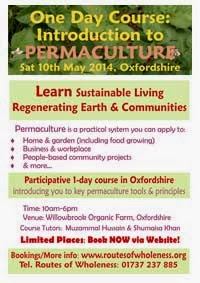 This
is an introductory day that promises to be fun, educational and transformative!
There will be opportunities for networking with other course
participants.
This
is an introductory day that promises to be fun, educational and transformative!
There will be opportunities for networking with other course
participants.
Venue: Willowbrook Organic Farm, Hampton Gay, Oxfordshire.
Date:: Saturday May 10th 2014
Times: 10am-6pm
(Advance Booking Only: see link below)
Permaculture is a practical system for sustainable living, based on observing principles and patterns in nature. By maximising relationships in living systems, permaculture has empowered people worldwide to develop dynamic, resilient projects that work with nature, rather than against it. Whatever scale or aspect of human living, whether the home and garden, community or congregation space, or one’s own life and career, permaculture can be applied to each situation.
This interactive taster day will introduce you to some of the fundamental tools and principles that can be used to design sustainable, resilient projects.
The course content will include:
Course fees £55 standard rate / £45 concessionary rate
(Advance Bookings Only)
Food: Teas will be provided; Participants will need to bring a packed lunch/any snacks.
Visit 'Routes of Wholeness' for More info / to Book: www.routesofwholeness.org
To support a rich learning space, we are limiting participant numbers to a small group size. If you know you want to participate on the course, we recommend you book as soon as possible in order to secure your place.
-------------
We are delighted to publicise the following course which takes place at Willowbrook Organic Farm in Oxfordshire in May 2014.
Learn
Principles for Sustainable
Living
& Regenerating the Earth &
Communities:
INTRODUCTION TO PERMACULTURE: ONE-DAY
COURSE
Organised by 'Routes of
Wholeness', at Willowbrook Organic Farm in Oxfordshire. Venue: Willowbrook Organic Farm, Hampton Gay, Oxfordshire.
Date:: Saturday May 10th 2014
Times: 10am-6pm
(Advance Booking Only: see link below)
Permaculture is a practical system for sustainable living, based on observing principles and patterns in nature. By maximising relationships in living systems, permaculture has empowered people worldwide to develop dynamic, resilient projects that work with nature, rather than against it. Whatever scale or aspect of human living, whether the home and garden, community or congregation space, or one’s own life and career, permaculture can be applied to each situation.
This interactive taster day will introduce you to some of the fundamental tools and principles that can be used to design sustainable, resilient projects.
The course content will include:
- What is permaculture?
- Introduction to permaculture ethics and principles
- Nature observation
- Social permaculture
- Permaculture as a design system
- Applying permaculture
- Next steps
Course fees £55 standard rate / £45 concessionary rate
(Advance Bookings Only)
Food: Teas will be provided; Participants will need to bring a packed lunch/any snacks.
Visit 'Routes of Wholeness' for More info / to Book: www.routesofwholeness.org
To support a rich learning space, we are limiting participant numbers to a small group size. If you know you want to participate on the course, we recommend you book as soon as possible in order to secure your place.
-------------
22 Nov 2012
Islam & Climate Booklet: Now Available Outside UK!

We are now able to take orders for our colour photo-booklet, Islam
& Climate Change~A Call to Heal, from countries
outside the UK.
 This inspiring booklet was produced by our small team of activists
with attention to both process and outcome. No corporate nor government funding.
Powered by the People!
This inspiring booklet was produced by our small team of activists
with attention to both process and outcome. No corporate nor government funding.
Powered by the People!
The booklet is both informative and inspiring. It is ideal for groups,
congregations, schools etc..
For more information: Click here
You can also download the online PDF for free from here
Please feel free to share with relevant contacts.
23 Aug 2012

5 Jun 2012
WIN at Alternative Rio - London Sun June 17th 2012
"We will not achieve environmental justice without a fundamental shift in values”
-Values Session at Alternative Conference for Rio Summit
Date: Sunday June 17th 2012
Time: 2:30 - 3:45 PM Venue: Institute of Education, Thornhaugh Street of Russell Square (Russell Square Tube)
Time: 2:30 - 3:45 PM Venue: Institute of Education, Thornhaugh Street of Russell Square (Russell Square Tube)
Speakers: Muzammal Hussain, Wisdom in Nature
Tony Emerson, Christian Ecology Link
Richard Hawkins, Public Interest Research Centre
For more info about the conference (and to register a place), visit http://www.campaigncc.
Early confirmed speakers for the conference as a whole include:
John McDonnell MP (Labour), Jean Lambert MEP (Green Party), Deborah Doane (World Development Movement), Jeremy Leggett (Solar Century), Jenny Jones(Green AM & Mayoral candidate), Aniol Esteban (New Economics Foundation), Derek Wall (Green Party/Green Left), John Stewart (chair Airport Watch, HACAN etc)Stephen Tindale (ex-Director, Greenpeace), Oliver Tickell (author Kyoto 2), Mayer Hillman, Mel Evans (Platform), Prof Peter Mollinga (SOAS), Hannah Smith (COIN &Refugee & Migrant Climate Forum), Keith Taylor MEP (Green Party), Deepak Rughani (Biofuelwatch), Murad Qureshi (GLA & Bangladeshi community), John Lanchberry (RSPB), Rich Hawkins (PIRC), David Powell (Economics Campaigne,Friends of the Earth), George Barda (Occupy LSX), Centre for Alternative Technology, Action Aid, Native Spirit Foundation, UK Tar Sands Network, David Wasdell (Meridian Project), Andrew Lockley & Tim Kruger (on geoengineering), John Maclaverty (GROW Campaign, Oxfam), Suzanne Jeffrey (CCC Trade Union Group), Debi Wagner (US Citizens Aviation Watch via skype), Chris Baugh (assistant General Sec Public & Commercial Services Union), Peter Challenor (National Oceanography Centre), Danny Chivers, Chris Church (Low Carbon Communites), Speaker from the Eradicating Ecocide Campaign, Gerry Wolfe (TREC-power from the deserts), Muzammal Hussain (Wisdom in Nature), Susan Roaf & Fergus Nichol (on built environment), Terry Reintke (co-spokesperson FYEG- Federation Young Euro- Greens), Melanie Strickland (Wild Law, Occupy), Ian Mason (Wild Law), Daniel Scharfe (Greenspeed), Tony Emerson, Christian Ecology Link, Emma Biermann (350.org), Neva Frecheville (WWF), Dan Plesch (Director, Department of International Studies and Diplomacy, SOAS), Harald Heubaum (CISD, CEPES, SOAS)… and many more invited.
__._,_.___
7 Nov 2011
WIN's Fourth Core Strand: 'Climate Justice'
The Climate Justice strand comprises an intention to move:
Away from dependence on fossil fuels;
Away from dependence on fossil fuels;
towards non-polluting energy, needs above profit, and low impact living.
9 Oct 2011
'Identities in Transition' Seminar - Leicester
---
'IDENTITIES' IN TRANSITION' SEMINAR
**Registration essential**
Date: Friday 14th October 2011
Time: 9.30 for 10.00am til 5pm
Venue: University of Leicester: Garendon Room on the Fourth floor of the Charles Wilson Building on the main University of Leicester campus. A campus map and travel directions can be found at http://www2.le.ac.uk/maps.
Registration: The event is free, and lunch is provided: but a place must be reserved in advance. More info including to register:
The seminar, part of the series “Sustainability Transitions: rethinking everyday practices, identities and livelihoods”, starts from the premise that many of the identities that individuals claim for themselves today in the Global North have been shaped by consumption practices fuelled by the high carbon economy. We also know that there are links between poverty, racism and gender inequalities and the people most likely to experience the most detrimental impacts of climate change and resource scarcity. This workshop explores the role of the high carbon economy in shaping these social identities and questions how they might be reconfigured through the process of transition to a sustainable, low carbon future. It focuses on three interlinked themes:
- How contemporary identities have been shaped by the high carbon economy
- How those identities might change and be reconfigured through the process of transition to a sustainable, low carbon future
- What it means to identify with (movements for) sustainability transitions.
Programme
09.30 Registration and coffee
10.00 Identities in Transition: some observations and questions
Speakers: Gavin Brown and Jenny Pickerill
10.15 Introductions and goals What do you want out of today?

Speaker: Jon Anderson
Questions
11.30 Panel discussion: Addressing diverse identities in climate change activism and advocacy
Speakers: Michelle Bastian; and Shumaisa Khan (Wisdom In Nature)
Questions and discussion
12.30 Lunch, An opportunity for informal discussion
13.30 Workshop: “Permaculture” and the escape into Whiteness: Sustainable Transition and Racialism
Speaker: Joseph De Lappe
Discussion
14.30 The Footpaths project: facilitating low carbon lifestyles
Speakers: Jill Fisher and Emily Hodgkinson
Questions and discussion
15.30 Coffee
15.45 Transitioning to Lower-carbon Identities: Three Tales from the "Everyday"
Speaker: Robyn Dowling
16.45 Questions
17.00 Closing discussion
Finish
-----
26 Mar 2011
Islamic ecology in the classroom
Ecology and community cohesion
Rokeby School's collaboration with the Climate Change Youth Development Trust (CCYDT) gave 20 of their pupils the opportunity to participate in weekly workshops on faith climate perspectives. One of the faith perspectives was to be the Islamic, and I had received invitation to deliver that week's workshop at this East London school. Alongside motivating action through faith, the aim, was to simultaneously nurture community cohesion. This conveniently resonated with my own value system of viewing the social ecology as inseparable from the wider one. I was excited to be a part of this.
Facilitator's homework
Prior to the workshop, I had been well primed as to the range and nature of the pupils by the director of CCYDT, Sabino Miranda: I knew that the pupils would be boys, mostly Muslim, but also Hindu, Christian and no formal faith, within an age range of 13-15 years, with a few a little older.
Most workshops I had delivered have been for adults and so I decided to reach out to my good friend and colleague across the pond, Mohamad Chakaki, to explore and hear ideas. Mohamad has given many more workshops to school age children than myself and I value his thoughts.
My ideas following these interactions were as follows: Keep it varied, keep it moving, and allow for some healthy disorder!
Making it universal
I had 1½ hours. We began with a go-round ice-breaker so everyone spoke from the start. Then, rather than going straight into any Islamic eco-theology, I had decided it might work better to explore principles through exercises that stimulated each participant to connect with their own inner compass/sense of ethics first, and then being given a chance to share. I attempted to frame this in a universal language to support inclusively.
Such a foundation can, I feel, potentially lend itself to the terminology and principles associated with any faith tradition. The group would thus be better equipped to look at what initially emerged in an open way, and then later in the workshop, within the framework of core Islamic concepts that underlie the outward aspects of the faith, including action to restore ecological balance.
The first exercise was the 'spectrum line', which is designed to draw out viewpoints and discussion on different issues. Participants choose to stand anywhere along the length of an imaginary line according to how strongly they agree or disagree with a statement. E.g. "Can we have too much of a good thing?" (to later explore the idea of mizan/balance). Varied ideas sprung from this exercise allowing for a healthy spread of viewpoints.
Then, using a numbering system, the pupils were divided into four groups, each taking on one of two questions for discussion (e.g. "Think 'natural world'. Think 'human communties'. Does the natural world have anything to teach us?"). They had fifteen minutes for this which I thought this might end up being too short. However, they got their ideas down faster than I anticipated. Their presentations were both intersting and varied in content.
Weaving it together
Afterwards I attempted to weave into a short talk what had emerged from the exercises whilst drawing on key Islamic concepts. I followed this with a five minute slide-show on Muslims engaged in ecological action (Although they can have a place, I like to avoid too many visuals preferring instead to be more directly relating with those present). There was then space for questions, a bit of last minute sharing, and then the distributing of the WIN photo-booklets on Islam & Climate Change for the pupils.
Afterwards I attempted to weave into a short talk what had emerged from the exercises whilst drawing on key Islamic concepts. I followed this with a five minute slide-show on Muslims engaged in ecological action (Although they can have a place, I like to avoid too many visuals preferring instead to be more directly relating with those present). There was then space for questions, a bit of last minute sharing, and then the distributing of the WIN photo-booklets on Islam & Climate Change for the pupils.
All in all, it was a fulfilling day, and although I am sure I had the luxury of a pretty focussed group of children, I'm looking forward to to engaging more with a younger age group as I am able.
Post workshop reflections
Here are some reflections/ideas/'things' I feel I want to make note of for myself following this workshop. Happy to hear anyone else's reflections on any of these areas as well..
- With children, short varied exercises can engage them better than something that goes on for too long or too much of the same.
- Taking a group of children deep into Islamic eco-theology in a short time can be challenging, and is indeed impossible at 5pm when they've been at school since 8! On the other hand, giving a flavour of 2 or 3 basic concepts such as fitrah (natural disposition/innate goodness, which some seemed to grasp really well), mizan (balance), and tawhid (unity/oneness) is feasible to weave effectively into a single workshop on climate change dynamics and taking action.
- I found I could have addressed key themes/topics - that were raised by the children within the workshop - better than i did during my short talk at the end. What I might do next time in a similar situation is actually note down keywords as the themes/topics came up, and glance and reflect on them at appropriate times before I give a talk.
- A certain level of disorder is to be expected from time-to-time - not everyone can stay focussed the whole time. Thus, a limited degree of chaos or 'play' alongside the intended sequence of events seemed to act as a healthy release that then allowed a more naturally guided return to the formal thread of activities. That's how it felt with this kind group, but I'd be interested to hear of anyone else's experiences!? How much 'disorder' is healthy?...
- I arrived at the school just 5 minutes before the workshop (due to a misunderstanding over timings) so had less time to organise e.g. pre-prepare some flip-charts, familiarise myself with the space etc... than I had imagined. This however pushed me to think more in terms of essentials and go more with instinct, which I have found can be a strength. On other occasions though, I am aware that too little time to settle before a workshop does little to help me be present.
- With regards the 'spectrum line' exercise, after drawing out some thoughts from a group of participants bunched close together, thought-provoking questioning can tap into deeper layers. This of course needs balancing with the comfort level of the person being questioned and drawing our a variety of viewpoints in the time available.
9 Dec 2010
Reflections Across the Pond: Green, Muslim and American
The flying question
 It was 2004. I was at a public meeting on climate change. The lecture hall was buzzing with energy. Ideas, questions and answers were exchanged between the audience - mostly students - and the speakers, one of whom was Mayer Hillman.
 Mayer is the author of the informative 'How We Can Save the Planet', and during the course of this event did not hesitate in showing his distaste to flying. He also made it more personal and correspondingly more uncomfortable.
"Who will now commit to never flying again?"
He threw the question at us with force, like a long-standing campaigner who believed it was now or never. As he asked this, I checked in with myself and found myself grappling internally. I was aware that the warming effect of flying can be several times greater than other forms of transport because greenhouse gases have more of an impact at high altitude. Also, the distances we fly tend to be large with flying being a cheap and time-saving travelling option. The place that aviation takes with regards social norms and its contribution to climate change is hard to over-emphasise, which is why there is a necessary movement resisting its expansion.
In response to Mayer's question, a surprising number of people put up their hand. The part of me that wanted to be seen as righteous wished I was one of them, but I would have been lying if I did. With dozens of close friends and relatives in other continents, uncomfortable though it felt with Mayer's glare piercing the room, I had to keep my hand down. Although I had, by that time, virtually made an internal commitment to not flying for leisure holidays - and even in other situations to use coach, train or boat, for example - I could not commit to never flying again.
It was Autumn 2010. Here was another moment when I grappled with the flying question. My wife is from the US and I had not seen most of her immediate family for three and a half years. At the same time, she would be in the States for a significant period of time to complete her PhD. Was I to also go? Over a few weeks of consideration and weighing things up in my awareness, I began to move towards the idea of joining her and her family in New Jersey for part of that time. I also felt I could squeeze more from that one trip by also connecting with friends in nearby states.
In November, thus, I did set off, travelling by plane, for three weeks in the US. It so happened that whilst I was there I also managed to meet with some inspiring individuals in the US Green Islam movement. Here, I share some of these experiences as well other parts of my trip.
DC Green Muslims

Within a few days of my landing, I visited Washington DC to catch up with an aunt and uncle. I found out from my friend Mohamad Chakaki, co-founder of DC Green Muslims, that Sarah Jawaid from the group was speaking at an inter-faith climate change meeting on the day I was due to arrive! This sounded perfect, and I managed to make it just in time for this event, being met at the local metro station by Ryan Strom, another member of the DC Green Muslims team.
On the panel along with Sarah, was a Christian and Jewish speaker. Plenty of ideas were shared. Some of the more memorable comments included one from the Jewish speaker, Josh Tulkin, Founding Board Member of the Baltimore Jewish Environmental Network, who pointed out the disconnect between our actions and climate impacts - that when we start our car, for example, it's not that we're literally putting a gun to someone's head, yet the accumulative effect of these seemingly innocent actions build up to cause loss of life, which goes against all faith traditions.
Another memorable comment came from Sarah, who described an innovative means by which the DC Green Muslims had stimulated people to be more present in themselves and to their surroundings. She and her co-organisers had invited people to a Green Dinner event. Shortly before the start time, the windows to the room were boarded up, and cardboard was balanced vertically on the tables to prevent people, once they had arrived and taken their seat, from seeing their neighbour. The idea was to wake people up to the space they were in and to notice how it made them feel, however awkward or uncomfortable.
Sarah added that the state of the altered room was basically a metaphor for what we often experience daily in our lives, yet become desensitised to. Following a period of being present to this altered room, the participants were then given a chance to re-arrange it themselves to their liking! The DC Green Muslims have impressed me with their imaginative grassroots approach, and this is but one example.
Sarah added that the state of the altered room was basically a metaphor for what we often experience daily in our lives, yet become desensitised to. Following a period of being present to this altered room, the participants were then given a chance to re-arrange it themselves to their liking! The DC Green Muslims have impressed me with their imaginative grassroots approach, and this is but one example.
Park 51

Back in New Jersey, my wife and I took a day trip to New York absorbing some of Manhattan. It was a Friday and we stopped for prayers at the Park 51 Community Centre, a couple of blocks away from Ground Zero.
The sermon (khutba) was given by Imam Feisal Abdul-Rauf, and was one of the most liberating I had experienced. It wasn't just the content, but the way it was delivered - with love and presence, opening up a space that was much bigger than just words being spoken . The content itself was about compassion, and inviting Muslim to move beyond the label 'Muslim' to what the term actually points to, the surrendering of the self to the Divine - and to reflect on what that means including in our caring for those who might have different viewpoints to our own. I left the centre with a feeling of gratitude and hope.
The sermon (khutba) was given by Imam Feisal Abdul-Rauf, and was one of the most liberating I had experienced. It wasn't just the content, but the way it was delivered - with love and presence, opening up a space that was much bigger than just words being spoken . The content itself was about compassion, and inviting Muslim to move beyond the label 'Muslim' to what the term actually points to, the surrendering of the self to the Divine - and to reflect on what that means including in our caring for those who might have different viewpoints to our own. I left the centre with a feeling of gratitude and hope.
Green Deen
 That same evening, we were fortunate to be able to meet Ibrahim Abdul-Matin and to attend a workshop he was facilitating at Columbia University in New York. Ibrahim is the author of the newly released and very readable book Green Deen - What Islam Teaches About Protecting the Planet.
 At his workshop, there were about 30 participants, mostly students. After some mostly seated exercises, Ibrahim got us moving - we took positions in different corners of the room according to where we stood in response to questions he threw at us. We then shared with those standing with us, and then with the wider group. It was a well run, engaging workshop, and Ibrahim's background in community organising was evident.
One of the comments he made to the group that stayed with me went something like this,
"You have value not because of what you own, what you wear, nor because of what you earn. You have value simply because God created you".
This wasn't academic stuff, rather a way - albeit pitched for those who believe in God - of getting to the basis of our self-worth that necessarily brings down the walls of an artificial value-system which society imposes onto us, and out of which arises consumerism and the compulsive pursuit of status.
Massachusetts
It was the last week of my trip and I spent a couple of days in Boston, Massachusetts. From there, I visited Cambridge to connect with Mohamad Chakaki, a friend whom I mentioned earlier and with whom I thoroughly enjoy hearing and sharing ideas. I also met with Misha, a close relative and outstanding student, who is at Harvard, and an Auntie on my mother's side. This was my second time in Cambridge, having visited nineteen years previously after a period of working in Canada during a summer. The area I visited - around Harvard Square - was certainly much busier, with plenty more cars, but I could still sense some of the quality of intimacy that I had experienced the previous time.
Progressive New York Radio
 After an extended seven hour coach journey back to New Jersey, I took to the phone to be interviewed by Saadia Aslam from Radio Tahrir. Radio Tahrir is a weekly programme about the Arab and Muslim Community and is broadcast on the independent New York radio station, WBAI Radio.
 Saadia asked me about the work Wisdom In Nature is doing in the UK. I talked about our new booklet, Islam & Climate Change: A Call to Heal, our Islamic Community Food Project, and our emphasis on process and working in a holistic way that includes consciously integrating social ecology into our work. Saadia was also keen to hear my experiences of the Green Islam movement in the US. I enjoyed sharing and am impressed by the dedicated work the radio station is doing.
The podcast of my interview can be found on the following webpage - It's the November 23rd 2010 broadcast, and the interview starts at about 30 minutes after the music piece by Maher Zain.
Progressive Muslims
 During the course of my trip, on several occasions I heard the name IMAN. IMAN or the Inner-City Muslim Action Network is an organisation that Ibrahim Abdul-Matin profiles in his book, and which Mohamad Chakaki also enthusiastically talked to me about in Cambridge.
 I discovered that IMAN aims to weave together social justice with the arts, and to also bring in the environmental. One of their projects is called Project Green Reentry. This involves supporting ex-offenders in Chicago with on-the-job training as they essentially construct their own homes sustainably. This is meant to help them to socially integrate whilst simultaneously respecting the earth. As a keen believer in a holistic approach - I increasingly feel that isolated environmentalism, or indeed isolated activism of any kind, is ultimately self-defeating as it will work against the interconnected nature of things - I am keen to learn more about the intelligent work that IMAN is doing.
The two sides of the Pond
So, how does the 'Green Islam' movement in the US compare with that in the UK?
Whilst I haven't explored the movement in the US sufficiently enough to give a confident answer, it was clear that the folks I met there hold alot of respect for the work going on here! Whilst it's true, however, that we've been working with this for a longer period, perhaps they underestimate what they have achieved in such a short space of time.
My own sense about the movement in the US, from direct contact with a few key individuals, is that it has set in motion a creative energy and quality of work that is refreshing. There also seems to be a healthy experimenting with ways, verbally or otherwise, to express Islamic principles so they can be practical and alive to those of us growing up in contemporary western culture. I felt that our more 'mature' movement in the UK can certainly take inspiration and lessons from the movement there.
At the same time, we have a grounding and a history through which many lessons have been learnt and a certain degree of resilience developed. All in all, there appears to be much scope for a mutually nurturing relationship, whose benefits can and must extend beyond our immediate space and time.
Whilst I haven't explored the movement in the US sufficiently enough to give a confident answer, it was clear that the folks I met there hold alot of respect for the work going on here! Whilst it's true, however, that we've been working with this for a longer period, perhaps they underestimate what they have achieved in such a short space of time.
My own sense about the movement in the US, from direct contact with a few key individuals, is that it has set in motion a creative energy and quality of work that is refreshing. There also seems to be a healthy experimenting with ways, verbally or otherwise, to express Islamic principles so they can be practical and alive to those of us growing up in contemporary western culture. I felt that our more 'mature' movement in the UK can certainly take inspiration and lessons from the movement there.
At the same time, we have a grounding and a history through which many lessons have been learnt and a certain degree of resilience developed. All in all, there appears to be much scope for a mutually nurturing relationship, whose benefits can and must extend beyond our immediate space and time.
Back in the UK

Now in the UK, I am soon met by the graceful dance of snowfall, and the corresponding clumsiness of our predictable inability to cope well with it! I am grateful for having had the privilege of being able to travel to the US. The technology we have today can make vast distances appear small and I am acutely aware of the need to take time to reflect and to be grateful, and to also acknowledge that there are physical limits to the pace of consumption that our planet can take. Although I have not chosen never to fly again, I have consciously chosen to not take flying for granted.
So, now it's also time to get some more work. The economic situation. Hmm, that's another aspect which, in this inter-connected world, needs co-healing...
So, now it's also time to get some more work. The economic situation. Hmm, that's another aspect which, in this inter-connected world, needs co-healing...
© Muzammal Hussain
1 Sept 2010
Can You Help Us? Financial APPEAL for Print Copies of Islam & Climate Photo-booklet

Whilst we have finally launched the online version of our popular colour booklet, Islam & Climate Change ~ A Call to Heal, (downloadable for free), we still haven't yet had our first batch of copies printed. The reason is simple: Finances. As a grassroots organisation we need money from people like You to be able to do this.
To get the first batch printed (we are going for recycled paper, using a printing company with a strong ethical stance) we need at least an additional £800 for one-thousand copies of the 20-page colour booklet. We ask if you would be willing to help us reach this amount so we can have copies available as soon as possible. They would be distributed for free with donations suggested (which will help cover the next batch and so on! - this would make it sustainable in the longer run!)
Our bank account details are on our donate page
If you have any questions please contact us, or feel free to use the comments tag at the bottom of this blog post.
To get the first batch printed (we are going for recycled paper, using a printing company with a strong ethical stance) we need at least an additional £800 for one-thousand copies of the 20-page colour booklet. We ask if you would be willing to help us reach this amount so we can have copies available as soon as possible. They would be distributed for free with donations suggested (which will help cover the next batch and so on! - this would make it sustainable in the longer run!)
Our bank account details are on our donate page
If you have any questions please contact us, or feel free to use the comments tag at the bottom of this blog post.
With thanks from the Wisdom In Nature team for any financial help you can give us.
23 Aug 2010
Islam & Climate Change ~ A Call To Heal: Online Booklet Launch
We are delighted to announce the launch of the online version of our long-awaited colour booklet: Islam & Climate Change ~ A Call to Heal. It is available to download for free from our main website.
We've been dedicating our time to this for quite a bit longer than we had originally planned - a few months longer in fact! - and whilst painful at times, we managed to patiently work through the difficult parts to experience the joys that follow, and which come from working within a great team. And yes, we are pleased with the outcome as well! We invite you to take a look.
The Wisdom In Nature team
We've been dedicating our time to this for quite a bit longer than we had originally planned - a few months longer in fact! - and whilst painful at times, we managed to patiently work through the difficult parts to experience the joys that follow, and which come from working within a great team. And yes, we are pleased with the outcome as well! We invite you to take a look.
The Wisdom In Nature team
---
From a small team of faith-inspired community activists...

This picture guide outlines an Islamic perspective on one of the most pressing challenges of our time. In simple language and with pictures, it introduces the following themes:
Disturbance of the Natural Order; A Call to the Fitrah; Unnatural Disasters; Islam: A Religion of Harmony; Fulfilling our Role as Khalifah; A Revival towards Wholeness; The Power of Many…
Climate Change is a signal that humankind has lost its course. By drawing on spiritual wisdom, we can respond to this call - this call to heal. This booklet was produced by a team of community activists to educate, cultivate reflection and inspire holistic action to help build a fairer and more sustainable world for all.
Download for free from here
The booklet was produced through voluntary efforts by a team of committed activists along with design support as we neared completion.
Financial help needed, to support our work and make print copies available: As soon as we are able, we would like to have print copies of this booklet to offer and distribute for free to the wider public. In order to help us to further our work and to make these copies available, financial contributions are invited and gratefully received. (More details are on page 12 in the booklet for anyone who might like to support us in this way).
With thanks from the Wisdom In Nature team
Subscribe to:
Posts (Atom)


