Showing posts with label permaculture. Show all posts
Showing posts with label permaculture. Show all posts


9 Jan 2014
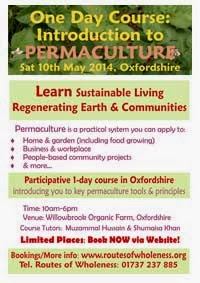
Register Now! Permaculture Intro Course (Oxfordshire): Sat May 10th 2014
We live in times that require the building of wholesome and resilient alternatives. Permaculture is a way of supporting us to do just that.
We are delighted to publicise the following course which takes place at Willowbrook Organic Farm in Oxfordshire in May 2014.
 This
is an introductory day that promises to be fun, educational and transformative!
There will be opportunities for networking with other course
participants.
This
is an introductory day that promises to be fun, educational and transformative!
There will be opportunities for networking with other course
participants.
Venue: Willowbrook Organic Farm, Hampton Gay, Oxfordshire.
Date:: Saturday May 10th 2014
Times: 10am-6pm
(Advance Booking Only: see link below)
Permaculture is a practical system for sustainable living, based on observing principles and patterns in nature. By maximising relationships in living systems, permaculture has empowered people worldwide to develop dynamic, resilient projects that work with nature, rather than against it. Whatever scale or aspect of human living, whether the home and garden, community or congregation space, or one’s own life and career, permaculture can be applied to each situation.
This interactive taster day will introduce you to some of the fundamental tools and principles that can be used to design sustainable, resilient projects.
The course content will include:
Course fees £55 standard rate / £45 concessionary rate
(Advance Bookings Only)
Food: Teas will be provided; Participants will need to bring a packed lunch/any snacks.
Visit 'Routes of Wholeness' for More info / to Book: www.routesofwholeness.org
To support a rich learning space, we are limiting participant numbers to a small group size. If you know you want to participate on the course, we recommend you book as soon as possible in order to secure your place.
-------------
We are delighted to publicise the following course which takes place at Willowbrook Organic Farm in Oxfordshire in May 2014.
Learn
Principles for Sustainable
Living
& Regenerating the Earth &
Communities:
INTRODUCTION TO PERMACULTURE: ONE-DAY
COURSE
Organised by 'Routes of
Wholeness', at Willowbrook Organic Farm in Oxfordshire. Venue: Willowbrook Organic Farm, Hampton Gay, Oxfordshire.
Date:: Saturday May 10th 2014
Times: 10am-6pm
(Advance Booking Only: see link below)
Permaculture is a practical system for sustainable living, based on observing principles and patterns in nature. By maximising relationships in living systems, permaculture has empowered people worldwide to develop dynamic, resilient projects that work with nature, rather than against it. Whatever scale or aspect of human living, whether the home and garden, community or congregation space, or one’s own life and career, permaculture can be applied to each situation.
This interactive taster day will introduce you to some of the fundamental tools and principles that can be used to design sustainable, resilient projects.
The course content will include:
- What is permaculture?
- Introduction to permaculture ethics and principles
- Nature observation
- Social permaculture
- Permaculture as a design system
- Applying permaculture
- Next steps
Course fees £55 standard rate / £45 concessionary rate
(Advance Bookings Only)
Food: Teas will be provided; Participants will need to bring a packed lunch/any snacks.
Visit 'Routes of Wholeness' for More info / to Book: www.routesofwholeness.org
To support a rich learning space, we are limiting participant numbers to a small group size. If you know you want to participate on the course, we recommend you book as soon as possible in order to secure your place.
-------------
27 Dec 2013
What We Got Up To In 2013: Islamic Ecology ~ Permaculture ~ Facilitation
Peace
all,
Over the past few weeks, we've been worming away, developing the fertility of the soil (both literally and metaphorically!), preparing it to receive seeds as the world moves into the next solar cycle.
Over the past few weeks, we've been worming away, developing the fertility of the soil (both literally and metaphorically!), preparing it to receive seeds as the world moves into the next solar cycle.
We will share our news, events, collaborations and courses as developments manifest, God willing, in 2014. Please stay tuned. We ask you to support us as you are able, participate where you can, raise ideas for collaborations, and keep us in your prayers.
We also would like to share with you some of what took place for WIN over 2013. Below is a summary (with links) to read and share.
ISLAM &
PERMACULTURE
In 2010, we designed and delivered probably the first Islam & Permaculture Course anywhere in the world.
This year (2013), WIN Reps ran several more Permaculture courses and
workshops (in Brighton, Surrey and London) including one on Islam, Sufism &
the Permaculture Approach at the London Permaculture Festival which drew well
over 60 people>> Click here to read a short summary.
VIDEO: INTERCONNECTEDNESS & RELATIONSHIP: BASIS FOR AN ISLAMIC ECOLOGY
VIDEO: INTERCONNECTEDNESS & RELATIONSHIP: BASIS FOR AN ISLAMIC ECOLOGY
WIN Reps spoke at the Inclusive Mosque
Initiative on the above topic. You can watch the Youtube video
here
GM FOOD & ISLAM ON THE WEB
We launched a comprehensive Islam & GM Food web-section (which took us quite a few months work!), with a clear statement as to WIN's position on GM Food!
NON-VIOLENCE & ISLAM: POST WOOLWICH: WIN STATEMENT
GM FOOD & ISLAM ON THE WEB
We launched a comprehensive Islam & GM Food web-section (which took us quite a few months work!), with a clear statement as to WIN's position on GM Food!
NON-VIOLENCE & ISLAM: POST WOOLWICH: WIN STATEMENT
PERMACULTURE BLOG POSTS ON WIN Blog:
Islam & Permaculture, by WIN Rep, Shumaisa Khan
9 Months No-Dig Permaculture in Small Growing Space
Why
No Digging?: Nature as a Teacher
Permaculture: Growing Food in a Small Space
All Permaculture-related Blog Posts>> http://wisdominnature.blogspot.co.uk/search/label/permaculture
Permaculture: Growing Food in a Small Space
All Permaculture-related Blog Posts>> http://wisdominnature.blogspot.co.uk/search/label/permaculture
PERMACULTURE PLOT WORK DAYS
We held two work days at our no-dig permaculture plot. A Big thank you again to those who helped.
DEEPENING FACILITATION: FEEDBACK FROM 'FACILITATING CHANGE' WEEK IN WALES
WIN Rep Muzammal Hussain reported on the "challenging, yet exhilarating" 'Facilitating Change' week in rural Wales for grassroot facilitators from the UK and Europe. Read the full post
G8: HUNGER SOLUTIONS: AWAY FROM CORPORATE CONTROL, TOWARDS FOOD SOVEREIGNTY>>
In the leadup to the G8 we put out a statement about world hunger, power, and corporate control>> http://tinyurl.com/mulxakd
ALSO!>>
WIN facilitated a participative 'Ecology and Faith' forum in Bath: WHO CARES? HOW CAN FAITH HELP OR HINDER A MORE SUSTAINABLE WORLD? Some photos
We also switched our elist from
the more corporate Yahoo to the grassroots Riseup! And finally set up a PayPal account
to give more options for you to donate dosh to WIN to
support our work on Islamic ecology, permaculture & facilitation>> http://www.wisdominnature.org.uk/Finance/donate.htm#account
That's all for now!
Wishing you a wonderful end of year.
'til 2014....
3 Oct 2013
Why No Digging?: Nature as a Teacher
"Why no digging?"... This important question was recently asked on social media following a post I wrote yesterday titled, '9 Months No-Dig Permaculture in Small Growing Space'.
 I felt the answer to this question deserved a blog post of its own, and which can then be referred to in future posts around no-dig approaches to food growing.
My own understanding of permaculture is that it draws on nature as a teacher. Nature can be an example of how to nourish and regenerate the earth. (A Divine name, for instance, is Ar-Razzaq: The Nourisher, or Ever Provider, and there are many other beautiful ones that could also be relevant here).
Nature demonstrates deep and coherent principles of sustainability, and if through witnessing and reflecting on nature, we can be humble enough to allow nature to be our teacher, there are principles we might discover that nature embodies and that we can apply in creating our own systems, whether this be around food growing, economic systems, or social ones. Of course these can all interact, and that is one of the beauties of this interconnected dynamic world we are part of!
So, back to digging. If we look at nature, we can see that it rarely digs in the sense that it rarely dramatically inverts the soil. Instead, nature tends to work gently. In a forest, for instance, leaves fall, they slowly breakdown on the surface, and are gradually taken to deeper layers, in particular through earthworm activity. This process of organic matter being left on the soil surface and taken down (without digging) is a part of the process that naturally builds the fertilty of the soil and feeds life, a foundation for the creative effortless development and sustenance of a forest and the abundance that comes from it for an incredibly diverse range of life forms.
Permaculture would be not about copying this exactly, but about drawing on these principles to design systems (permaculture is a design approach) that provide for our needs in a sustainable way - which means also caring for our wider family: the earth and our fellow human beings.
Breaking it down a bit more, here are some specific tangible reasons for not digging (or at least minimising it):
While digging is something I would try to avoid where possible, there is an unofficial permaculture principle that underlies all of them, and prevents permaculture from becoming dogmatic. This principle is 'It depends'! After all, there are instances where some kind of digging would be appropriate and helpful (e.g. in heavily compacted soil). The aim, instead of no digging [full stop], is rather to create the conditions that minimise the need to dig, particularly over the longer term, and that means digging as little as possible in the first place. In our case, we have been fortunate whereby we have got away essentially without digging the soil at all.
All the best to everyone who is working (or working less!) to do this, and thank you to all my teachers who have helped me to explore the wonderful approach of permaculture which continues to support me in drawing on principles in nature to inspire my work in all its forms.
And thank you Saimma, for the question!
----
I have found these two books to be really helpful (and both of which have pages about tilling/not tilling the soil):
The Permaculture Garden: by Graham Bell (simpler)
The Earth Care Manual: By Patrick Whitefield (more comprehensive)
I felt the answer to this question deserved a blog post of its own, and which can then be referred to in future posts around no-dig approaches to food growing.My own understanding of permaculture is that it draws on nature as a teacher. Nature can be an example of how to nourish and regenerate the earth. (A Divine name, for instance, is Ar-Razzaq: The Nourisher, or Ever Provider, and there are many other beautiful ones that could also be relevant here).
Nature demonstrates deep and coherent principles of sustainability, and if through witnessing and reflecting on nature, we can be humble enough to allow nature to be our teacher, there are principles we might discover that nature embodies and that we can apply in creating our own systems, whether this be around food growing, economic systems, or social ones. Of course these can all interact, and that is one of the beauties of this interconnected dynamic world we are part of!
So, back to digging. If we look at nature, we can see that it rarely digs in the sense that it rarely dramatically inverts the soil. Instead, nature tends to work gently. In a forest, for instance, leaves fall, they slowly breakdown on the surface, and are gradually taken to deeper layers, in particular through earthworm activity. This process of organic matter being left on the soil surface and taken down (without digging) is a part of the process that naturally builds the fertilty of the soil and feeds life, a foundation for the creative effortless development and sustenance of a forest and the abundance that comes from it for an incredibly diverse range of life forms.
Permaculture would be not about copying this exactly, but about drawing on these principles to design systems (permaculture is a design approach) that provide for our needs in a sustainable way - which means also caring for our wider family: the earth and our fellow human beings.
Breaking it down a bit more, here are some specific tangible reasons for not digging (or at least minimising it):
- By inverting the soil, many microorganisms accustomed to living and functioning at a particular soil depth will die, and this impacts negatively on soil fertility (and increases the need for adding fertilisers/external inputs).
- Digging can bring weed seeds to the surface, increasing the need for further digging and leading to an upward spiral of digging! Instead what we have been doing on our plot is, in part, seeing weeds as a form of life that store valuable nutrients. By just hoeing weeds along the surface of the soil, we leave them on the surface (as mulch) where they suppress further weed growth and break down naturally, gradually releasing nourishment for other life, like leaves do when falling on the soil surface in a forest.
- Soil is a carbon sink. Digging releases the carbon stored in the ground into the atmosphere, so is counter to what we ideally want to be doing to reduce greenhouse gas emissions.
While digging is something I would try to avoid where possible, there is an unofficial permaculture principle that underlies all of them, and prevents permaculture from becoming dogmatic. This principle is 'It depends'! After all, there are instances where some kind of digging would be appropriate and helpful (e.g. in heavily compacted soil). The aim, instead of no digging [full stop], is rather to create the conditions that minimise the need to dig, particularly over the longer term, and that means digging as little as possible in the first place. In our case, we have been fortunate whereby we have got away essentially without digging the soil at all.
All the best to everyone who is working (or working less!) to do this, and thank you to all my teachers who have helped me to explore the wonderful approach of permaculture which continues to support me in drawing on principles in nature to inspire my work in all its forms.
And thank you Saimma, for the question!
----
I have found these two books to be really helpful (and both of which have pages about tilling/not tilling the soil):
The Permaculture Garden: by Graham Bell (simpler)
The Earth Care Manual: By Patrick Whitefield (more comprehensive)
2 Oct 2013
9 Months No-Dig Permaculture in Small Growing Space
I thought I would share a couple of photos to help convey some kind of pictorial overview as to changes that took place on our permaculture plot since we first got it.
Below is the plot as we got it about 9 months ago, in December 2012. The photo is taken from the south east corner of the plot>>
You can see lots of grass and weeds. The plot had not been worked on for many months as the previous holder was suffering from poor health.
After taking stock of the plot and reflecting on how to move forward, we thought that realistically it made sense that we work primarily on about half of it for the first year.
We were also committed to using permaculture principles, no insecticides/herbicides (i.e. organic) and to working with the plot without digging.
So, How did we do?! Let's move to the 'nine months later' mark. Just below is a photo taken from about the same position only a few days ago...
This is the plot near the end of September 2013. Early on, we built a compost structure from reclaimed wooden pallets (top part of photo).The area we've been growing on is about 16 square meters. We divided it into 4 beds, 2 are horse shoe shaped and 2 are rectangular.
Crops that we've been growing on these four beds include: potatoes, perpetual spinach, swiss beet, french beans (Blauhilde and Golden Gate varieties), courgettes, kale, radish, carrots, and squash... and yes, we did manage to work on the weedy site to grow all this food without digging! (A couple of open workdays helped, so thank you to everyone who came down for them).
Hopefully I'll get a chance to share more about how we did this on a future post.
Below is the plot as we got it about 9 months ago, in December 2012. The photo is taken from the south east corner of the plot>>
 |
| DECEMBER 2012 |
You can see lots of grass and weeds. The plot had not been worked on for many months as the previous holder was suffering from poor health.
After taking stock of the plot and reflecting on how to move forward, we thought that realistically it made sense that we work primarily on about half of it for the first year.
We were also committed to using permaculture principles, no insecticides/herbicides (i.e. organic) and to working with the plot without digging.
So, How did we do?! Let's move to the 'nine months later' mark. Just below is a photo taken from about the same position only a few days ago...
 |
| 9 MONTHS LATER>> SEPTEMBER 2013 |
This is the plot near the end of September 2013. Early on, we built a compost structure from reclaimed wooden pallets (top part of photo).The area we've been growing on is about 16 square meters. We divided it into 4 beds, 2 are horse shoe shaped and 2 are rectangular.
Crops that we've been growing on these four beds include: potatoes, perpetual spinach, swiss beet, french beans (Blauhilde and Golden Gate varieties), courgettes, kale, radish, carrots, and squash... and yes, we did manage to work on the weedy site to grow all this food without digging! (A couple of open workdays helped, so thank you to everyone who came down for them).
Hopefully I'll get a chance to share more about how we did this on a future post.
15 Jul 2013
London Permaculture Festival 2013: Our stall & workshop experience...
...A
really fulfilling day at the London Permaculture festival yesterday,
with many good conversations and connections around the stall.
The workshop we facilitated titled Islam, Sufism & the Permaculture Approach was more popular than expected, with well over 60 people participating.
 After a short introduction, I invited the participants to introduce themselves to each other in pairs; we then had some zhikr with light percussion followed by a short period of silence; and we then explored relations between the self/individual, the community, nature, the economy, and the Divine all from an Islamic perspective. The photos is of the flipchart which captures key ideas shared by the group.
We then reflected together on the key emphasis/qualities of Sufism in relation to Islam (a BIG question!).
We then considered how the permaculture ethics (earth care, people care and fair shares) as well as several permaculture principles and a Permaculture placement tool relate to Islam & Sufism
The participants comprised a good handful of Muslims dotted around the room amongst people of diverse beliefs. The diversity helped draw out a number of key themes that enriched the sharing. There were wonderful contributions, and much learning for all of us.
Gratitude to all who attended, and to the organisers of the wonderful festival.
We look forward to further collaborations with at least some of the wonderful people we connected with...
The workshop we facilitated titled Islam, Sufism & the Permaculture Approach was more popular than expected, with well over 60 people participating.
 After a short introduction, I invited the participants to introduce themselves to each other in pairs; we then had some zhikr with light percussion followed by a short period of silence; and we then explored relations between the self/individual, the community, nature, the economy, and the Divine all from an Islamic perspective. The photos is of the flipchart which captures key ideas shared by the group.
We then reflected together on the key emphasis/qualities of Sufism in relation to Islam (a BIG question!).
We then considered how the permaculture ethics (earth care, people care and fair shares) as well as several permaculture principles and a Permaculture placement tool relate to Islam & Sufism
The participants comprised a good handful of Muslims dotted around the room amongst people of diverse beliefs. The diversity helped draw out a number of key themes that enriched the sharing. There were wonderful contributions, and much learning for all of us.
Gratitude to all who attended, and to the organisers of the wonderful festival.
We look forward to further collaborations with at least some of the wonderful people we connected with...
21 Jun 2013
Islam, Sufism & the Permaculture Approach: @ LondonPermacultureFestival: Sun 14th July 2013
Wisdom In Nature invites you to:
ISLAM, SUFISM & THE PERMACULTURE APPROACH
A workshop at the London Permaculture Festival

Date: Sunday 14th July
2013
Time: Workshop: 3pm-3.50pm; London Permaculture Festival: 11am-7pm
Venue: Cecil Sharp House, 2 Regent's Park Rd, Camden , London, NW1 7AY. Getting there/Map: Click here
Much could be said about the relationship between these three perspectives. This short workshop will be but a little dip! While we may adapt according to numbers of people and our sense of what is needed, the intended theme will be: 'Relationship', and how this is at the heart of Islam, Sufism and Permaculture. We hope to also include some Sufi chanting (optional participation), and sharing.
Much could be said about the relationship between these three perspectives. This short workshop will be but a little dip! While we may adapt according to numbers of people and our sense of what is needed, the intended theme will be: 'Relationship', and how this is at the heart of Islam, Sufism and Permaculture. We hope to also include some Sufi chanting (optional participation), and sharing.
Workshop Facilitators: Shumaisa Khan (WIN) & Muzammal Hussain (WIN)
Also a chance to find out more about the work of Wisdom In Nature and ways of collaborating.
Cost: £5 / £4 concs (u18's free) entrance to the Permaculture Festival: No additional cost for the Workshop!
Twitter: www.twitter.com/wisdominnature
About Permaculture: Permaculture is as a practical
system for sustainable living, based on observing principles and patterns in
nature. Rather than seeing living systems as disconnected parts, permaculture
helps us to see them as a whole and aims to maximise the relationships between
things. Permaculture has empowered people worldwide to develop projects that
work with nature, rather than against it.
WIN will also have a stall at the festival. Come speak with us!
About the London Permaculture Festival:
The London Permaculture Festival is a non-profit grassroots event and is one of the largest permaculture events in the country.
With Workshops, Storytelling, Music, Kids Dome &
more.
Topics include: Islam, Sufism & Permaculture; Introduction to Permaculture; Surviving climate change; Our own body ecology and health; Systems, Patterns and Principles in Permaculture Design; Sustainability and parenting; Multi-stakeholder co-ops and community share issues; How to grow food in containers; Create a worm composter; Keeping chickens; Natural beekeeping; Growing plants from seed; and others...
Festival Website/More info: http://www.londonpermaculturefestival.com
13 Jun 2013
A Perspective on Islam and Permaculture
You may have noticed that quite a few of WIN's activities of late are around permaculture, and that our new strapline includes permaculture. If you're wondering what the heck it is and what does it have to do with Islam, then you might find this blog post helpful!
Permaculture - A Brief Intro
 Permaculture is a design system for meeting human needs, one which integrates various components to achieve a functional and self-regulating whole. Inherent to this is understanding the connections and relationships among the components. Relationships occur at different levels - the relationships between the various components that contribute to soil; the relationships between the soil, water, flora and fauna, etc.; and the relationship between human economic, physical, cultural, and social needs and ways of meeting them, which of course connect to the non-human elements of the wider ecosystem. Permaculture is about maximising beneficial relationships among the various components.
According to Bill Mollison, the 'father of permaculture', it emerged as a response to perceived social problems amidst the oil crisis in the 1970s. He recognised that the ecological problems were connected to social problems, and both the ecological and social problems were the result of the economic system in place.
Permaculture and Islam
What does all this have to do with Islam? Islam, in a sense, is a whole system in which the economic, social, ecological, and spiritual are integrated, which is the antithesis of contemporary society. The norm is people working at increasingly sedentary jobs in an industrial economic system that is based on money that has very little value – its value comes from the belief in it rather than tangible value. This system is characterised by compartmentalisation and disconnectedness – they keep the system going.
For example, most people would not tolerate sweatshop labour to take place in their neighbourhood because there would likely be face-to-face interaction with local people. It would be difficult to live with oppression in such proximity. But globalisation has made this an unlikely scenario – we are extremely disconnected in real terms, despite being more connected than ever in other ways. Real disconnectedness is associated with an excessive waste of energy – including human energy – and of natural resources, and of course contributes to ill health of both humans and other species. Related to this is one of the principles of permaculture - integrate, rather than segregate.
Muslims are not immune from the fragmentation I have just described. Practising Islam seems to have become confined to certain religious acts - such as salat and zakat, while reflection and contemplation - which the Qur'an makes significantly more references to - have been relegated to the periphery. For Muslims then, permaculture offers a design system that can help us apply the whole system approach that Islam is, which can be quite transformative and powerful. One need only remember what Prophet Muhammad, peace and blessings be upon him, accomplished in Mecca. In fact, we can draw parallels between the avarice and social inequality we see today and Meccan society at that time. A similar transformation needs to happen now - without which all the outer economic, social, and ecological activism will fail.
Permaculture offers a useful set of tools which we can apply to practice a broader and deeper Islam, but permaculture is simply a design system, so Muslims, through the whole system approach of Islam, can enrich permaculture. We at Wisdom in Nature are keen to develop our theoretical and experiential knowledge of permaculture and share and apply this with other Muslims, but one of the challenges we face is the lack of demand. Most people tend to confine activism to signing petitions, buying some ethical products, single issue campaigns, etc., all of which may have a place but tend to address symptoms of a diseased world rather than the cause of the disease.
See our website for more information about workshops on permaculture and other areas that Wisdom in Nature can deliver.
A version of this article which was written by Shumaisa Khan was printed in SISTERS Magazine in April 2013.
Permaculture - A Brief Intro
 Permaculture is a design system for meeting human needs, one which integrates various components to achieve a functional and self-regulating whole. Inherent to this is understanding the connections and relationships among the components. Relationships occur at different levels - the relationships between the various components that contribute to soil; the relationships between the soil, water, flora and fauna, etc.; and the relationship between human economic, physical, cultural, and social needs and ways of meeting them, which of course connect to the non-human elements of the wider ecosystem. Permaculture is about maximising beneficial relationships among the various components.
According to Bill Mollison, the 'father of permaculture', it emerged as a response to perceived social problems amidst the oil crisis in the 1970s. He recognised that the ecological problems were connected to social problems, and both the ecological and social problems were the result of the economic system in place.
Permaculture and Islam
What does all this have to do with Islam? Islam, in a sense, is a whole system in which the economic, social, ecological, and spiritual are integrated, which is the antithesis of contemporary society. The norm is people working at increasingly sedentary jobs in an industrial economic system that is based on money that has very little value – its value comes from the belief in it rather than tangible value. This system is characterised by compartmentalisation and disconnectedness – they keep the system going.
For example, most people would not tolerate sweatshop labour to take place in their neighbourhood because there would likely be face-to-face interaction with local people. It would be difficult to live with oppression in such proximity. But globalisation has made this an unlikely scenario – we are extremely disconnected in real terms, despite being more connected than ever in other ways. Real disconnectedness is associated with an excessive waste of energy – including human energy – and of natural resources, and of course contributes to ill health of both humans and other species. Related to this is one of the principles of permaculture - integrate, rather than segregate.
Muslims are not immune from the fragmentation I have just described. Practising Islam seems to have become confined to certain religious acts - such as salat and zakat, while reflection and contemplation - which the Qur'an makes significantly more references to - have been relegated to the periphery. For Muslims then, permaculture offers a design system that can help us apply the whole system approach that Islam is, which can be quite transformative and powerful. One need only remember what Prophet Muhammad, peace and blessings be upon him, accomplished in Mecca. In fact, we can draw parallels between the avarice and social inequality we see today and Meccan society at that time. A similar transformation needs to happen now - without which all the outer economic, social, and ecological activism will fail.
Permaculture offers a useful set of tools which we can apply to practice a broader and deeper Islam, but permaculture is simply a design system, so Muslims, through the whole system approach of Islam, can enrich permaculture. We at Wisdom in Nature are keen to develop our theoretical and experiential knowledge of permaculture and share and apply this with other Muslims, but one of the challenges we face is the lack of demand. Most people tend to confine activism to signing petitions, buying some ethical products, single issue campaigns, etc., all of which may have a place but tend to address symptoms of a diseased world rather than the cause of the disease.
See our website for more information about workshops on permaculture and other areas that Wisdom in Nature can deliver.
A version of this article which was written by Shumaisa Khan was printed in SISTERS Magazine in April 2013.
8 May 2013
Workday on Permaculture Plot (Surrey): Mon 27th May 2013 - In Solidarity with 'Worldwide March against Monsanto'
Wisdom In Nature invites you to:
ALLOTMENT WORKDAY ON PERMACULTURE PLOT (SURREY) - In Solidarity with 'Worldwide March against Monsanto'
Registration info below>>
Date: ***Change of Date*** (due to illness) to Monday 27th May (i.e. Monday of Bank holiday weekend - it was originally planned for the 25th)
Time: 12pm-3pm.
Location: Reigate, Surrey. (Just outside M25, a couple of miles from Reigate train station. Reigate is within an hour from London on the train. Car parking available).
This is a volunteering day on a Saturday in Reigate (an hour's train ride from London). The plot is relatively new and in its beginnings as a permaculture project. The day would be of particular interest to anyone who would like to spend a few hours working on the land, and would like to see some permaculture principles being tried out on a land-based project.
Open to people of all faiths and beliefs, and all gardening abilities. No experience is necessary.
This workday was originally planned on the same day as the 'Worldwide March against Monsanto', with hundreds of protests being planned across the world. More info: http://tinyurl.com/cz9z25v The workday is being held in solidarity with these protests (even though the date of the workday has changed to Monday 27th May).
On Islam & GM: http://wisdominnature.org.uk/Resources/GM/gmintro.htm
To find out more/register your interest: email us on: volunteer[AT]wisdominnature.org.uk with your full name and contact number. Once registered, we will then send you email updates in the lead-up.
Things to bring
Gardening gloves (if you have any, but not essential)
Rough footwear.
Waterproofs in case.
A packed lunch.
Fluids & perhaps a hot drink in a flask for yourself
WIN website: www.wisdominnature.org.uk
ALLOTMENT WORKDAY ON PERMACULTURE PLOT (SURREY) - In Solidarity with 'Worldwide March against Monsanto'
Registration info below>>
Date: ***Change of Date*** (due to illness) to Monday 27th May (i.e. Monday of Bank holiday weekend - it was originally planned for the 25th)
Time: 12pm-3pm.
Location: Reigate, Surrey. (Just outside M25, a couple of miles from Reigate train station. Reigate is within an hour from London on the train. Car parking available).
This is a volunteering day on a Saturday in Reigate (an hour's train ride from London). The plot is relatively new and in its beginnings as a permaculture project. The day would be of particular interest to anyone who would like to spend a few hours working on the land, and would like to see some permaculture principles being tried out on a land-based project.
Open to people of all faiths and beliefs, and all gardening abilities. No experience is necessary.
This workday was originally planned on the same day as the 'Worldwide March against Monsanto', with hundreds of protests being planned across the world. More info: http://tinyurl.com/cz9z25v The workday is being held in solidarity with these protests (even though the date of the workday has changed to Monday 27th May).
On Islam & GM: http://wisdominnature.org.uk/Resources/GM/gmintro.htm
I'm interested - What to
do?
To find out more/register your interest: email us on: volunteer[AT]wisdominnature.org.uk with your full name and contact number. Once registered, we will then send you email updates in the lead-up.
If you would like to speak with us, call 0845 456
3960 (local rate).
If we have alot of interest, we may have to put a
hold on further registrations.
Things to bring
Gardening gloves (if you have any, but not essential)
Rough footwear.
Waterproofs in case.
A packed lunch.
Fluids & perhaps a hot drink in a flask for yourself
WIN website: www.wisdominnature.org.uk
Twitter: www.twitter.com/wisdominnature
Facebook: www.facebook.com/wisdominnature
Tel. 0845 456 3960 (local rate)
Facebook: www.facebook.com/wisdominnature
Tel. 0845 456 3960 (local rate)
26 Mar 2013
Video of WIN talks: Interconnectedness & Relationship: Basis for an Islamic Ecology
Earlier this month, WIN Reps Shumaisa Khan and Muzammal Hussain spoke at an Inclusive Mosque Initiative event.
The topic was: 'Interconnectedness and Relationship: Basis for an Islamic Ecology'.
The talks were followed by a discussion.
Areas covered included: Nature as a teacher, Permaculture, Interconnectedness between campaigns/issues, Economy, Islamic ecological concepts, technology, intentional communities, and the challenge of deeper group work.
You can watch the full video below:
27 Jan 2013
Permaculture: Growing Food in a Small Space
Just 10 years ago, 'permaculture', was a term known to just a tiny minority of people. Today, the term is known much more widely, with more and more people getting trained up in this remarkable approach of designing sustainable systems and applying it in their own lives and communities.
While I initially heard of permaculture in the late '90's, it wasn't for another 10 years (i.e. in 2008), that I took any formal training in it - a weekend course run by Naturewise that both inspired me and made me thirsty for more...
The following year, I applied to get onto Earth Activist Training - a two week residential intensive, while camping at Landmatters eco-community in Devon, that weaves together a full Permaculture Design Course (PDC) with sustainable activism and spirituality. One of the powerful ingredients of this course was the presence of some experienced activists in the direct action movement in the UK. It was a privilege to have been on it and I describe it a little within this post here.
When I returned from the EAT course, one of the first projects I completed was converting a small area of land in our garden into a productive growing space.
In the Beginning: Start with Observation..
 One thing we permaculturisits like to do before designing a system is to observe it - and an aspect of observation involves recognising potential 'threats' or 'constraints' to the site. Through creative design, we might then consider how to work around (or within) those constraints. This cute creature seen basking in the sun lived above us. She enjoyed certain activities on our small piece of land. Although she probably didn't realise it herself, her digging holes to relieve herself was seen as a bit of a 'constraint' in getting some things growing on the land! So, I wanted to find a way around this...
 To work around her behaviour, (or intrinsic characteristic), I decided to protect the site with netting. This actually had the added beneficial effect of preventing snails from getting to the veggies! I also put a layer of compost onto the soil, which you can see in the photo, the idea being to increase soil fertility and further cover any existing cat poop. Some of the compost was bought, and some was worm compost that we produce from organic kitchen waste.
Additonally, I chose to work on the site without digging, which would otherwise disturb the soil layers and microbiology, and would bring weed seeds to the surface. This would inevitably increase the need to dig in the future, setting up a viscious cycle. Instead I would hoe out any weeds at the surface,and let them lie on the soil. Letting the weeds rest on the soil in this way better mirrors principles in nature, and allows the weeds to breakdown where they directly feed the land.
Permaculture Principle: Make the least change for the greatest effect
 I then covered the compost with a layer of straw. This was for a couple of
reasons: firstly, to help prevent the compost drying out, and secondly
to reduce the chances of any weed seeds that may be present near the soil surface from germinating.
I then covered the compost with a layer of straw. This was for a couple of
reasons: firstly, to help prevent the compost drying out, and secondly
to reduce the chances of any weed seeds that may be present near the soil surface from germinating.
Maximise growing space by 'Stacking'
 This particular form of stacking is called 'vertical stacking'. We can also stack in time e.g. by growing crops that occupy the same space in different seasons so the land is productive throughout the year; or if we share the same living space with someone else but use it at different times of the day. (Permaculture can help design social systems as well as gardens! Indeed it can help integrate the two!) In the photo, the tall plant against the back south-facing wall is a beautiful climbing french bean, called Blauhilde. Yet, even though it is at the back, it still gets plenty of sunlight by nature of its height. There's also a few tomato and perpetual spinach plants in the photo, as well as Rosemary. So, lots of diversity in a small space.

Here's a few of the purple french beans being harvested. The plant is high yielding and the beans are delicious! They also have this unusual characteristic that while purple when raw, they turn green when cooked! The plant also has wonderful tiny purple flowers that you can see more easily by enlarging the photo.
 Here is a close up of a perpetual spinach plant (protected by netting). What I love about perpetual spinach is, you plant it once and it provides yield for months on end. I'm surprised more people don't grow it. Even with just a few plants we often had more than we could eat, and would often enjoy sharing the harvest with our neighbour.

Permaculture Pricniple: The Problem is the Solution

In this picture are potatoes being chitted indoors to get them started early, before planting them in the soil outdoors. This particular variety came from Seedy Sunday.

 There is a permaculture principle that 'the problem is the solution'. To make good use of space, I managed to secure some unwanted used tyres (the 'problem') from a local store, and used them to grow the potatoes (i.e the solution!).
As the potato plants grew, I would put another tyre on top of the existing ones, added some compost and topsoil, and thus made greater use of vertical space. This meant getting a greater yield for the same land surface area.

If you feel permaculture could be useful for your group and are interested in a workshop with Wisdom In Nature, click here for more information.
Further Reading
Here's a short selection of books that I've found useful and inspiring alongside course that I've attended...
The Permaculture Way / Also, The Permaculture Garden: Both by Graham Bell
Two very readable books by the same author. Both are useful in their own right.
Permaculture: A Beginners Guide, By Graham Burnett
A wonderful little book provides an excellent introduction to the permaculture approach.
The One Straw Revolution: By Masanobu Fukuoka
Not explicitly about permaculture but an inspiration to many permaculture practitioners.
Muzammal Hussain
While I initially heard of permaculture in the late '90's, it wasn't for another 10 years (i.e. in 2008), that I took any formal training in it - a weekend course run by Naturewise that both inspired me and made me thirsty for more...
The following year, I applied to get onto Earth Activist Training - a two week residential intensive, while camping at Landmatters eco-community in Devon, that weaves together a full Permaculture Design Course (PDC) with sustainable activism and spirituality. One of the powerful ingredients of this course was the presence of some experienced activists in the direct action movement in the UK. It was a privilege to have been on it and I describe it a little within this post here.
When I returned from the EAT course, one of the first projects I completed was converting a small area of land in our garden into a productive growing space.
In the Beginning: Start with Observation..
 One thing we permaculturisits like to do before designing a system is to observe it - and an aspect of observation involves recognising potential 'threats' or 'constraints' to the site. Through creative design, we might then consider how to work around (or within) those constraints. This cute creature seen basking in the sun lived above us. She enjoyed certain activities on our small piece of land. Although she probably didn't realise it herself, her digging holes to relieve herself was seen as a bit of a 'constraint' in getting some things growing on the land! So, I wanted to find a way around this...
  To work around her behaviour, (or intrinsic characteristic), I decided to protect the site with netting. This actually had the added beneficial effect of preventing snails from getting to the veggies! I also put a layer of compost onto the soil, which you can see in the photo, the idea being to increase soil fertility and further cover any existing cat poop. Some of the compost was bought, and some was worm compost that we produce from organic kitchen waste.
Additonally, I chose to work on the site without digging, which would otherwise disturb the soil layers and microbiology, and would bring weed seeds to the surface. This would inevitably increase the need to dig in the future, setting up a viscious cycle. Instead I would hoe out any weeds at the surface,and let them lie on the soil. Letting the weeds rest on the soil in this way better mirrors principles in nature, and allows the weeds to breakdown where they directly feed the land.
Permaculture Principle: Make the least change for the greatest effect

Maximise growing space by 'Stacking'
Rather than making expensive interventions with potentially harmful consequences, permaculture is more about maximising the relationship between existing resources - this means working with what is already there in a harmonious way. Thus, using a permaculture principle called 'stacking', taller plants can be grown close to shorter ones - the taller ones are positioned furthest from the sun, and the smaller ones closer to it. This minimises competition for sunlight and means greater overall yields for the same area.
 This particular form of stacking is called 'vertical stacking'. We can also stack in time e.g. by growing crops that occupy the same space in different seasons so the land is productive throughout the year; or if we share the same living space with someone else but use it at different times of the day. (Permaculture can help design social systems as well as gardens! Indeed it can help integrate the two!) In the photo, the tall plant against the back south-facing wall is a beautiful climbing french bean, called Blauhilde. Yet, even though it is at the back, it still gets plenty of sunlight by nature of its height. There's also a few tomato and perpetual spinach plants in the photo, as well as Rosemary. So, lots of diversity in a small space.
Here's a few of the purple french beans being harvested. The plant is high yielding and the beans are delicious! They also have this unusual characteristic that while purple when raw, they turn green when cooked! The plant also has wonderful tiny purple flowers that you can see more easily by enlarging the photo.
 Here is a close up of a perpetual spinach plant (protected by netting). What I love about perpetual spinach is, you plant it once and it provides yield for months on end. I'm surprised more people don't grow it. Even with just a few plants we often had more than we could eat, and would often enjoy sharing the harvest with our neighbour.
Also planted were broad beans. These were actually harvested before the other crops.
Permaculture Pricniple: The Problem is the Solution

In this picture are potatoes being chitted indoors to get them started early, before planting them in the soil outdoors. This particular variety came from Seedy Sunday.

 There is a permaculture principle that 'the problem is the solution'. To make good use of space, I managed to secure some unwanted used tyres (the 'problem') from a local store, and used them to grow the potatoes (i.e the solution!).
Here's a sample of the harvest of potatoes.
So that's a brief outline of a few permaculture principles that can be used by anyone, to grow food even in a small urban space.
Permaculture Workshops
Further Reading
Here's a short selection of books that I've found useful and inspiring alongside course that I've attended...
The Permaculture Way / Also, The Permaculture Garden: Both by Graham Bell
Two very readable books by the same author. Both are useful in their own right.
Permaculture: A Beginners Guide, By Graham Burnett
A wonderful little book provides an excellent introduction to the permaculture approach.
The One Straw Revolution: By Masanobu Fukuoka
Not explicitly about permaculture but an inspiration to many permaculture practitioners.
The Earth Care Manual: By Patrick Whitefield
Comprehensive, and very well written. For Britain and other Temperate Climates.
Muzammal Hussain
29 May 2010
Event:Tue 8th June: Permaculture & Activism: WIN at WDM meeting (Brighton)
 On Tuesday 8th June 2010, I look forward to leading a discussion on Permaculture & Activism at the Brighton & Hove local group of the World Development Movement (more about the group here) They are a fantastic group and have a small core of experienced, intelligent activists. In fact, they in part inspired the initiation of Wisdom In Nature (I was an active member of WDM in Brighton several years ago). I have found their discussions to be really stimulating, and they enjoy reaching out to explore a range of areas far beyond any immediate topic they might be campagining on.
 The event starts at 7.30pm (Venue: Brighton Peace & Environment Centre (BPEC), 39 - 41 Surrey Street, opposite Brighton station), and the discussion is part of their June monthly meeting at which they'll also be revisiting their past events and planning new stuff.
27 Jan 2010
Come to the 'Edge': A Muslim, an Ecologist and Permaculture
“Come to the edge, he said.
They said: We are afraid.
Come to the edge, he said. They came.
He pushed them…and they flew.”
They said: We are afraid.
Come to the edge, he said. They came.
He pushed them…and they flew.”
Guillaume Appollinaire
The Cultural Commute
Being an ecologist and a Muslim, I often experience what seem to be two distinct worlds. The first is the world of low carbon lifestyles, non-hierarchical decision making, and compost toilets in which you can’t pee, interspersed with questions like “are you sure it’s vegan?” The other is the world of high carbon jumaa’s, and a string of questions such as “where’s the lamb bro?”, and “what do the scholars say about that?”
Enriching though this cultural commute might be, the overhanging cloud that moves with me is that I often do not feel like a true citizen of either world. Rather, I feel like someone who gets a kick out of living in lands in which I understand the language, but am unable to properly speak it – and whilst I admit that I have to an extent generalised in my description of these two worlds, there are nonetheless elements of reality I have experienced that fit the cultural outlines rather well.
It’s not that I don’t strive for a low-carbon life-style, or that I wouldn’t refer to a scholar, or that I don’t see the value of non-hierarchical organising, for example (I do and would on all three accounts!), but more that associated with the cultures in which these behaviours and comments are norms, can be a cargo of assumptions. These assumptions, like any that are deep-rooted enough, can give rise to blind-spots to perspectives which need wider awareness if those perspectives are to be perceived, given breathing space, and dialogued with.
The Meeting of Worlds
My personal journey, is guided I hope by spirituality, by Islam, and the knowledge that Islam is intrinsically ecological, that the world of a ‘Muslim’ is in truth, inseparable from the world of an ‘ecologist’. However, a commute of the kind I described earlier is inevitable for me on at least two accounts - firstly because of a role I have landed in, as an activist, student and mentor in an Islamic environmental network, and secondly because of my belief that the meeting of worlds can be a place of richness and beauty. Thus, I can find myself conversing with a hard-core anarchist, a mosque regular, a rep from an NGO driven by funding targets and a member of the Transition Town Network all within the space of a few days.
A conversation with a member of any one of the above groups might make me feel both inspired and humbled. In some instances, however, I might feel less an equal party to a conversation and more like a recipient of a robotic sermon from an over-zealous citizen of another world. Whilst after the latter experience, my belief that a meeting of worlds is a great thing could benefit from gentle resuscitation, both instances are nonetheless examples of what permaculturists might call ‘the edge’.
The Scope of the 'Edge': Permaculture & Islam
‘The edge’ was explained to me during a two week permaculture and activism course I participated in during the summer of 2009 in Devon. One of the course instructors was a woman called Starhawk. A humble character, she is the author of about a dozen books, and also has a wealth of experience in activism, including on the Middle East, corporate globalisation, environmentalism as well as on economic justice. Her approach is such that she is committed to creating the kind of world she wants to live in, rather than simply campaigning against the one she doesn’t. What particularly impressed me about Starhawk (as though the above wasn’t enough!) was her understanding of diversity issues that I had picked up through some of her writings. She seemed be one of the few ecologists in the North who really knew what it was like to be in a marginalised group, and how to be inclusive to those who were.
The other lead instructor, Andy Goldring, in his deliciously animated and energetic style, explained that in terms of natural systems, ‘the edge’ is an area where two eco-systems come together to form a third. For example, this could be where a forest meets with a meadow, or a lake with woodland, or a pond with grassland. Because they contain species from both eco-systems, edges are areas of dynamism, diversity and creativity. Hence, this is why spiral and curved shapes are common in systems based on permaculture principles. A spiral shaped pond offers several times more edge than a rectangular or round one of equal size. This allows for greater interaction and hence gives more opportunity for biodiversity to develop.
Starhawk then followed by pointing out the cultural ‘edge’. In music for instance, the meeting point, or edge

between two musical cultures can give rise to an altogether new musical form. And for me, the presence of two distinct groups, such as certain Muslims and certain ecologists can give its own unique edge experience! Naturally, the meeting point between two systems or social groups is also a vulnerable place where there is potential for tension, though if each system is also given its own space, this provides conditions which can enhance resilience.
A good dose of edge-ness can thus be a blessing, whilst too much, or at least edge without room to breathe, might make us… edgy, I suppose!
The Qur’ an points to the importance of edge in the context of cultural diversity through the following verse:
O men! Behold, We have created you all out of a male and a female, and have made you into nations and tribes, so that you might come to know one another. (Qur’ an: 49:13)
Islam also values another kind of edge. That is the edge within daily cycles, the junction points between times of the day, such as during sunset and dawn, for example. These points of transition are, for Muslims, a time to
A good dose of edge-ness can thus be a blessing, whilst too much, or at least edge without room to breathe, might make us… edgy, I suppose!
The Qur’ an points to the importance of edge in the context of cultural diversity through the following verse:
O men! Behold, We have created you all out of a male and a female, and have made you into nations and tribes, so that you might come to know one another. (Qur’ an: 49:13)
Islam also values another kind of edge. That is the edge within daily cycles, the junction points between times of the day, such as during sunset and dawn, for example. These points of transition are, for Muslims, a time to

punctuate worldly activity with formal worship through salaat. Performed with presence, it is a step towards the unity behind cultural and natural diversity, the constancy behind change, the unseen behind the seen. A frequent dose of such an experience nurtures an attitude of compassion, something that is essential if the meeting between elements from two worlds is to be a healthy one.
As well as outwardly, there are inner edges. For instance, an over-guarded edge can create in me walls of separation, and herein lies a fragmented consciousness. Yet, if I begin to reflect on how different beliefs I hold exist in the context of each other and deeper levels of my self, then I am opening myself up for new ideas and inspiration. My thinking can become more whole.
What Space to Reflect?
Through the financial and ecological crises, strands connecting different areas of life have become more visible. The financial system is, as our relationship with the earth – it is unsustainable - and indeed our financial system, entrenched in money creation, interest-based lending and growth is a core contributor to resource depletion, pollution, climate catastrophe and violence. Simultaneously, with the increasing rate of change that such an economy brings, our attention is like a feather on a stormy day, blown from place to place with no time to settle. Thus, the essential space needed to reflect on experiences, on what it means to live according to the fitrah, for insights to emerge, and to create a world that is more meaningful is being constrained by the world as it is.
Finding the Doors and Walking through
Yet, opportunities for transformation can form with only slight adjustments to our way of life. These opportunities are contained, for instance, in situations in which wisdom and insights can be shared, when skills or talent that any of us has can find their ways to others. This is the nature of many traditions, and skills-sharing has also become common in Transition initiatives, a movement originating in Kinsale, Ireland, that aims to respond to the twin challenges of peak oil and climate change. Thus, a dinner invitation can be modified into a pot-luck experience coupled with the sharing of skills or a passion. On the same occasion that we savour some culinary delights, a close friend might teach us how to mend clothes, weave a basket out of items we might otherwise throw away, or grow our own mint on the windowsill. Another friend might share some poetry, be inspired to play out a meaningful sketch, or teach calligraphy.
What Space to Reflect?
Through the financial and ecological crises, strands connecting different areas of life have become more visible. The financial system is, as our relationship with the earth – it is unsustainable - and indeed our financial system, entrenched in money creation, interest-based lending and growth is a core contributor to resource depletion, pollution, climate catastrophe and violence. Simultaneously, with the increasing rate of change that such an economy brings, our attention is like a feather on a stormy day, blown from place to place with no time to settle. Thus, the essential space needed to reflect on experiences, on what it means to live according to the fitrah, for insights to emerge, and to create a world that is more meaningful is being constrained by the world as it is.
Finding the Doors and Walking through
Yet, opportunities for transformation can form with only slight adjustments to our way of life. These opportunities are contained, for instance, in situations in which wisdom and insights can be shared, when skills or talent that any of us has can find their ways to others. This is the nature of many traditions, and skills-sharing has also become common in Transition initiatives, a movement originating in Kinsale, Ireland, that aims to respond to the twin challenges of peak oil and climate change. Thus, a dinner invitation can be modified into a pot-luck experience coupled with the sharing of skills or a passion. On the same occasion that we savour some culinary delights, a close friend might teach us how to mend clothes, weave a basket out of items we might otherwise throw away, or grow our own mint on the windowsill. Another friend might share some poetry, be inspired to play out a meaningful sketch, or teach calligraphy.
 Thus, a simple and common social event, such as having dinner together can through almost no extra effort become even more sociable and fun, whilst helping to create a more wholesome world. This would be analogous to the example described earlier, of one pond having more edge than another of exactly the same size, simply by virtue of being a different shape. There is greater scope for interaction, drawing out diversity, creativity and resilience. In the social context, it can mean in the example given, deeper human relationships, a move from consumerism to sharing, from corporations to community, and the opening of innumerable doors from which further possibilities can emerge.
 The Problem is the Solution
With the environmental crises being widely recognised, green has become the colour of the day – and can thus be a safe paint to use, particularly in a society in which we feel we must struggle hard to be accepted. It is my prayer that our becoming green couples itself with the kind of transformations that are needed to be truly green. With simple changes that enrich relationships, as one important dimension, we can begin to move through the challenges of our time. Thus, by increasing the community ‘edge’, we can help turn crises into transformative, soul nurturing opportunities. It is not always new technologies that we will need, and we must be mindful of the attraction of green consumerism. Ultimately more powerful, more available, and yet more easily overlooked is the poorly tapped potential of the human soul and community spirit, through solutions that we can implement without corporate involvement, solutions that help us better see and appreciate what and who has been there all along.
© Muzammal Hussain
A version of this article was published in the Oct 2009 edition of Emel magazine.
Wisdom In Nature have organised an Islam & Permaculture Introduction day on Sat 27th March 2010 in Tooting, London. To find out more, please click here
Subscribe to:
Posts (Atom)


