Showing posts with label food. Show all posts
Showing posts with label food. Show all posts


9 Jan 2014
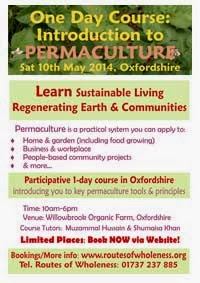
Register Now! Permaculture Intro Course (Oxfordshire): Sat May 10th 2014
We live in times that require the building of wholesome and resilient alternatives. Permaculture is a way of supporting us to do just that.
We are delighted to publicise the following course which takes place at Willowbrook Organic Farm in Oxfordshire in May 2014.
 This
is an introductory day that promises to be fun, educational and transformative!
There will be opportunities for networking with other course
participants.
This
is an introductory day that promises to be fun, educational and transformative!
There will be opportunities for networking with other course
participants.
Venue: Willowbrook Organic Farm, Hampton Gay, Oxfordshire.
Date:: Saturday May 10th 2014
Times: 10am-6pm
(Advance Booking Only: see link below)
Permaculture is a practical system for sustainable living, based on observing principles and patterns in nature. By maximising relationships in living systems, permaculture has empowered people worldwide to develop dynamic, resilient projects that work with nature, rather than against it. Whatever scale or aspect of human living, whether the home and garden, community or congregation space, or one’s own life and career, permaculture can be applied to each situation.
This interactive taster day will introduce you to some of the fundamental tools and principles that can be used to design sustainable, resilient projects.
The course content will include:
Course fees £55 standard rate / £45 concessionary rate
(Advance Bookings Only)
Food: Teas will be provided; Participants will need to bring a packed lunch/any snacks.
Visit 'Routes of Wholeness' for More info / to Book: www.routesofwholeness.org
To support a rich learning space, we are limiting participant numbers to a small group size. If you know you want to participate on the course, we recommend you book as soon as possible in order to secure your place.
-------------
We are delighted to publicise the following course which takes place at Willowbrook Organic Farm in Oxfordshire in May 2014.
Learn
Principles for Sustainable
Living
& Regenerating the Earth &
Communities:
INTRODUCTION TO PERMACULTURE: ONE-DAY
COURSE
Organised by 'Routes of
Wholeness', at Willowbrook Organic Farm in Oxfordshire. Venue: Willowbrook Organic Farm, Hampton Gay, Oxfordshire.
Date:: Saturday May 10th 2014
Times: 10am-6pm
(Advance Booking Only: see link below)
Permaculture is a practical system for sustainable living, based on observing principles and patterns in nature. By maximising relationships in living systems, permaculture has empowered people worldwide to develop dynamic, resilient projects that work with nature, rather than against it. Whatever scale or aspect of human living, whether the home and garden, community or congregation space, or one’s own life and career, permaculture can be applied to each situation.
This interactive taster day will introduce you to some of the fundamental tools and principles that can be used to design sustainable, resilient projects.
The course content will include:
- What is permaculture?
- Introduction to permaculture ethics and principles
- Nature observation
- Social permaculture
- Permaculture as a design system
- Applying permaculture
- Next steps
Course fees £55 standard rate / £45 concessionary rate
(Advance Bookings Only)
Food: Teas will be provided; Participants will need to bring a packed lunch/any snacks.
Visit 'Routes of Wholeness' for More info / to Book: www.routesofwholeness.org
To support a rich learning space, we are limiting participant numbers to a small group size. If you know you want to participate on the course, we recommend you book as soon as possible in order to secure your place.
-------------
3 Oct 2013
Why No Digging?: Nature as a Teacher
"Why no digging?"... This important question was recently asked on social media following a post I wrote yesterday titled, '9 Months No-Dig Permaculture in Small Growing Space'.
 I felt the answer to this question deserved a blog post of its own, and which can then be referred to in future posts around no-dig approaches to food growing.
My own understanding of permaculture is that it draws on nature as a teacher. Nature can be an example of how to nourish and regenerate the earth. (A Divine name, for instance, is Ar-Razzaq: The Nourisher, or Ever Provider, and there are many other beautiful ones that could also be relevant here).
Nature demonstrates deep and coherent principles of sustainability, and if through witnessing and reflecting on nature, we can be humble enough to allow nature to be our teacher, there are principles we might discover that nature embodies and that we can apply in creating our own systems, whether this be around food growing, economic systems, or social ones. Of course these can all interact, and that is one of the beauties of this interconnected dynamic world we are part of!
So, back to digging. If we look at nature, we can see that it rarely digs in the sense that it rarely dramatically inverts the soil. Instead, nature tends to work gently. In a forest, for instance, leaves fall, they slowly breakdown on the surface, and are gradually taken to deeper layers, in particular through earthworm activity. This process of organic matter being left on the soil surface and taken down (without digging) is a part of the process that naturally builds the fertilty of the soil and feeds life, a foundation for the creative effortless development and sustenance of a forest and the abundance that comes from it for an incredibly diverse range of life forms.
Permaculture would be not about copying this exactly, but about drawing on these principles to design systems (permaculture is a design approach) that provide for our needs in a sustainable way - which means also caring for our wider family: the earth and our fellow human beings.
Breaking it down a bit more, here are some specific tangible reasons for not digging (or at least minimising it):
While digging is something I would try to avoid where possible, there is an unofficial permaculture principle that underlies all of them, and prevents permaculture from becoming dogmatic. This principle is 'It depends'! After all, there are instances where some kind of digging would be appropriate and helpful (e.g. in heavily compacted soil). The aim, instead of no digging [full stop], is rather to create the conditions that minimise the need to dig, particularly over the longer term, and that means digging as little as possible in the first place. In our case, we have been fortunate whereby we have got away essentially without digging the soil at all.
All the best to everyone who is working (or working less!) to do this, and thank you to all my teachers who have helped me to explore the wonderful approach of permaculture which continues to support me in drawing on principles in nature to inspire my work in all its forms.
And thank you Saimma, for the question!
----
I have found these two books to be really helpful (and both of which have pages about tilling/not tilling the soil):
The Permaculture Garden: by Graham Bell (simpler)
The Earth Care Manual: By Patrick Whitefield (more comprehensive)
I felt the answer to this question deserved a blog post of its own, and which can then be referred to in future posts around no-dig approaches to food growing.My own understanding of permaculture is that it draws on nature as a teacher. Nature can be an example of how to nourish and regenerate the earth. (A Divine name, for instance, is Ar-Razzaq: The Nourisher, or Ever Provider, and there are many other beautiful ones that could also be relevant here).
Nature demonstrates deep and coherent principles of sustainability, and if through witnessing and reflecting on nature, we can be humble enough to allow nature to be our teacher, there are principles we might discover that nature embodies and that we can apply in creating our own systems, whether this be around food growing, economic systems, or social ones. Of course these can all interact, and that is one of the beauties of this interconnected dynamic world we are part of!
So, back to digging. If we look at nature, we can see that it rarely digs in the sense that it rarely dramatically inverts the soil. Instead, nature tends to work gently. In a forest, for instance, leaves fall, they slowly breakdown on the surface, and are gradually taken to deeper layers, in particular through earthworm activity. This process of organic matter being left on the soil surface and taken down (without digging) is a part of the process that naturally builds the fertilty of the soil and feeds life, a foundation for the creative effortless development and sustenance of a forest and the abundance that comes from it for an incredibly diverse range of life forms.
Permaculture would be not about copying this exactly, but about drawing on these principles to design systems (permaculture is a design approach) that provide for our needs in a sustainable way - which means also caring for our wider family: the earth and our fellow human beings.
Breaking it down a bit more, here are some specific tangible reasons for not digging (or at least minimising it):
- By inverting the soil, many microorganisms accustomed to living and functioning at a particular soil depth will die, and this impacts negatively on soil fertility (and increases the need for adding fertilisers/external inputs).
- Digging can bring weed seeds to the surface, increasing the need for further digging and leading to an upward spiral of digging! Instead what we have been doing on our plot is, in part, seeing weeds as a form of life that store valuable nutrients. By just hoeing weeds along the surface of the soil, we leave them on the surface (as mulch) where they suppress further weed growth and break down naturally, gradually releasing nourishment for other life, like leaves do when falling on the soil surface in a forest.
- Soil is a carbon sink. Digging releases the carbon stored in the ground into the atmosphere, so is counter to what we ideally want to be doing to reduce greenhouse gas emissions.
While digging is something I would try to avoid where possible, there is an unofficial permaculture principle that underlies all of them, and prevents permaculture from becoming dogmatic. This principle is 'It depends'! After all, there are instances where some kind of digging would be appropriate and helpful (e.g. in heavily compacted soil). The aim, instead of no digging [full stop], is rather to create the conditions that minimise the need to dig, particularly over the longer term, and that means digging as little as possible in the first place. In our case, we have been fortunate whereby we have got away essentially without digging the soil at all.
All the best to everyone who is working (or working less!) to do this, and thank you to all my teachers who have helped me to explore the wonderful approach of permaculture which continues to support me in drawing on principles in nature to inspire my work in all its forms.
And thank you Saimma, for the question!
----
I have found these two books to be really helpful (and both of which have pages about tilling/not tilling the soil):
The Permaculture Garden: by Graham Bell (simpler)
The Earth Care Manual: By Patrick Whitefield (more comprehensive)
2 Oct 2013
9 Months No-Dig Permaculture in Small Growing Space
I thought I would share a couple of photos to help convey some kind of pictorial overview as to changes that took place on our permaculture plot since we first got it.
Below is the plot as we got it about 9 months ago, in December 2012. The photo is taken from the south east corner of the plot>>
You can see lots of grass and weeds. The plot had not been worked on for many months as the previous holder was suffering from poor health.
After taking stock of the plot and reflecting on how to move forward, we thought that realistically it made sense that we work primarily on about half of it for the first year.
We were also committed to using permaculture principles, no insecticides/herbicides (i.e. organic) and to working with the plot without digging.
So, How did we do?! Let's move to the 'nine months later' mark. Just below is a photo taken from about the same position only a few days ago...
This is the plot near the end of September 2013. Early on, we built a compost structure from reclaimed wooden pallets (top part of photo).The area we've been growing on is about 16 square meters. We divided it into 4 beds, 2 are horse shoe shaped and 2 are rectangular.
Crops that we've been growing on these four beds include: potatoes, perpetual spinach, swiss beet, french beans (Blauhilde and Golden Gate varieties), courgettes, kale, radish, carrots, and squash... and yes, we did manage to work on the weedy site to grow all this food without digging! (A couple of open workdays helped, so thank you to everyone who came down for them).
Hopefully I'll get a chance to share more about how we did this on a future post.
Below is the plot as we got it about 9 months ago, in December 2012. The photo is taken from the south east corner of the plot>>
 |
| DECEMBER 2012 |
You can see lots of grass and weeds. The plot had not been worked on for many months as the previous holder was suffering from poor health.
After taking stock of the plot and reflecting on how to move forward, we thought that realistically it made sense that we work primarily on about half of it for the first year.
We were also committed to using permaculture principles, no insecticides/herbicides (i.e. organic) and to working with the plot without digging.
So, How did we do?! Let's move to the 'nine months later' mark. Just below is a photo taken from about the same position only a few days ago...
 |
| 9 MONTHS LATER>> SEPTEMBER 2013 |
This is the plot near the end of September 2013. Early on, we built a compost structure from reclaimed wooden pallets (top part of photo).The area we've been growing on is about 16 square meters. We divided it into 4 beds, 2 are horse shoe shaped and 2 are rectangular.
Crops that we've been growing on these four beds include: potatoes, perpetual spinach, swiss beet, french beans (Blauhilde and Golden Gate varieties), courgettes, kale, radish, carrots, and squash... and yes, we did manage to work on the weedy site to grow all this food without digging! (A couple of open workdays helped, so thank you to everyone who came down for them).
Hopefully I'll get a chance to share more about how we did this on a future post.
6 Jun 2013
Sat 8th June 2013: Hunger Action!: Away from corporate control, towards Food Sovereignty
"He who
sleeps on a full stomach whilst his neighbour goes hungry is not one of us."
Saying of Prophet
Muhammad (peace be upon him)
On Sat 8th June, in the lead up to the
G8, David Cameron is hosting an international hunger summit in London.
On this day, various actions by grassroot networks are planned.
BEYOND 'IF': Wisdom In Nature (WIN)
appreciates that a number of NGO's, including some Muslim ones, are supporting
the big IF campaign, and that the IF campaign has some good points (such as, tax
transparency, action on land grabs and biofuels, for example). WIN also believes
that the IF campaign has a fundamental gap - it remains weak on the issue of
'power'. There is no clear demand to take away corporate control from food and
farming and give it back to people - and it thus seems to leave food and
farming open to further control by GM companies. Additionally, we would like to
see support for the already developing Food Sovereignty
movement that arose over many years through small scale farmers around
the world.
Image via: www.theprisma.co.uk "Food sovereignty proposes an alternative food system that creates practical, sustainable and democratic solutions to the failed industrialised food model. It is an approach developed by smallscale food producers in the global South that has become a global movement....It is the right of peoples to healthy and culturally appropriate food produced through ecologically sound and sustainable methods, and their right to define their own food and agriculture systems."

Approximately a billion people in the world are
'hungry'. We feel that real solutions to hunger must facilitate communities to
define their own food and agricultural systems, and not to be prescribed to by
large corporations.
Thus, after consideration within, Wisdom In
Nature has chosen to give its support to Food
Sovereignty events on Sat June 8th: the events are direct: they
involve creating community gardens as a demonstration that food is a right for
everyone!
**To find
out how you can join in Food Sovereignty Events in the UK on
Sat 8th June: See below!!**
Other info>>
'Beyond Expectation: Participating in
Radical Food Movement Event' (Food Sovereignty in UK)
Blog post by WIN Rep, Muzammal
Hussain
"This was not my first event on food
justice - I had been to dozens. Yet... walking through woodland that happened to
be slippery, slopey and still, I weaved my way to Organiclea, a workers food
growing cooperative on the edge of London, to attend a food justice event that
went far beyond expectation..." Read full post>>> http://tinyurl.com/brw8m3q
Why 'War On Want' won't join the IF Campaign:
http://tinyurl.com/ba93dl8
**G8 HUNGER SUMMIT:
JOIN IN FOOD SOVEREIGNTY EVENTS!!**
Saturday 8 June
2013, London and across the UK
Actions to stop the corporate takeover
of the world food system.
Where: London,
Manchester, Edinburgh, Bristol, Stroud
When: Sat 8 June 2013Meeting place in London: Meet at 9.30am outside The Blackfriars pub, 174 Queen Victoria St, London EC4V 4EG. (Nearest tube: Blackfriars. Take the Blackfriars Bridge exit and the pub is on your right as you exit the station.) From there we will move as a group to a nearby location for the action.
Theme: Create a pop up community garden in central London (and other cities across the UK)
More information: Email info@foodsovereigntynow.org.uk to find out more or check facebook event
When: Sat 8 June 2013Meeting place in London: Meet at 9.30am outside The Blackfriars pub, 174 Queen Victoria St, London EC4V 4EG. (Nearest tube: Blackfriars. Take the Blackfriars Bridge exit and the pub is on your right as you exit the station.) From there we will move as a group to a nearby location for the action.
Theme: Create a pop up community garden in central London (and other cities across the UK)
More information: Email info@foodsovereigntynow.org.uk to find out more or check facebook event
Things to bring for
London: Wheelbarrows, tools, plants to plant, seeds, soil, banners, and
anything else to make a community garden flourish.
Organised by the UK food sovereignty
movement
On 8 June, in the lead up to the G8,
David Cameron is hosting a hunger summit in London. This summit is a meeting
where some of the biggest corporations (including Monsanto, Cargill, Vodafone
and Unilever) in the world are going to pledge millions to “stop” world
hunger.
This is part of what is called the New
Alliance for Food Security and Nutrition (launched at the G8 last year). In
actual fact, this New Alliance is going to be the vehicle to spread land
grabbing and GM across the African agricultural economy. African countries are
going to be signed up to aid conditionalities that will open them up for private
takeover of their land and seeds and further resource extraction. Civil society
organisations in Africa are not being consulted; their demands are to put power
into the hands of small producers not large corporations.
A few weeks ago, a group of community
gardeners, radical NGOs and anti-corporate activists met in London to make sure
an alternative voice goes out on the 8 June.
With the IF
campaign not doing enough to criticise the New Alliance, the hunger
summit is set to give David Cameron his ‘Make Poverty History’
moment at the same time as signing away African people’s rights. There must be
action now to delegitimise this hunger summit and call for the real solutions to
the food system set out in food sovereignty.
This is why you must spread the word
and come and join us to take action on 8th.
The idea is to plant a community
garden outside the venue of the hunger summit. This will demonstrate that food
is a right for everyone not a commodity to make profit from. So bring your
barrows, bring your plants, bring some soil and bring some seeds and show the
world that food is for people not for profit.
To find out more about the location
and target for the protest send us an email to:
info@foodsovereigntynow.org.uk
Critiques of the G8 New
Alliance: http://tinyurl.com/lsbhv3h
For more details of the
Edinburgh action: http://tinyurl.com/kvugxfg
For more details of the
Stroud action: http://tinyurl.com/lwxfytu
16 May 2013
GM and the Ummah: Should Muslims be eating genetically modified (GM) food?
When readiness of a meal coincides with the time for salah (compulsory ritual prayer), the eating of the meal comes first:Narrated Nafi': Ibn 'Umar said, "Allah's Apostle (SAW) said, 'If the supper is served for anyone of you and the Iqama is pronounced, start with the supper and don't be in haste till you finish it." If food was served for Ibn 'Umar and Iqama was pronounced, he never came to the prayer till he finished it (i.e. food) in spite of the fact that he heard the recitation (of the Qur'an) by the Imam (in the prayer). Narrated Ibn 'Umar: The Prophet (SAW) said, "If anyone of you is having his meals, he should not hurry up till he is satisfied even if the prayer has been started." (Bukhari Book 11, Hadith 642)
With this in mind, I invite you to reflect upon the importance of eating Allah’s gift of food in its best condition. Specifically, I ask you to consider that there may be something wrong with foods that are genetically modified (GM).
Whenever Allah SWT applies the description 'halal’ (lawful; legal) to food in the Qur’an, He also uses the description ‘tayyib’, meaning ‘pure’ or ‘good’. As Muslims, we need to know about the purity of our food. This includes GM food.
"Allah created the heavens and the earth in true (proportions): verily in that is a Sign for those who believe." The Qur'an (29:44)
Does GM corrupt Allah SWT's 'true proportions'? To begin addressing this question, let us (briefly) consider what the process of making GM crops entails and what this means for the earth …
To genetically modify the cells of a plant, a gene is usually taken from another plant or other organism and inserted into the plant. All of the plant's cells are then affected by the new gene and take on its characteristics. This includes the reproductive cells, meaning that subsequent generations will inherently carry the GM trait. The inserted gene will be chosen for a particular characteristic, but the insertion process can also lead to impacts on neighbouring genes.
GM can lead to changes that go beyond those that can occur through traditional cross breeding. When GM crops are grown in open land, the spread of GM from them cannot be contained since plants are pollenated by wind and insects. We must question whether impacts upon the food chain and the environment surrounding GM crops can be comprehensively predicted or controlled. These impacts include effects upon the people who eat the products of animals fed with GM crops, for example meat, dairy products or eggs.
As Muslims, we need to consider whether or not the open growing of GM crops, that lead to changes that cannot be contained, transgresses the balance in Allah SWT's creation.
“The sun and the moon follow courses (exactly) computed;
And the herbs and the trees – both (alike) bow in adoration.
And the Firmanent has He raised high, and He has set up the Balance (of Justice),
In order that ye may not transgress (due) balance.”
The Qur'an (55:5-8)
Do we know whether or not GM food products are tayyib?
“Eat and drink of the sustenance provided by Allah, and do no evil nor mischief on the (face of the) earth.”
The Qur'an (2:60)
The more that GM crops are grown in the environment, the more crops around them can become (and already have become) contaminated through wind and insect pollenation. If GM crops are modified with cells from unlawful organisms, will we be able to eat them? Will we even know whether or not our food contains GM? In our endeavours to eat food in the best and most wholesome condition, don’t we need to consider the entire food production process as well as taking care over the slaughtering of meat, the cooking of meals and the serving?
“It is He Who hath made you (His) agents, inheritors of the earth.” (Other translations of agents include 'viceroys' and 'successors')
The Qur'an (6:165)
As an agent of the earth, appointed by Allah SWT, have you made an informed decision about GM food yet?
“So direct your face toward the religion, inclining to truth. [Adhere to] the fitrah of Allah upon which He has created [all] people. No change should there be in the creation of Allah. That is the correct religion, but most of the people do not know.” (Other translations of Allah SWT's fitrah include 'original' and 'nature')
The Qur'an (30:30)
We choose, every moment, to make intentions, provisions and actions as Muslims. As Muslims, we must uphold Allah's balance in the earth, and avoid spreading mischief. I ask you to make a decision about how you, as a Muslim in this interconnected earth, need to behave regarding GM foods.
Jabir reported that Allah's Messenger (may Peace be upon him) commanded the licking of fingers and the dish, saying: “You do not know in what portion the blessing lies."
(Sahih Muslim Book 23, Hadith 5043)
I pray that you will not neglect any small actions that would deny you Allah SWT’s blessings through His gift of food, including the blessings of truth, purity and goodness. May you succeed in achieving the best conditions for every morsel of food that you serve and eat.
Useful webpages:
GM and Islam by Wisdom in Nature
http://www.wisdominnature.org.uk/Resources/GM/gmintro.htm
GM Watch
http://www.gmwatch.org/
Non GMO Project
http://www.nongmoproject.org/
Food Sovereignty
http://www.foodsovereignty.org
Organic halal food to buy (UK)
http://willowbrookorganic.org
http://www.organic-halal-meat.com
Beyond Halal
http://beyondhalal.com/
This article was published in SISTERS Magazine in April 2013 http://www.sisters-magazine.com/
8 May 2013
Workday on Permaculture Plot (Surrey): Mon 27th May 2013 - In Solidarity with 'Worldwide March against Monsanto'
Wisdom In Nature invites you to:
ALLOTMENT WORKDAY ON PERMACULTURE PLOT (SURREY) - In Solidarity with 'Worldwide March against Monsanto'
Registration info below>>
Date: ***Change of Date*** (due to illness) to Monday 27th May (i.e. Monday of Bank holiday weekend - it was originally planned for the 25th)
Time: 12pm-3pm.
Location: Reigate, Surrey. (Just outside M25, a couple of miles from Reigate train station. Reigate is within an hour from London on the train. Car parking available).
This is a volunteering day on a Saturday in Reigate (an hour's train ride from London). The plot is relatively new and in its beginnings as a permaculture project. The day would be of particular interest to anyone who would like to spend a few hours working on the land, and would like to see some permaculture principles being tried out on a land-based project.
Open to people of all faiths and beliefs, and all gardening abilities. No experience is necessary.
This workday was originally planned on the same day as the 'Worldwide March against Monsanto', with hundreds of protests being planned across the world. More info: http://tinyurl.com/cz9z25v The workday is being held in solidarity with these protests (even though the date of the workday has changed to Monday 27th May).
On Islam & GM: http://wisdominnature.org.uk/Resources/GM/gmintro.htm
To find out more/register your interest: email us on: volunteer[AT]wisdominnature.org.uk with your full name and contact number. Once registered, we will then send you email updates in the lead-up.
Things to bring
Gardening gloves (if you have any, but not essential)
Rough footwear.
Waterproofs in case.
A packed lunch.
Fluids & perhaps a hot drink in a flask for yourself
WIN website: www.wisdominnature.org.uk
ALLOTMENT WORKDAY ON PERMACULTURE PLOT (SURREY) - In Solidarity with 'Worldwide March against Monsanto'
Registration info below>>
Date: ***Change of Date*** (due to illness) to Monday 27th May (i.e. Monday of Bank holiday weekend - it was originally planned for the 25th)
Time: 12pm-3pm.
Location: Reigate, Surrey. (Just outside M25, a couple of miles from Reigate train station. Reigate is within an hour from London on the train. Car parking available).
This is a volunteering day on a Saturday in Reigate (an hour's train ride from London). The plot is relatively new and in its beginnings as a permaculture project. The day would be of particular interest to anyone who would like to spend a few hours working on the land, and would like to see some permaculture principles being tried out on a land-based project.
Open to people of all faiths and beliefs, and all gardening abilities. No experience is necessary.
This workday was originally planned on the same day as the 'Worldwide March against Monsanto', with hundreds of protests being planned across the world. More info: http://tinyurl.com/cz9z25v The workday is being held in solidarity with these protests (even though the date of the workday has changed to Monday 27th May).
On Islam & GM: http://wisdominnature.org.uk/Resources/GM/gmintro.htm
I'm interested - What to
do?
To find out more/register your interest: email us on: volunteer[AT]wisdominnature.org.uk with your full name and contact number. Once registered, we will then send you email updates in the lead-up.
If you would like to speak with us, call 0845 456
3960 (local rate).
If we have alot of interest, we may have to put a
hold on further registrations.
Things to bring
Gardening gloves (if you have any, but not essential)
Rough footwear.
Waterproofs in case.
A packed lunch.
Fluids & perhaps a hot drink in a flask for yourself
WIN website: www.wisdominnature.org.uk
Twitter: www.twitter.com/wisdominnature
Facebook: www.facebook.com/wisdominnature
Tel. 0845 456 3960 (local rate)
Facebook: www.facebook.com/wisdominnature
Tel. 0845 456 3960 (local rate)
27 Jan 2013
Permaculture: Growing Food in a Small Space
Just 10 years ago, 'permaculture', was a term known to just a tiny minority of people. Today, the term is known much more widely, with more and more people getting trained up in this remarkable approach of designing sustainable systems and applying it in their own lives and communities.
While I initially heard of permaculture in the late '90's, it wasn't for another 10 years (i.e. in 2008), that I took any formal training in it - a weekend course run by Naturewise that both inspired me and made me thirsty for more...
The following year, I applied to get onto Earth Activist Training - a two week residential intensive, while camping at Landmatters eco-community in Devon, that weaves together a full Permaculture Design Course (PDC) with sustainable activism and spirituality. One of the powerful ingredients of this course was the presence of some experienced activists in the direct action movement in the UK. It was a privilege to have been on it and I describe it a little within this post here.
When I returned from the EAT course, one of the first projects I completed was converting a small area of land in our garden into a productive growing space.
In the Beginning: Start with Observation..
 One thing we permaculturisits like to do before designing a system is to observe it - and an aspect of observation involves recognising potential 'threats' or 'constraints' to the site. Through creative design, we might then consider how to work around (or within) those constraints. This cute creature seen basking in the sun lived above us. She enjoyed certain activities on our small piece of land. Although she probably didn't realise it herself, her digging holes to relieve herself was seen as a bit of a 'constraint' in getting some things growing on the land! So, I wanted to find a way around this...
 To work around her behaviour, (or intrinsic characteristic), I decided to protect the site with netting. This actually had the added beneficial effect of preventing snails from getting to the veggies! I also put a layer of compost onto the soil, which you can see in the photo, the idea being to increase soil fertility and further cover any existing cat poop. Some of the compost was bought, and some was worm compost that we produce from organic kitchen waste.
Additonally, I chose to work on the site without digging, which would otherwise disturb the soil layers and microbiology, and would bring weed seeds to the surface. This would inevitably increase the need to dig in the future, setting up a viscious cycle. Instead I would hoe out any weeds at the surface,and let them lie on the soil. Letting the weeds rest on the soil in this way better mirrors principles in nature, and allows the weeds to breakdown where they directly feed the land.
Permaculture Principle: Make the least change for the greatest effect
 I then covered the compost with a layer of straw. This was for a couple of
reasons: firstly, to help prevent the compost drying out, and secondly
to reduce the chances of any weed seeds that may be present near the soil surface from germinating.
I then covered the compost with a layer of straw. This was for a couple of
reasons: firstly, to help prevent the compost drying out, and secondly
to reduce the chances of any weed seeds that may be present near the soil surface from germinating.
Maximise growing space by 'Stacking'
 This particular form of stacking is called 'vertical stacking'. We can also stack in time e.g. by growing crops that occupy the same space in different seasons so the land is productive throughout the year; or if we share the same living space with someone else but use it at different times of the day. (Permaculture can help design social systems as well as gardens! Indeed it can help integrate the two!) In the photo, the tall plant against the back south-facing wall is a beautiful climbing french bean, called Blauhilde. Yet, even though it is at the back, it still gets plenty of sunlight by nature of its height. There's also a few tomato and perpetual spinach plants in the photo, as well as Rosemary. So, lots of diversity in a small space.

Here's a few of the purple french beans being harvested. The plant is high yielding and the beans are delicious! They also have this unusual characteristic that while purple when raw, they turn green when cooked! The plant also has wonderful tiny purple flowers that you can see more easily by enlarging the photo.
 Here is a close up of a perpetual spinach plant (protected by netting). What I love about perpetual spinach is, you plant it once and it provides yield for months on end. I'm surprised more people don't grow it. Even with just a few plants we often had more than we could eat, and would often enjoy sharing the harvest with our neighbour.

Permaculture Pricniple: The Problem is the Solution

In this picture are potatoes being chitted indoors to get them started early, before planting them in the soil outdoors. This particular variety came from Seedy Sunday.

 There is a permaculture principle that 'the problem is the solution'. To make good use of space, I managed to secure some unwanted used tyres (the 'problem') from a local store, and used them to grow the potatoes (i.e the solution!).
As the potato plants grew, I would put another tyre on top of the existing ones, added some compost and topsoil, and thus made greater use of vertical space. This meant getting a greater yield for the same land surface area.

If you feel permaculture could be useful for your group and are interested in a workshop with Wisdom In Nature, click here for more information.
Further Reading
Here's a short selection of books that I've found useful and inspiring alongside course that I've attended...
The Permaculture Way / Also, The Permaculture Garden: Both by Graham Bell
Two very readable books by the same author. Both are useful in their own right.
Permaculture: A Beginners Guide, By Graham Burnett
A wonderful little book provides an excellent introduction to the permaculture approach.
The One Straw Revolution: By Masanobu Fukuoka
Not explicitly about permaculture but an inspiration to many permaculture practitioners.
Muzammal Hussain
While I initially heard of permaculture in the late '90's, it wasn't for another 10 years (i.e. in 2008), that I took any formal training in it - a weekend course run by Naturewise that both inspired me and made me thirsty for more...
The following year, I applied to get onto Earth Activist Training - a two week residential intensive, while camping at Landmatters eco-community in Devon, that weaves together a full Permaculture Design Course (PDC) with sustainable activism and spirituality. One of the powerful ingredients of this course was the presence of some experienced activists in the direct action movement in the UK. It was a privilege to have been on it and I describe it a little within this post here.
When I returned from the EAT course, one of the first projects I completed was converting a small area of land in our garden into a productive growing space.
In the Beginning: Start with Observation..
 One thing we permaculturisits like to do before designing a system is to observe it - and an aspect of observation involves recognising potential 'threats' or 'constraints' to the site. Through creative design, we might then consider how to work around (or within) those constraints. This cute creature seen basking in the sun lived above us. She enjoyed certain activities on our small piece of land. Although she probably didn't realise it herself, her digging holes to relieve herself was seen as a bit of a 'constraint' in getting some things growing on the land! So, I wanted to find a way around this...
  To work around her behaviour, (or intrinsic characteristic), I decided to protect the site with netting. This actually had the added beneficial effect of preventing snails from getting to the veggies! I also put a layer of compost onto the soil, which you can see in the photo, the idea being to increase soil fertility and further cover any existing cat poop. Some of the compost was bought, and some was worm compost that we produce from organic kitchen waste.
Additonally, I chose to work on the site without digging, which would otherwise disturb the soil layers and microbiology, and would bring weed seeds to the surface. This would inevitably increase the need to dig in the future, setting up a viscious cycle. Instead I would hoe out any weeds at the surface,and let them lie on the soil. Letting the weeds rest on the soil in this way better mirrors principles in nature, and allows the weeds to breakdown where they directly feed the land.
Permaculture Principle: Make the least change for the greatest effect

Maximise growing space by 'Stacking'
Rather than making expensive interventions with potentially harmful consequences, permaculture is more about maximising the relationship between existing resources - this means working with what is already there in a harmonious way. Thus, using a permaculture principle called 'stacking', taller plants can be grown close to shorter ones - the taller ones are positioned furthest from the sun, and the smaller ones closer to it. This minimises competition for sunlight and means greater overall yields for the same area.
 This particular form of stacking is called 'vertical stacking'. We can also stack in time e.g. by growing crops that occupy the same space in different seasons so the land is productive throughout the year; or if we share the same living space with someone else but use it at different times of the day. (Permaculture can help design social systems as well as gardens! Indeed it can help integrate the two!) In the photo, the tall plant against the back south-facing wall is a beautiful climbing french bean, called Blauhilde. Yet, even though it is at the back, it still gets plenty of sunlight by nature of its height. There's also a few tomato and perpetual spinach plants in the photo, as well as Rosemary. So, lots of diversity in a small space.
Here's a few of the purple french beans being harvested. The plant is high yielding and the beans are delicious! They also have this unusual characteristic that while purple when raw, they turn green when cooked! The plant also has wonderful tiny purple flowers that you can see more easily by enlarging the photo.
 Here is a close up of a perpetual spinach plant (protected by netting). What I love about perpetual spinach is, you plant it once and it provides yield for months on end. I'm surprised more people don't grow it. Even with just a few plants we often had more than we could eat, and would often enjoy sharing the harvest with our neighbour.
Also planted were broad beans. These were actually harvested before the other crops.
Permaculture Pricniple: The Problem is the Solution

In this picture are potatoes being chitted indoors to get them started early, before planting them in the soil outdoors. This particular variety came from Seedy Sunday.

 There is a permaculture principle that 'the problem is the solution'. To make good use of space, I managed to secure some unwanted used tyres (the 'problem') from a local store, and used them to grow the potatoes (i.e the solution!).
Here's a sample of the harvest of potatoes.
So that's a brief outline of a few permaculture principles that can be used by anyone, to grow food even in a small urban space.
Permaculture Workshops
Further Reading
Here's a short selection of books that I've found useful and inspiring alongside course that I've attended...
The Permaculture Way / Also, The Permaculture Garden: Both by Graham Bell
Two very readable books by the same author. Both are useful in their own right.
Permaculture: A Beginners Guide, By Graham Burnett
A wonderful little book provides an excellent introduction to the permaculture approach.
The One Straw Revolution: By Masanobu Fukuoka
Not explicitly about permaculture but an inspiration to many permaculture practitioners.
The Earth Care Manual: By Patrick Whitefield
Comprehensive, and very well written. For Britain and other Temperate Climates.
Muzammal Hussain
22 Jan 2013
Islamic Group: Away from GM Crops - Towards Holistic Approaches Aligned with Core Islamic Principles
WIN's Position on GM Food


Away from GM Crops -
Towards holistic approaches aligned with core Islamic Principles
Towards holistic approaches aligned with core Islamic Principles
"At WIN, through our research, discussions and reflections, we believe that the release of GM organisms into the wider ecology should, from an Islamic perspective, be opposed.
Furthermore, we believe that there are approaches - such as permaculture, organic farming and agroforestry
- that have fewer risks, are based on a greater recognition of the
interconnectedness of life, and which instead of undermining
relationships, draw on principles that nurture them. They thus are more
in alignment with core principles from the spiritual traditions
including Islam.
We ask Muslim
communities around the world to wake up to the fact that industrial
farming practices, of which GM is a part, do not fit with core Islamic
values. In the same light, we cannot turn a blind eye to the fact that
GM crops are fed to animals destined for halal slaughter.
If
the 'halal' stamp is incapable of defining what is Islamic, we must
move beyond the false comfort zone the term 'halal' has provided, for
it is now beyond any doubt that a more authentic 'Islam' needs to
emerge, one that is alive to the challenges of our time, yet remains in
union with the spirit of this beautiful tradition.
Also, we believe
that as we move away from large scale industrial farming towards smaller
scale decentralised food production, this would not only be more
compatible with a sustainable, life supporting future, but would also
lead to greater empowerment. Such a move will also draw people, land,
livelihood and traditional local knowledge together, enriching
biodiversity and nurturing community.
Witnessing the
small, but growing numbers of Muslims working at the grassroots with
fellow citizens of the world to create a new, more wholesome paradigm
gives us much hope.
We have produced
the GM section on our website in a style that we hope is readable, while
outlining key background information to help readers appreciate the
reasoning and principles leading us to take the clear position we have.
We received no
funding for this project, and the production of this part of the website
was completed entirely through voluntary efforts.
Wisdom
In Nature is open to collaboration and partnerships with like-minded
people, networks and organisations. Applications for volunteering are also welcome. Please get in touch!"
--------------
Visit the
GM & Islam section on
Wisdom In Nature's website>>
GM & Islam section on
Wisdom In Nature's website>>
13 Jan 2013
Seedy Sunday: UK's Biggest Seed Swap!: Sun 3rd Feb 2013, Brighton
Seedy Sunday Brighton, the UK's biggest and longest-running community seed swap event.

Date: Sunday 3rd February, 10am - 4.00pm
Venue: Brighton Corn Exchange, Church Street, BN1 1UE.
Venue: Brighton Corn Exchange, Church Street, BN1 1UE.
Seedy Sunday is the UK's biggest community seed swap. The event takes place every February in Brighton and Hove, in southern England. Seedy Sunday is also a campaign to protect biodiversity and protest against the increasing control of the seed supply by a handful of large companies.
Entry
to Seedy Sunday is just £3, concessions £2, children free. Come and
enjoy more than 50 stalls, lots of talks, demonstrations and children's
activities as well as the community seed-swap.
Seedy Sunday is supported by The Heritage Seed Library and The Millennium Seed Bank and generously sponsored by Infinity Foods.
More info: www.seedysunday.org
Location Map: Click here
Location Map: Click here
More info: www.seedysunday.org
Location Map: Click here
Subscribe to:
Posts (Atom)


Seedy Sunday Talks Programme 2013
Every year Seedy Sunday aims to provide a stimulating, challenging and entertaining series of talks during the day and this year we're very excited to have some great speakers joining us to discuss some very important topics. Whether you're interested in politics and campaigning or horticulture and sowing the seeds you've swapped, there are talks on this year's programme for everyone. Each talk will be followed by an opportunity for questions and discussion.(Check the programme on the day for final details)