Pages

14 Oct 2010

Personal Story 2, by Ali Ajaz: Islamic Community Food Project at Spitalfields

"Disenchanted with biased globalised food system" check!
"Tired of seeing a new Tesco Express opening up 5 minutes from the old Tesco Express" check!
"Unhappy about seeing the old Tesco Express in the first place" –check!
"Interested in exploring alternatives" check!
"A community food initiative sounds good" check!

Having been aware of the important work that Wisdom in Nature have been involved with, I’d been meaning to be a part of this interesting movement for some time now. But events came and went as the toils of this world seemed to get the better of me and my ‘free’ time. However, upon hearing about an Islamic Community Food Project, I was determined to attend hoping to learn something tangible from this grassroots, progressive movement which was based upon the underpinnings of Islamic principles. What could sound better than this?

This first meeti
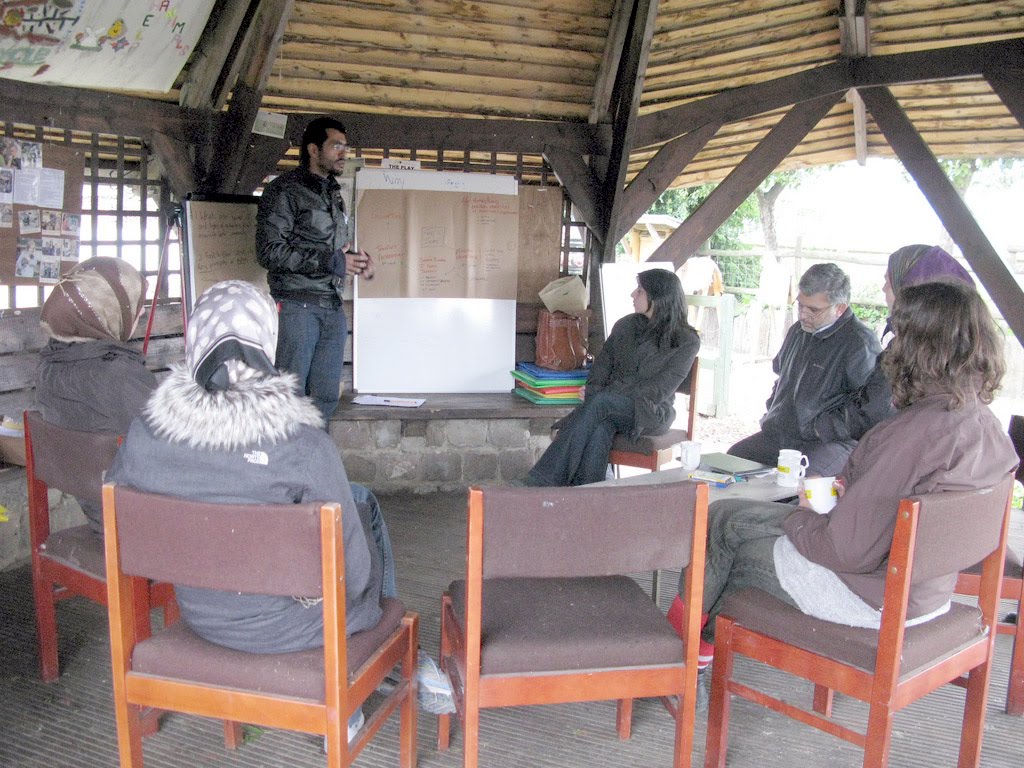
ng was held at Spitalfields City Farm and although I live less than a few miles away, I had no idea that it existed. Neatly tucked away amongst the urban hustle and bustle, it provided a very welcoming distraction to the all too familiar commotion of the Sunday market in East London. The day started off by helping out with a number of duties on the farm. Now this may sound somewhat daft but I experienced a hint of apprehension about doing something on a farm. I attributed this to my urbanised upbringing and limited connection/neglect of the natural environment around me. I was therefore surprised by the degree of tranquillity obtained from just pulling weeds on this cool Sunday morning. More of this was what I needed!

The afternoon session initially focused upon getting better acquainted with the other members of the group and it became apparent very quickly that there was a common enthusiasm shared by all. Individuals from various backgrounds, seemly united by a hope to be part of something exciting, something meaningful. The group dynamics were allowed to evolve naturally by the expert guidance from Muzammal and Wasi. Concepts of food and community in an Islamic context were explored by the group and by the end of the afternoon, I felt an optimistic vibe reverberating though the group, this despite the ever falling temperature. This Islamic Community Food Project has the potential to grow and bloom into something special and I am looking forward to being a part of it.

Ali Ajaz

All Photos © Wisdom In Nature

Personal Story 1, by Saira Khan: Islamic Community Food Project at Spitalfields

Food For Thought

The “Islamic Community Food Project”, my eyes glazed over a little bit as I read the b
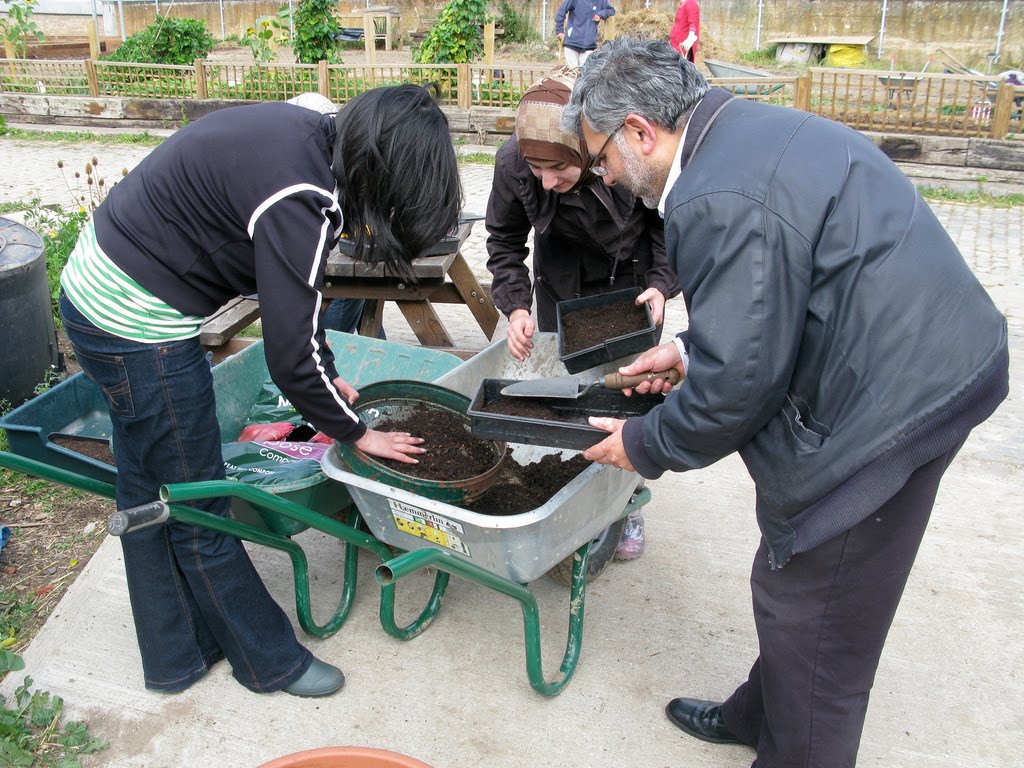
riefing sheet on my way to Spitalfields City Farm. Hailing from the concrete jungle that is London I’m not sure I had ever set foot on a farm before. Yet on one particularly cold September day I found myself trudging through a farm, trawling through compost, planting seeds, and trying to stare down some uber cool geese strutting around me with what I am convinced was the theme to Saturday Night Fever in the background … I’m not sure I won that stare battle, I got the feeling that they kind of run the place, like some sort of bird Mafia. Not only did I never imagine I would be doing all of the above, but I found that I was actually thoroughly enjoying myself!

I must confess that it was with more than a pinch of trepidation that I volunteered to be part of this project. I wasn’t exactly clear on what it was all about, but this was actually a blessing in disguise because I found that the atmosphere of encouragement, empowerment and participation meant that as the day went on and as the group undertook various discussions and exercises, it became clear that on some level we already knew what we wanted to achieve and the project could in effect be what we collectively wanted it to be. Consequently in a kind of “wax on wax off” moment, the excellent facilitators, Muzammal and Wasi (of Wisdom In Nature) and Naomi (of Spitalfields City Farm), gently prodded our collective knowledge and experience in order to give us the realisation of what our objectives were in developing the project and how we could each contribute to it’s future development. It really is an exciting prospect and I’m looking forward to seeing how it develops.

As for the people involved, I honestly can’t speaking highly enough of the facilitators and the attendees at the project. Each person came with their own story and a great deal of enthusiasm and energy. I felt that this group of like minded people who found themselves laughing, praying, meditating, conversing and eating delicious food together could really be part of something extraordinary.

So, to conclude, I’m glad to report that following our first meeting the Islamic Community Food Project is now up and running. They say that each journey begins with the first step, and I can honestly say that I thoroughly enjoyed making that step and look forward to the future leaps and bounds!

Saira Khan


All Photos
© Wisdom In Nature

19 Sept 2010

Thurs 28th Oct: Faith and the Environment (London)


I find Transition initiatives an exciting community-led idea, and have on occasion witnessed individuals tirelessly working to complete inspiring projects that have rippled to empower the local community. There is much to be said in today's world, about people owning their power by organising together. It takes passion, patience, the ability to work authentically in groups, and with inner work can be used as a vehicle for spiritual growth. 

This public seminar in Kingston, is organised by Kingston interfaith Forum along with the local Transition initiative and Kingston Council. An area that some Transition initiatives are looking more closely at is that of diversity. I'm honoured to have been invited to speak at this collaborative event, and look forward to meeting and engaging with fellow speakers, workshop leaders and participants.

Date:  Thursday 28 October 2010
Time:  6pm-8.30pm 
Venue: Guildhall Council Chamber, Kingston, KT1 1EU; Map & Directions 

A free public seminar organised by Kingston Inter Faith Forum in partnership with Transition Town Kingston and the Royal Borough of Kingston upon Thames

REGISTER YOUR PLACE: This event is open to all who reserve a place with Jean Cousens tel. 020 8547 5023 email: jean.cousens@rbk.kingston.gov.uk by 8th October 2010.
Refreshments provided. 

‘Never doubt that a small group of thoughtful, committed citizens can change the world. Indeed, it is the only thing that ever has.’ (Margaret Meades) 

Speakers: 
Dr Muzammal Hussain, Founder of ‘Wisdom in Nature’, on: Engaged Spirituality and Diversity in an Age of Transition: with an Islamic Perspective.
Dr Laurie Michaelis, Co-ordinator of Living Witness: Quakers for Sustainability.
Chaired by the Leader of the Council, Councillor Derek Osbourn

Click here for more info

1 Sept 2010

Can You Help Us? Financial APPEAL for Print Copies of Islam & Climate Photo-booklet


Whilst we have finally launched the online version of our popular colour booklet, Islam & Climate Change ~ A Call to Heal, (downloadable for free), we still haven't yet had our first batch of copies printed. The reason is simple: Finances. As a grassroots organisation we need money from people like You to be able to do this.

To get the first batch printed (we are going for recycled paper, using a printing company with
a strong ethical stance) we need at least an additional £800 for one-thousand copies of the 20-page colour booklet. We ask if you would be willing to help us reach this amount so we can have copies available as soon as possible. They would be distributed for free with donations suggested (which will help cover the next batch and so on! - this would make it sustainable in the longer run!)

Our bank account details are on our donate page

If you have any questions please contact us, or feel free to use the comments tag at the bottom of this blog post.

With thanks from the Wisdom In Nature team for any financial help you can give us.

26 Aug 2010

Retreat: deeper into life, not further from it

At the beginning of this month I was lucky enough to be a part of a weekend retreat – 24 hours away from the usual bustle and buzz of life in London, in the beautiful setting of the Quadrangle.  LIFE (Local Initiative for Faith and the Environment) is a group, working with women in Lambeth, to bring them together over inter-faith dialogue and the environment.  The Quadrangle is a farmstead in Shoreham, Kent – lovingly restored, and sitting within the peaceful and quietly stunning Darent Valley, it provides a perfect space for community activities.

Rebecca Brewin and Saadat Yusuf of LIFE coordinated this 24 hours ‘LIFE-giving retreat’, taking a group of women from the usual busy-ness of their lives, and bringing them to the beauty and tranquility of the Kentish countryside.   The weekend allowed each of us to experience life in a way we maybe forget too often, with the responsibilities and duties that we often  need to attend to, before being able to attend to ourselves.

We were led in sessions of yoga, introduced to foraging, and walked together, surrounded by beauty and kissed by the sun.  We cooked and ate together, had a sewing circle where we learnt to make something practical and pretty, and even sang together.  And throughout the weekend, the warmth of true, heart-driven sharing permeated all that we did.  In the reflections on Qur’an and eco-poetry session that I held, I was warmed to hear people really speaking honestly and reflectively, and this authenticity and genuine interest was something recurrent throughout our time together.

‘Together’ – I keep using this word to describe our time away, and really for me, it sums up so much the feeling that the weekend left me with – a feeling of having really shared and learnt from these women in a way I could never do alone, or even when surrounded by people, but without that openness and naturalness.  ‘Warm glow’ became my default setting for the time there, and I carried the tranquility and happiness from the weekend forward with me when I returned again to the buzzing of London town.
Here are a few pictures from my time at the Quadrangle with this lovely group of women, and a link to some others.  I look forward to the next time I can experience such a warm meeting of hearts and minds.


23 Aug 2010

Islam & Climate Change ~ A Call To Heal: Online Booklet Launch

We are delighted to announce the launch of the online version of our long-awaited colour booklet: Islam & Climate Change ~ A Call to Heal. It is available to download for free from our main website.

We've been dedicating our time to this for quite a bit longer than we had originally planned - a few months longer in fact! - and whilst painful at times, we managed to patiently work through the difficult parts to experience the joys that follow, and which come from working within a great team. And yes, we are pleased with the outcome as well! We invite you to take a look.

The Wisdom In Nature team
---

From a small team of faith-inspired community activists...


This picture guide outlines an Islamic perspective on one of the most pressing challenges of our time. In simple language and with pictures, it introduces the following themes:


Disturbance of the Natural Order; A Call to the Fitrah; Unnatural Disasters; Islam: A Religion of Harmony; Fulfilling our Role as Khalifah; A Revival towards Wholeness; The Power of Many…


Climate Change is a signal that humankind has lost its course. By drawing on spiritual wisdom, we can respond to this call - this call to heal. This booklet was produced by a team of community activists to educate, cultivate reflection and inspire holistic action to help build a fairer and more sustainable world for all.


Download for free from here


The booklet was produced through voluntary efforts by a team of committed activists along with design support as we neared completion.


Financial help needed, to support our work and make print copies available: As soon as we are able, we would like to have print copies of this booklet to offer and distribute for free to the wider public. In order to help us to further our work and to make these copies available, financial contributions are invited and gratefully received. (More details are on page 12 in the booklet for anyone who might like to support us in this way).

With thanks from the Wisdom In Nature team

10 Aug 2010

Sun 26th Sept: Islamic Community Food Project (London)

Awareness, Grassroots Organising, & Action..

Organised by Wisdom In Nature (WIN) with Spitalfields City Farm

Registration details below

Date: Sun 26th Sept 2010
Time: 11am to 4pm
Venue: Spitalfields City Farm, Buxton Street, London, E1 5AR. (Nearest tubes: Whitechapel (Hammersmith & City / District Lines), Aldgate East (Hammersmith & City / District Lines), Bethnal Green (Central Line); Buses D3)
Includes a hands-on practical.

As more people organise from the grassroots, community food initiatives are on the rise. These small steps not only empower, but offer alternatives to the globalised food system that favours multinationals. At the same time, within Muslim communities awareness is growing that Islam offers ecological principles that extend beyond the term 'halal'.

With a deeper food ethic waiting to emerge more fully, there is much that spiritual traditions can offer and Muslims and others can do, to contribute to a more holistic paradigm - one that empowers individuals, helps build resilient communities, and genuinely draws us towards a sustainable and more compassionate world.

When we come together with our different life experiences, skills, and backgrounds, we can achieve so much more than when we work in isolation. This day is for anyone who wants to work with others to help culture this new paradigm. It is for those who want to hear and share ideas & stories, reflect on what is possible, and take small, vital steps to make the imagined real.

The programme will include: A workshop with Wasi Daniju & Muzammal Hussain, from Wisdom In Nature;
& a practical on the land with Naomi Glass, from Spitalfields City Farm.

To make the most of the day, bring an open mind, a team spirit, and the yearning of your soul to create something wholesome for all. This is a first event, and for those who want it, can lead to further opportunities to connect and organise with like-minded participants.
Please dress for the weather and bring sturdy footwear. A vegetarian soup meal and refreshments will be provided. Feel free to complement with any small snack to share.

COST: £2 donation per person will cover expenses including food.
REGISTER: To reserve your place, please send an email titled 'Register', with your full name, to: communityfood_AT_wisdominnature.org.uk (replacing _AT_ with @ ) ; Note that registration is for the full day. and will only be complete once you receive a clear confirmation from us. We cannot guarantee registration received after midday on Thursday, 23rd September.

For more info: :
Wisdom In Nature - Islamic Ecological & Community Activism: www.wisdominnature.org.uk ; tel 0845 456 3960 (local rate)
Spitalfields City Farm: www.spitalfieldscityfarm.org

29 Jul 2010

Year of No Flying

A few days ago, amidst another weekend dash between Brighton and London, I sat down to have coffee with a couple who were trying to travel the world without flying. Their names are Anirvan and Barnali, and they are an Indian  couple who live in San Francisco.

At the time of our encounter near Gloucester Road tube station in London, they had already travelled through Bangladesh, India, Mongolia, China, Russia, Turkey, Italy, and France, to name a few countries. After London, they would head to Liverpool, and then by sea back to the States.

On their travels they had arranged meetings with numerous activists. They had contacted me a few weeks before their arrival in the UK, and during our meeting, I had a chance to share some of my personal reflections on, the beginnings of WIN; social dynamics within mosques and Muslim communities (as far as my experience allowed); power and hierarchy and my general sense that more equalising of power was central to ecological activism and creating the world we want to live in; and a Climate Camp workshop we led last year on 'Muslims and the Climate Movement', for example. 

I was very keen to also hear about their experiences, an Indian couple living in the States passionate about ecology - and travelling the world, yet trying not to fly whilst doing so. What had they learnt on the way? How did they relate to mainstream western environmentalists? What were the dynamics within a Hindu temple? How was their lifestyle perceived within Asian and Hindu communities?.. Time was short, and although we only touched the surface, I really enjoyed our conversations and was touched by their honesty and sincerity.

After the meeting, we continued chatting on the train having realised that we were all heading south. We followed up with more.. the ethical potential of micro-credits as they become popular; Islamic economics; and what it's like travelling ten days in a cargo ship.

I wish them both well, what they are doing is really inspiring, and there is more about it here:  


27 Jul 2010

Event: Sat 31st July- Sun 1st Aug: Ecology retreat: WIN at LIFE retreat for women (Shoreham)

I am excited to be taking part in a mini-retreat this weekend, organised by LIFE, Local Initiative for Faith and the Environment.

The 24-hour retreat will be at The Quadrangle, a converted barn in Kent.  It will include walks in the local area, exploring ecology, and sharing life stories.  We will also be sharing a dormitory, cooking together, and bringing food to share for a picnic on the first day.  I'm especially excited at the opportunity for some (indoor) camping inside the barn!

I will be facilitating a workshop in which we will be reflecting on verses from the Qur'an, and selcted verses of ecopoetry.

It is still possible to sign up for the day, though firm confirmation is needed as soon as possible.

Further details from LIFE:

If you are interested in coming, the cost will be on a donations basis, depending on how much you can afford.
£10 for unemployed / £20  for low income / £30 for fully employed

Contact: Rebecca Brewin – rebecca@handtoearth .net/ 07896 936 625
or Sadaat Yusuf - saadat_yusuf@ yahoo.co. uk / 07939 325 032

LIFE has been created as a bridge between faith-based networks and environmental action in the Borough of Lambeth.

The hope is that this bridge serves to bring people together around two of the most vital pillars of peace-building in society today: climate change and inter-faith dialogue.

29 May 2010

Event:Tue 8th June: Permaculture & Activism: WIN at WDM meeting (Brighton)

On Tuesday 8th June 2010, I look forward to leading a discussion on Permaculture & Activism at the Brighton & Hove local group of the World Development Movement (more about the group here) They are a fantastic group and have a small core of experienced, intelligent activists. In fact, they in part inspired the initiation of Wisdom In Nature (I was an active member of WDM in Brighton several years ago). I have found their discussions to be really stimulating, and they enjoy reaching out to explore a range of areas far beyond any immediate topic they might be campagining on.

The event starts at 7.30pm (Venue: Brighton Peace & Environment Centre (BPEC), 39 - 41 Surrey Street, opposite Brighton station), and the discussion is part of their June monthly meeting at which they'll also be revisiting their past events and planning new stuff.

28 Apr 2010

Event: Sat 5th June: A Basic Introduction to Islamic Eco-theology (London)

Date: Sat 5th June 2010

Time: 2.30pm - 5pm
Venue: Islamic Centre of England, 140 Maida Vale,
London W9 1QB (Nearest Tubes: Maida Vale, Kilburn Park Station): Google Map: click here


Organised jointly by Wisdom in Nature (www.wisdominnature.org.uk) and the Islamic Unity Society (www.ius.org.uk).


Speaker/facilitator: Muzammal Hussain, founder of Wisdom in Nature (WIN) with co-facilitators Leila Taheri (IUS) & Wasi Daniju (WIN)


We will hear a short talk outlining some basic principles of Islamic eco-theology. We will consider the implications of these principles in today's world and in our communities. The afternoon will also include a short workshop in which we explore an area more deeply using the Qur' an. There will be an opportunity for discussion and networking.

Please bring a copy of the Qur'an with translation and preferably also commentary if you have one.


The event is also on Facebook: Click here


Cost: £3 concessions; £5 standard rate

For further information, contact Wisdom in Nature on 0845 456 3960 (local rate);

To reserve a place email your full name to: green@ius.org.uk


27 Jan 2010

Come to the 'Edge': A Muslim, an Ecologist and Permaculture

“Come to the edge, he said.
They said: We are afraid.
Come to the edge, he said. They came.
He pushed them…and they flew.”

Guillaume Appollinaire


The Cultural Commute

Being an ecologist and a Muslim, I often experience what seem to be two distinct worlds. The first is the world of low carbon lifestyles, non-hierarchical decision making, and compost toilets in which you can’t pee, interspersed with questions like “are you sure it’s vegan?” The other is the world of high carbon jumaa’s, and a string of questions such as “where’s the lamb bro?”, and “what do the scholars say about that?”

Enriching though this cultural commute might be, the overhanging cloud that moves with me is that I often do not feel like a true citizen of either world. Rather, I feel like someone who gets a kick out of living in lands in which I understand the language, but am unable to properly speak it – and whilst I admit that I have to an extent generalised in my description of these two worlds, there are nonetheless elements of reality I have experienced that fit the cultural outlines rather well.

It’s not that I don’t strive for a low-carbon life-style, or that I wouldn’t refer to a scholar, or that I don’t see the value of non-hierarchical organising, for example (I do and would on all three accounts!), but more that associated with the cultures in which these behaviours and comments are norms, can be a cargo of assumptions. These assumptions, like any that are deep-rooted enough, can give rise to blind-spots to perspectives which need wider awareness if those perspectives are to be perceived, given breathing space, and dialogued with.


The Meeting of Worlds

My personal journey, is guided I hope by spirituality, by Islam, and the knowledge that Islam is intrinsically ecological, that the world of a ‘Muslim’ is in truth, inseparable from the world of an ‘ecologist’. However, a commute of the kind I described earlier is inevitable for me on at least two accounts - firstly because of a role I have landed in, as an activist, student and mentor in an Islamic environmental network, and secondly because of my belief that the meeting of worlds can be a place of richness and beauty. Thus, I can find myself conversing with a hard-core anarchist, a mosque regular, a rep from an NGO driven by funding targets and a member of the Transition Town Network all within the space of a few days.

A conversation with a member of any one of the above groups might make me feel both inspired and humbled. In some instances, however, I might feel less an equal party to a conversation and more like a recipient of a robotic sermon from an over-zealous citizen of another world. Whilst after the latter experience, my belief that a meeting of worlds is a great thing could benefit from gentle resuscitation, both instances are nonetheless examples of what permaculturists might call ‘the edge’. 


The Scope of the 'Edge': Permaculture & Islam

 
‘The edge’ was explained to me during a two week permaculture and activism course I participated in during the summer of 2009 in Devon. One of the course instructors was a woman called Starhawk. A humble character, she is the author of about a dozen books, and also has a wealth of experience in activism, including on the Middle East, corporate globalisation, environmentalism as well as on economic justice. Her approach is such that she is committed to creating the kind of world she wants to live in, rather than simply campaigning against the one she doesn’t. What particularly impressed me about Starhawk (as though the above wasn’t enough!) was her understanding of diversity issues that I had picked up through some of her writings. She seemed be one of the few ecologists in the North who really knew what it was like to be in a marginalised group, and how to be inclusive to those who were.

The other lead instructor, Andy Goldring, in his deliciously animated and energetic style, explained that in terms of natural systems, ‘the edge’ is an area where two eco-systems come together to form a third. For example, this could be where a forest meets with a meadow, or a lake with woodland, or a pond with grassland. Because they contain species from both eco-systems, edges are areas of dynamism, diversity and creativity. Hence, this is why spiral and curved shapes are common in systems based on permaculture principles. A spiral shaped pond offers several times more edge than a rectangular or round one of equal size. This allows for greater interaction and hence gives more opportunity for biodiversity to develop.

Starhawk then followed by pointing out the cultural ‘edge’. In music for instance, the meeting point, or edge
between two musical cultures can give rise to an altogether new musical form. And for me, the presence of two distinct groups, such as certain Muslims and certain ecologists can give its own unique edge experience! Naturally, the meeting point between two systems or social groups is also a vulnerable place where there is potential for tension, though if each system is also given its own space, this provides conditions which can enhance resilience.

A good dose of edge-ness can thus be a blessing, whilst too much, or at least edge without room to breathe, might make us… edgy, I suppose! 

The Qur’ an points to the importance of edge in the context of cultural diversity through the following verse:

O men! Behold, We have created you all out of a male and a female, and have made you into nations and tribes, so that you might come to know one another. (Qur’ an: 49:13)

Islam also values another kind of edge. That is the edge within daily cycles, the junction points between times of the day, such as during sunset and dawn, for example. These points of transition are, for Muslims, a time to
punctuate worldly activity with formal worship through salaat. Performed with presence, it is a step towards the unity behind cultural and natural diversity, the constancy behind change, the unseen behind the seen. A frequent dose of such an experience nurtures an attitude of compassion, something that is essential if the meeting between elements from two worlds is to be a healthy one.

As well as outwardly, there are inner edges. For instance, an over-guarded edge can create in me walls of separation, and herein lies a fragmented consciousness. Yet, if I begin to reflect on how different beliefs I hold exist in the context of each other and deeper levels of my self, then I am opening myself up for new ideas and inspiration. My thinking can become more whole.


What Space to Reflect?

Through the financial and ecological crises, strands connecting different areas of life have become more visible. The financial system is, as our relationship with the earth – it is unsustainable - and indeed our financial system, entrenched in money creation, interest-based lending and growth is a core contributor to resource depletion, pollution, climate catastrophe and violence. Simultaneously, with the increasing rate of change that such an economy brings, our attention is like a feather on a stormy day, blown from place to place with no time to settle. Thus, the essential space needed to reflect on experiences, on what it means to live according to the fitrah, for insights to emerge, and to create a world that is more meaningful is being constrained by the world as it is.


Finding the Doors and Walking through

Yet, opportunities for transformation can form with only slight adjustments to our way of life. These opportunities are contained, for instance, in situations in which wisdom and insights can be shared, when skills or talent that any of us has can find their ways to others. This is the nature of many traditions, and skills-sharing has also become common in Transition initiatives, a movement originating in Kinsale, Ireland, that aims to respond to the twin challenges of peak oil and climate change. Thus, a dinner invitation can be modified into a pot-luck experience coupled with the sharing of skills or a passion. On the same occasion that we savour some culinary delights, a close friend might teach us how to mend clothes, weave a basket out of items we might otherwise throw away, or grow our own mint on the windowsill. Another friend might share some poetry, be inspired to play out a meaningful sketch, or teach calligraphy.

Thus, a simple and common social event, such as having dinner together can through almost no extra effort become even more sociable and fun, whilst helping to create a more wholesome world. This would be analogous to the example described earlier, of one pond having more edge than another of exactly the same size, simply by virtue of being a different shape. There is greater scope for interaction, drawing out diversity, creativity and resilience. In the social context, it can mean in the example given, deeper human relationships, a move from consumerism to sharing, from corporations to community, and the opening of innumerable doors from which further possibilities can emerge.


The Problem is the Solution

With the environmental crises being widely recognised, green has become the colour of the day – and can thus be a safe paint to use, particularly in a society in which we feel we must struggle hard to be accepted. It is my prayer that our becoming green couples itself with the kind of transformations that are needed to be truly green. With simple changes that enrich relationships, as one important dimension, we can begin to move through the challenges of our time. Thus, by increasing the community ‘edge’, we can help turn crises into transformative, soul nurturing opportunities. It is not always new technologies that we will need, and we must be mindful of the attraction of green consumerism. Ultimately more powerful, more available, and yet more easily overlooked is the poorly tapped potential of the human soul and community spirit, through solutions that we can implement without corporate involvement, solutions that help us better see and appreciate what and who has been there all along.

© Muzammal Hussain 

A version of this article was published in the Oct 2009 edition of Emel magazine.

Wisdom In Nature have organised an Islam & Permaculture Introduction day on Sat 27th March 2010 in Tooting, London. To find out more, please click here


18 Jan 2010

Open space: Communication / Connectedness

Following on from the previous post, a second subgroup came up with the following ideas through their Open Space Process at one of our monthly forums...

Issue:
People are increasingly isolated from each other despite all the technology related to communication. Technology provides useful tools, but excessive reliance on technology can cause more anxiety-technology is not foolproof.

Ideas:
Educating children (and others) that one does not need to rely on gadgets to communicate, and reliance may diminish real connectedness.

Fun activities/spaces not involving technology (eg-no cellphones, computers).

Get to know neighbors-this builds trust, reduces anxiety parents often have about children, but relevant to nonparents as well. Start here, and build up, expanding circle of people you know and trust.

Open space process: How do we find out what the One God wants?

At a LINE monthly forum late last year we went through an Open Space Process within the context of the world we want to live in. Below are written notes from one of the subgroups. They divided their process into three parts, and following a request additional references were included afterwards...


1. How does God perceive how the world should be?


We are His creation, and as limited individuals we cannot know the Beginning or End.

God revealed (part of) His Truth over time to different people.

People – build up their own picture – spread their own view.


Abrahamic faiths have a belief in the Day of Judgement – where they’ll come to understand God’s full purpose.

Organised religious and secular groups impose on individuals their Way.

Communities should allow individuals to express their own Ways as long as these don’t harm others.


2. If we follow God, restraint comes from inside the individual


From the following weblink http://www.bbc.co.uk/blogs/thereporters/markeaston/2008/11/spotting_a_sociopath.html


Academics calculate that sociopaths account for about 3-4% of the male population and less than 1% of the female population. Professor Robert Hare from the University of British Columbia is one of the world's experts on sociopaths and psychopaths. He writes of people "completely lacking in conscience and in feelings for others".

In the same weblink Professor Hare describes how "they selfishly take what they want and do as they please, violating social norms and expectations without the slightest sense of guilt or regret".

There is an assumption (in our society) that everyone in the community lacks an internal moral compass and that society has to impose this externally (through laws, inspections and checks, etc). But from the link above we see that about 4 % of the population doesn’t care about others, but the vast majority, 96%, generally do have a conscience or internal moral framework to guide them. Although some people may have difficulty keeping to their framework due to circumstances.

Religion could be a possible external framework for the remaining 4%, where divine justice and/or retribution might give those who have no conscience a personal benefit for treating others better.

However, we should not forget that this research could be unreliable as it is a model of humankind described by humans themselves.


3. If we understood The Truth of what God wants from us in this life, we would understand everything (including everyone else), but this is not possible for humans on Earth.

As we become more faithful and more pious – we risk becoming more arrogant. We risk thinking we each have The (Only) Answer. We need to be self-critical of our own opinions – no one (human) has The Answer … each life is a separate journey.

In Islam, this arrogance that the pious risk getting is known as ujb
http://www.al-islam.org/nutshell/files/ujb.pdf

Ujb is a feeling of exaggeration of one's virtues and good deeds, their overestimation and satisfaction with them, accompanied with a sense of superiority on their account. A person with ujb considers himself free from all shortcomings and faults. In contrast, a feeling of pleasure and delight on performing virtuous deeds, accompanied with a sense of humility and modesty before God and gratitude for His favours is not ujb, but is a praiseworthy trait.

… In addition, a person afflicted with ujb never cares to rectify himself. Rather, he considers himself as a pious and virtuous person. He belittles his sins and never thinks of purging himself from them, and ultimately leads himself to eternal damnation. The dark curtain of ujb covers and corrupts his intellect, making him blind to his own shortcomings, and prevents him from achieving any kind of perfection.


A similar concept is known in Christianity too. It is easier to see the problems or faults of others than our own hypocrisy.

"You hypocrite, first take the log out of your own eye, and then you will see clearly to take the speck out of your brother's eye”.
http://bible.cc/matthew/7-5.htm


Once we think we have found The Answer we risk closing-up to further ideas. We should aim instead to get the best out of our circumstances and the best out of each other.

God only puts burdens on each soul up to its own capacity; we don’t have to attempt to work beyond our capacities. God wants for us ease, rather than strain and stress. His Will is to guide and teach us.

“… ALLAH burdens not any soul beyond its capacity…” Sher Ali translation, Holy Quran, 2:286


“… ALLAH desires not that HE should place you in a difficulty but HE desires to purify you and to complete HIS favour upon you, so that you may be grateful…” Sher Ali translation, Holy Quran, 5:6
http://www.quranbrowser.org/

Wisdom is the realisation that we can only aim to journey closer to the Truth.


On our journeys through life we should keep seeking, keep recognising our own limitations, and keep trying to support each other along the way.

6 Jan 2010

What's in a name - from LINE to WIN

by Wasi Daniju and Muzammal Hussain

Think for a moment about the last time you named something. A child perhaps, or a pet. Maybe something you created - a sculpture, painting, poem or song. Maybe a group or a team. Or maybe just a pet name for someone close. In this variety of cases, the time, thought and reflection put into deciding on this name no doubt varied, depending on the import placed on what was being named. In just about every case, though, the name chosen would be likely to reflect aspects of the named thing that you consider important, elements of it that you would want people to get an idea of as soon as they hear it.

Thus it was with LINE - London Islamic Network for the Environment, founded in 2004. The name encapsulated certain elements of the group and its aims. It was a practical name, demonstrating the group’s foundation on Islamic principles, and the focus of our activities, the environment.

In recent discussions of our ethos, our values and the actions that we take, however, we felt that actually, there were certain fundamental aspects of our ethos, values and actions that are not captured and reflected by this name. We agreed that actually, our scope is beyond the environment, and wider than 'Muslim'. These are not new ideas for the group, this has always been true, but time and experience have led to the emergence of a need to clearly express this. And so, from this reflection, our new name was chosen: Wisdom in Nature.

The drawing out of wisdom includes a process of reflection and sensing deeper connections to knowledge accumulated over time. It enables us to get to the essence - this requires both the heart and the mind. Developing wisdom necessitates transfomation, and a transformative approach has always been central to the group. We engage in deep dialogue and reflection, taking the time needed for wisdom to emerge, both within ourselves and as a collective.

When considering the word ‘nature’, the first thing that tends to come to mind is the natural world around us - the incredible and fascinating beauty of the flora and fauna, the amazing way in which billions of organisms coexist harmoniously, the peace and tranquility that can be found, sometimes in even the wildest of landscapes. By nature, we also consider our natural disposition, our innate nature, or fitrah, that pure state in which we were created . By living according to the fitrah, we more naturally fit harmoniously into the wider creation that we are a part of.

And thus the name ‘Wisdom in Nature’ encapsulates two intertwining ideas, that we hope our group embodies. Through reflection and sensing, we look to learn from the wisdom of the world around us. Rather than an over-attachment to new human-made sciences and technologies, we also consider the value of learning from the lessons that nature has to offer. In a number of places in the Qur’an, it is mentioned that in the world are ‘signs for those who reflect’. We believe that careful contemplation of the harmonious systems and beauty of the natural world can not only draw us closer to the Divine author of the works, but can also help us to discover solutions to the ecological and social imbalances present in the world today.

Furthermore, we believe that there is something innate in us that echoes nature’s methods - something in our own natures that holds an answer to the quandary we find ourselves in, if only we are able to reflect deeply enough, and listen to the quiet voice within.

We had an exciting and fruitful time as LINE. We now look forward to our future as Wisdom In Nature, and hope that, especially given the reflection in its choosing, we are able to maintain our ethos and be true to our name.

For more information about WIN's ethos and history, please visit our website here.